
Introduction
The "World Ocean" is a single, continuous body of salt water covering approximately 71% of Earth's surface. While we often speak of it in the singular, geographers and scientists divide this massive expanse into five distinct basins. These oceans regulate our climate, provide half of the world's oxygen, and house millions of species—many of which remain undiscovered in 2026. To understand the planet is to understand its water; without these vast blue expanses, Earth would be a barren, scorching rock hurtling through space.
Background / Context
Water is the lifeblood of our planet, with the oceans containing roughly 97% of Earth's water. Understanding these basins is more than a matter of trivia; it is vital for global trade, as 90% of all physical goods move via sea routes. Furthermore, oceans are the primary drivers of our weather. In 2026, new indices like the Relative Oceanic Niño Index (RONI) are helping scientists better track how ocean temperatures influence global weather patterns, providing more accurate predictions for agriculture and disaster management than ever before.
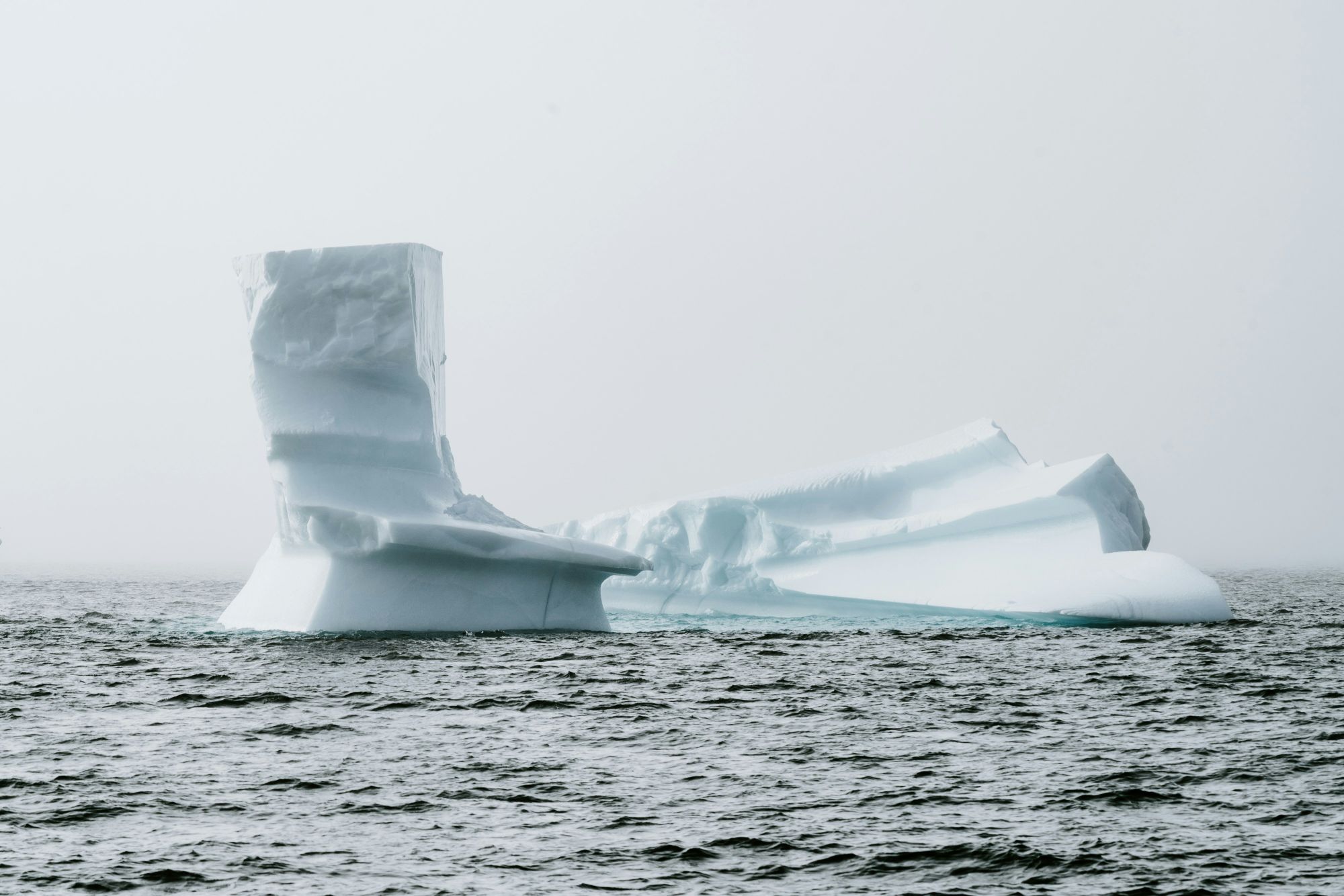 Artic Ocean
The Five Oceans: Profiles and Records
The Pacific Ocean: The Giant
The Pacific is the largest and deepest ocean, covering more area than all of Earth's landmasses combined. It is so vast that it is shrinking by about one inch per year as the Atlantic expands.
- Deepest Point: Challenger Deep in the Mariana Trench (~10,935 meters).
- Key Fact: It contains the "Ring of Fire," a 40,000 km horseshoe-shaped zone of intense volcanic and seismic activity.
- 2026 Trend: Advanced satellite monitoring now tracks the "Great Pacific Garbage Patch" with 95% more accuracy, aiding cleanup efforts.
The Atlantic Ocean: The Highway
The second-largest ocean, the Atlantic acts as the primary corridor for trade between the Americas, Europe, and Africa. It is characterized by the Mid-Atlantic Ridge, a massive underwater mountain range.
- Deepest Point: Brownson Deep in the Puerto Rico Trench (~8,378 meters).
- Key Fact: It is growing wider by about 2-5 centimeters per year due to seafloor spreading.
- Historical Note: It was the first ocean to be crossed by both ship and airplane.
The Indian Ocean: The Warmest
Tucked between Africa, Asia, and Australia, the Indian Ocean is known for its high surface temperatures, which limit its ability to sustain phytoplankton compared to colder oceans.
- Deepest Point: Unnamed Deep in the Java Trench (~7,187 meters).
- Key Fact: It is home to critical oil transit "choke points," such as the Strait of Hormuz and the Bab el-Mandeb.
- Climate Impact: Its unique monsoon patterns dictate the food security of billions of people in South Asia.
The Southern Ocean: The Youngest
Officially recognized as a standalone ocean by the National Geographic Society in 2021, it completely encircles Antarctica.
- Deepest Point: Factorian Deep in the South Sandwich Trench (~7,432 meters).
- Key Fact: It is defined by the Antarctic Circumpolar Current, a powerful water movement that keeps Antarctica cold and isolated.
- Ecosystem: It is a vital carbon sink, absorbing more $CO_2$ than almost any other region on Earth.
The Arctic Ocean: The Icy Frontier
The smallest and shallowest ocean, located mostly within the Arctic Circle. Much of it is covered by sea ice throughout the year, though this is rapidly changing.
- Deepest Point: Molloy Hole in the Fram Strait (~5,550 meters).
- Key Fact: It is the only ocean with a seasonal ice cover that determines the migration patterns of polar bears and narwhals.
- 2026 Reality: Scientists predict the first "Ice-Free Arctic Summer" could occur within the next decade if current warming trends persist.
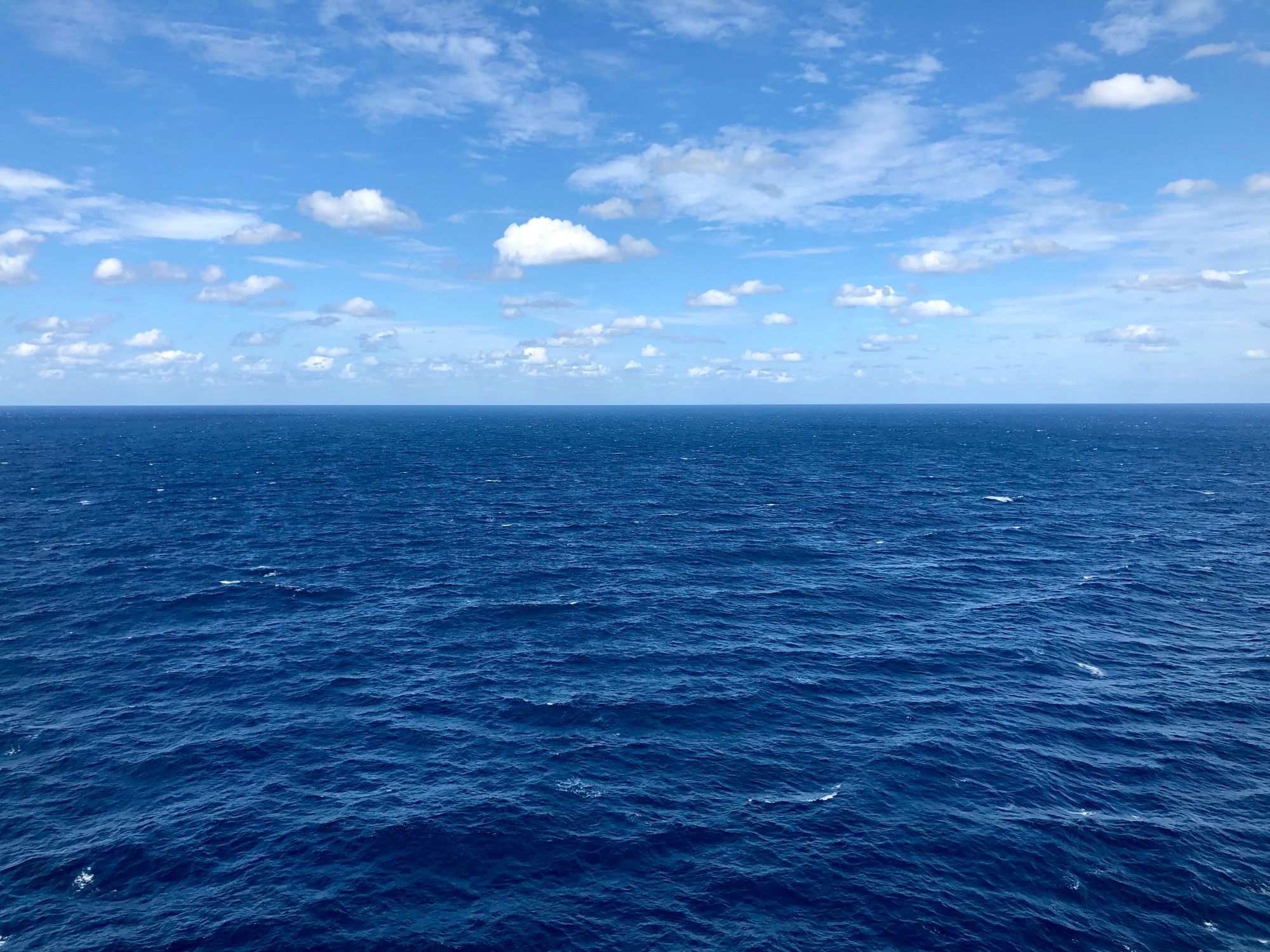 Atlantic Ocean
Analysis / Discussion: The Depth Challenge
Exploring the "Hadal Zone" (depths below 6,000 meters) remains one of humanity's greatest technical hurdles. To put it in perspective, more people have walked on the moon than have visited the deepest parts of our oceans. The pressure at the bottom of the Mariana Trench is over 1,000 times that of sea level roughly equivalent to an elephant standing on your thumb.
This extreme environment has forced life to adapt in alien ways. Creatures here often lack bones, are entirely transparent, or use bioluminescence to hunt in a world of perpetual darkness. As technology improves in 2026, autonomous underwater vehicles (AUVs) are beginning to map these trenches in high definition for the first time.
Benefits / Importance
The oceans act as Earth's "heat sink," absorbing over 90% of the excess heat generated by greenhouse gas emissions. They also play a critical role in the carbon cycle:
- Oxygen Production: Marine plants and algae produce between 50% and 80% of the oxygen we breathe.
- Economy: The "Blue Economy" is valued at over $3 trillion annually, supporting industries from tourism to pharmaceuticals derived from marine organisms.
Challenges / Issues
Despite their vastness, the oceans are under siege from human activity:
- Acidification: As oceans absorb $CO_2$, they become more acidic, which dissolves the shells of mollusks and kills coral reefs.
- Plastic Pollution: Microplastics have now been found in the deepest trenches and the most remote Arctic ice.
- Ghost Fishing: Discarded fishing nets continue to kill marine life for decades after they are lost.
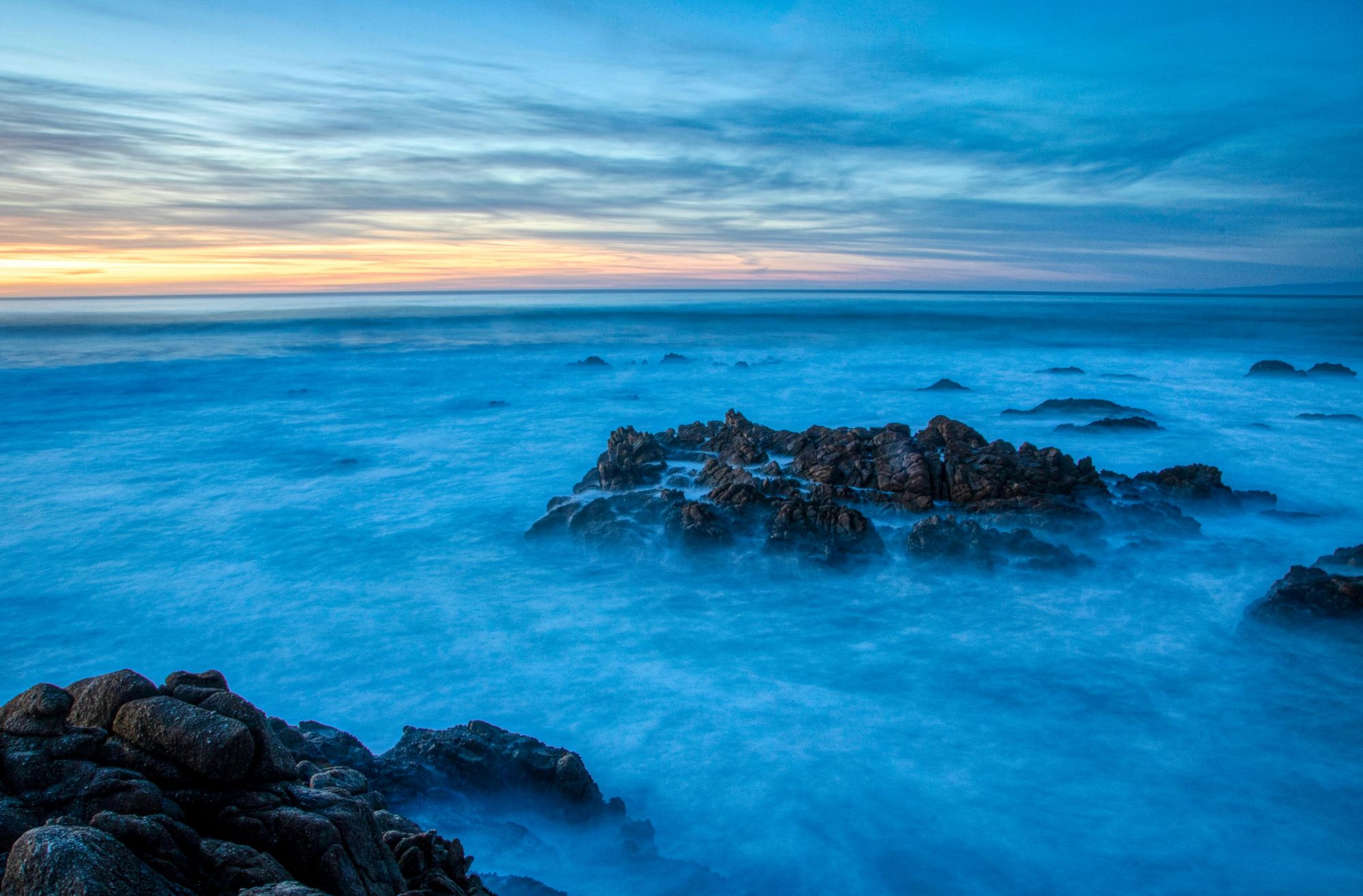 Pacific Ocean (Photo by Mick Haupt: https://www.pexels.com/photo/rocky-shore-at-sunset-6348203/)
Future Outlook / Trends
The "30x30" initiative—a global goal to protect 30% of the world's oceans by 2030—is the defining environmental movement of our time. In 2026, international treaties are finally being enforced to manage the "High Seas," areas outside national jurisdiction that were previously lawless.
Additionally, Deep-Sea Mining is a rising trend. Companies are eyeing the seafloor for polymetallic nodules containing cobalt and nickel for EV batteries. This represents a massive conflict: Do we strip-mine the ocean floor to save the atmosphere, or preserve the last untouched wilderness on Earth?
Comparative Ocean Statistics
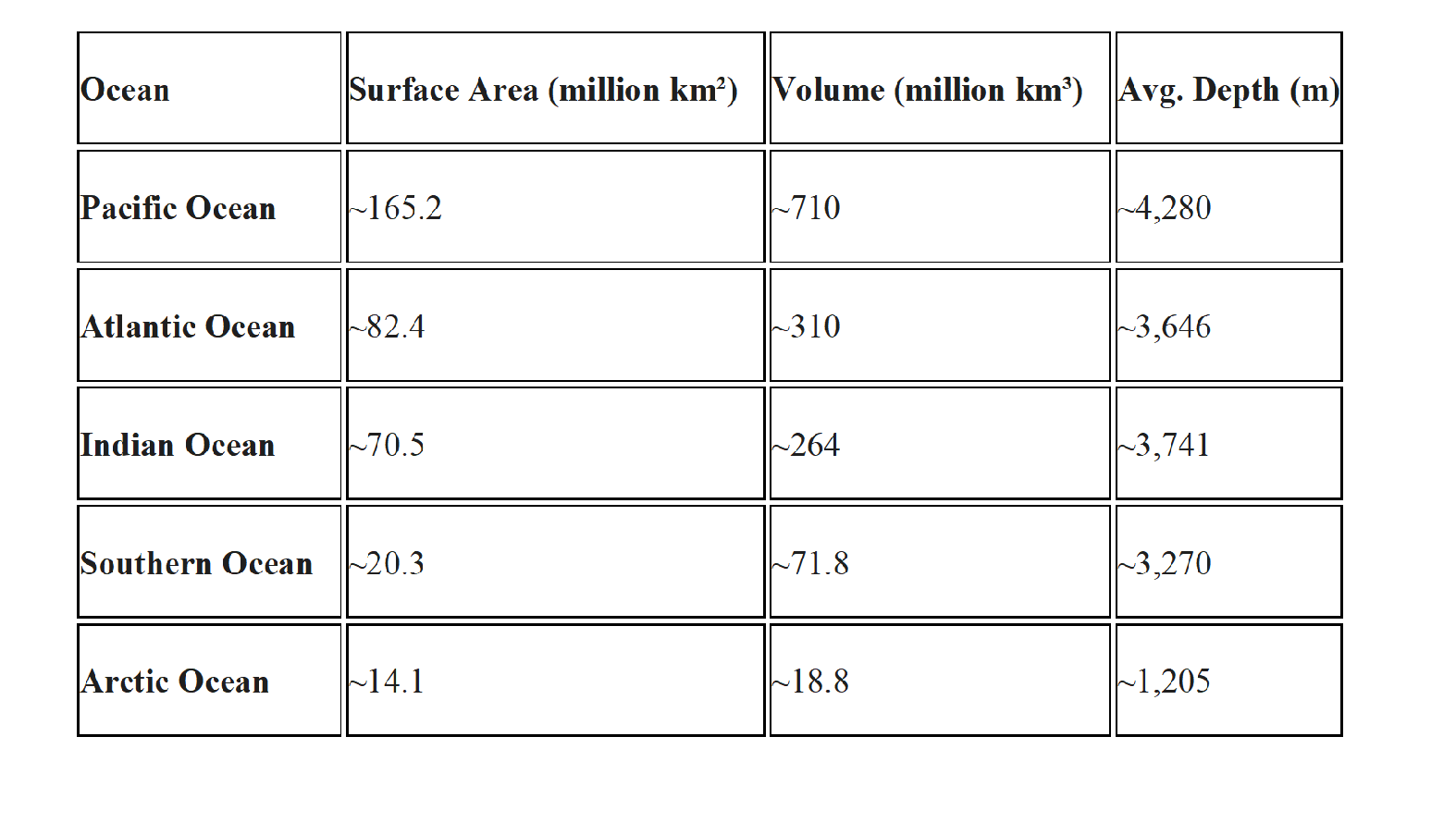
To put these massive bodies of water into perspective, the following table provides a clear comparative analysis based on 2026 geographical data.
Conclusion
The five oceans are not merely bodies of water; they are a sophisticated, interconnected life-support system. From the freezing, nutrient-rich currents of the Southern Ocean to the tropical biodiversity of the Pacific, each basin plays a unique, irreplaceable role. As we look toward the future, the health of our oceans will determine the health of our civilization. Protecting the "Great Blue" is no longer an environmental choice, it is a requirement for human survival.
Want more practice?
Take today's free daily challenge — a new set of questions every 24 hours.
Start Today's Challenge Browse All Quizzes