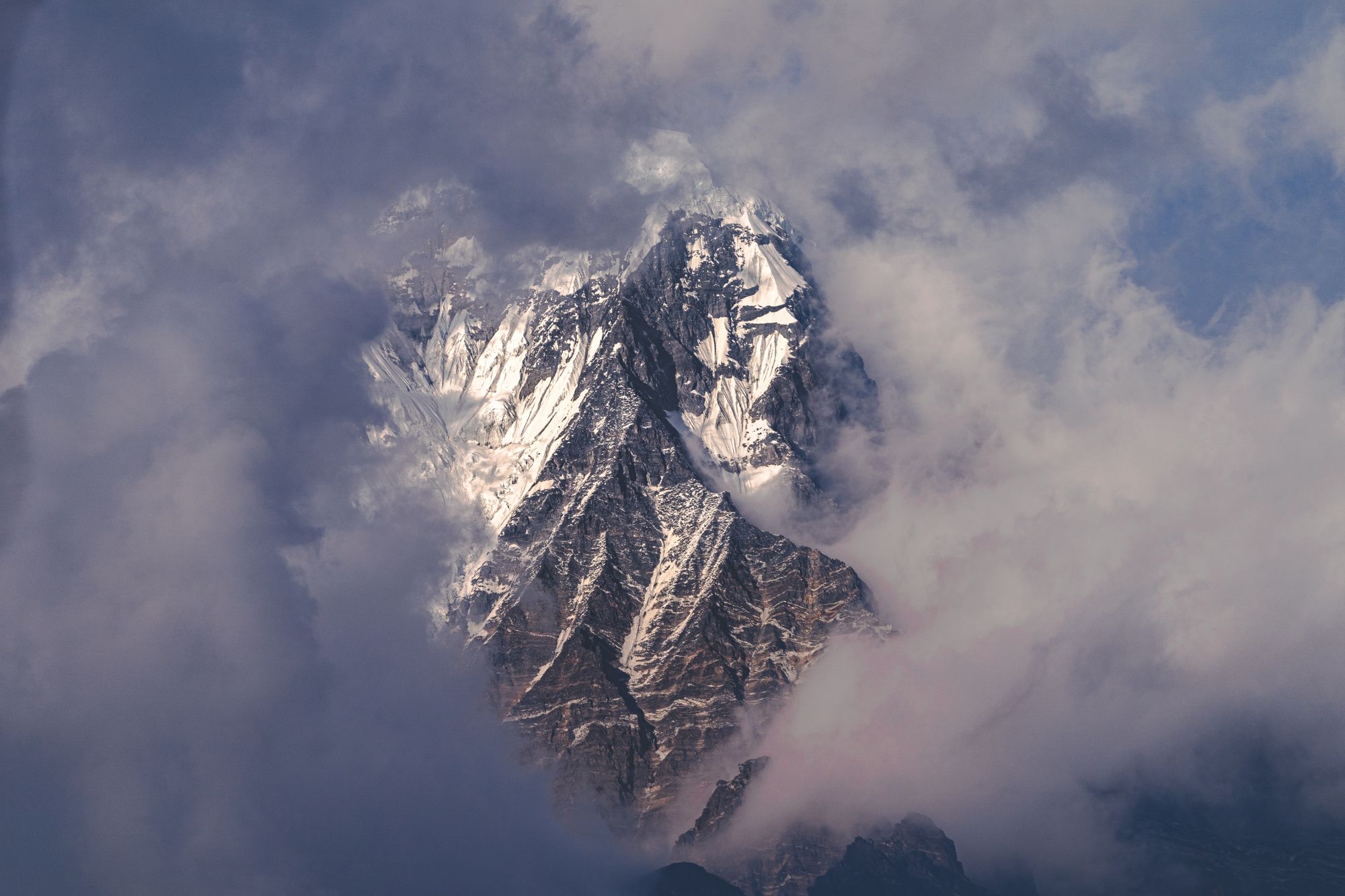
Introduction
For decades, the "Seven Summits"—the highest peak on each of the seven continents—has represented the pinnacle of human endurance and mountaineering ambition. Reaching these summits is not just a physical challenge; it is a journey through Earth’s most extreme environments, from the tropical glaciers of Indonesia to the windswept plateaus of Antarctica.
As we move through 2026, the allure of these peaks remains stronger than ever. However, the challenge is changing. Rising global temperatures are altering the ice and rock faces of these giants, and new GPS technologies are refining our understanding of their exact elevations. This guide provides a comprehensive breakdown of these legendary peaks, their history, and the unique challenges they present to those who dare to climb them.
 North Face of Everest Tibet China Panoramic
Background / Context: The Bass vs. Morrow Debate
The concept of the "Seven Summits" was first popularized in the 1980s by Richard Bass, but geographers quickly realized that defining a "continent" can be tricky. This led to two competing lists:
- The Bass List: Considers Mount Kosciuszko as the highest point of the Australian continent.
- The Messner List: Argues that Puncak Jaya (Carstensz Pyramid) in Indonesia is the true highest peak of the Australian tectonic plate (Oceania), as it is significantly more difficult and higher than Kosciuszko.
In 2026, most serious mountaineers follow the Messner list to claim the "True Seven Summits," though many collectors climb all eight just to be sure. This distinction highlights how our understanding of "continents" is often a mix of political boundaries and geological reality.
The Seven Summits: Profiles and Records
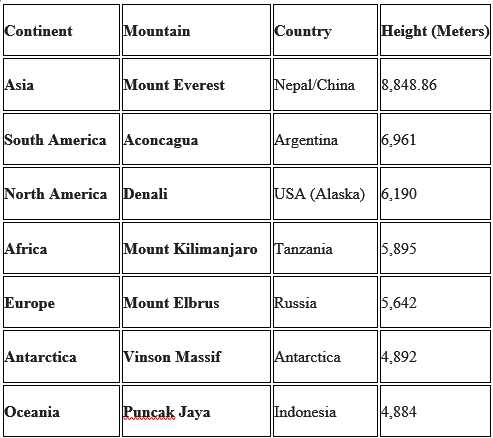
Top Mountains in Each Continent
Asia: Mount Everest (Sagarmatha/Chomolungma)
The undisputed "Roof of the World." Everest is not just a mountain; it is a global icon of ambition.
- 2026 Reality: Crowding on the South Col remains a major issue. New 2026 regulations by the Nepali government now require all climbers to use GPS tracking chips for safety and body recovery.
- Records: It is the highest point above sea level, though Hawaii’s Mauna Kea is technically taller if measured from the sea floor.
South America: Aconcagua
The highest peak outside of Asia, Aconcagua is often called the "Mountain of Death" not because of its technical difficulty, but because climbers underestimate its brutal winds and thin air.
- Fact: It is a "trekking peak," meaning it doesn't require ropes for the standard route, but the 7,000m altitude is a silent killer for the unprepared.
North America: Denali
Formerly known as Mt. McKinley, Denali is famous for its extreme cold and massive "base-to-peak" rise.
- The Challenge: Because it is located so far north, the barometric pressure makes the air feel thinner than it would at the equator, meaning 6,000m on Denali feels like 7,000m in the Himalayas.
Africa: Mount Kilimanjaro
The world's highest free-standing mountain. It is a massive stratovolcano with three distinct cones: Kibo, Mawenzi, and Shira.
- Ecology: Kilimanjaro is famous for its "Five Ecosystems," where climbers pass through rainforests, moorlands, and alpine deserts before reaching the arctic summit.
 Kilimanjaro from Amboseli
Analysis / Discussion: The "Commercialization" of the Peaks
In 2026, the debate over "guided" vs. "alpine" climbing has reached a boiling point. The Seven Summits have become a massive industry. On Everest and Aconcagua, luxury base camps now offer Wi-Fi, gourmet chefs, and supplemental oxygen "bubbles."
Critics argue that this "commodification of adventure" devalues the achievement and places inexperienced climbers in danger. However, proponents point out that the revenue from these expeditions is vital for local economies in Nepal, Tanzania, and Argentina. The 2026 trend is moving toward Mandatory Experience Requirements, where climbers must prove they have summited a 6,000m or 7,000m peak before being granted an Everest permit.
Benefits / Importance: Climate Sentinels
The Seven Summits are more than just trophies; they are Earth's most sensitive climate sensors.
- Glacial Monitoring: The glaciers of Puncak Jaya and Kilimanjaro are expected to disappear entirely by the end of the 2030s. Scientists use these peaks to measure "Vertical Warming," observing how temperatures change at high altitudes compared to sea level.
- Scientific Research: High-altitude labs on peaks like Elbrus provide critical data on cosmic rays and atmospheric chemistry.
 Morant's Curve
Challenges / Issues: The Trash and Trauma Crisis
Mountaineering in 2026 faces two major hurdles:
- The Garbage Problem: Decades of expeditions have left "The World’s Highest Junkyard" on Everest's South Col. In 2026, "Deposit Schemes" are now standard, where climbers lose thousands of dollars if they don't bring down a certain weight of trash.
- Political Borders: Mount Elbrus, located in the Caucasus, has seen fluctuating permit availability due to regional tensions, forcing many "Seven Summiters" to wait years for a chance to finish their list.
Future Outlook / Trends: Virtual Mountaineering & Sustainability
What does the future hold for the world's highest points?
- VR Tourism: For those who cannot afford the $50,000+ price tag of an Everest climb, high-definition 360-degree VR experiences are becoming a popular "low-carbon" alternative in 2026.
- Electric Base Camps: To reduce the carbon footprint, many expeditions are switching from diesel generators to portable solar arrays and hydrogen fuel cells to power their camps.
The Seven Summits represent the ultimate map of our planet's physical limits. Whether it is the thin, freezing air of Vinson in Antarctica or the jagged limestone of Puncak Jaya, these peaks continue to inspire awe and humility. As we continue to explore them in 2026, our goal must be to balance our desire for conquest with a deep respect for the fragile environments that exist only at the top of the world.
References
- International Mountaineering and Climbing Federation (UIAA) - 2026 Summit Safety Reports.
- Journal of Glaciology - "The Rapid Recession of Tropical Glaciers on Kilimanjaro and Jaya" (2025).
- Himalayan Database - Statistics on Everest Summits and Seasonality.
Want more practice?
Take today's free daily challenge — a new set of questions every 24 hours.
Start Today's Challenge Browse All Quizzes