
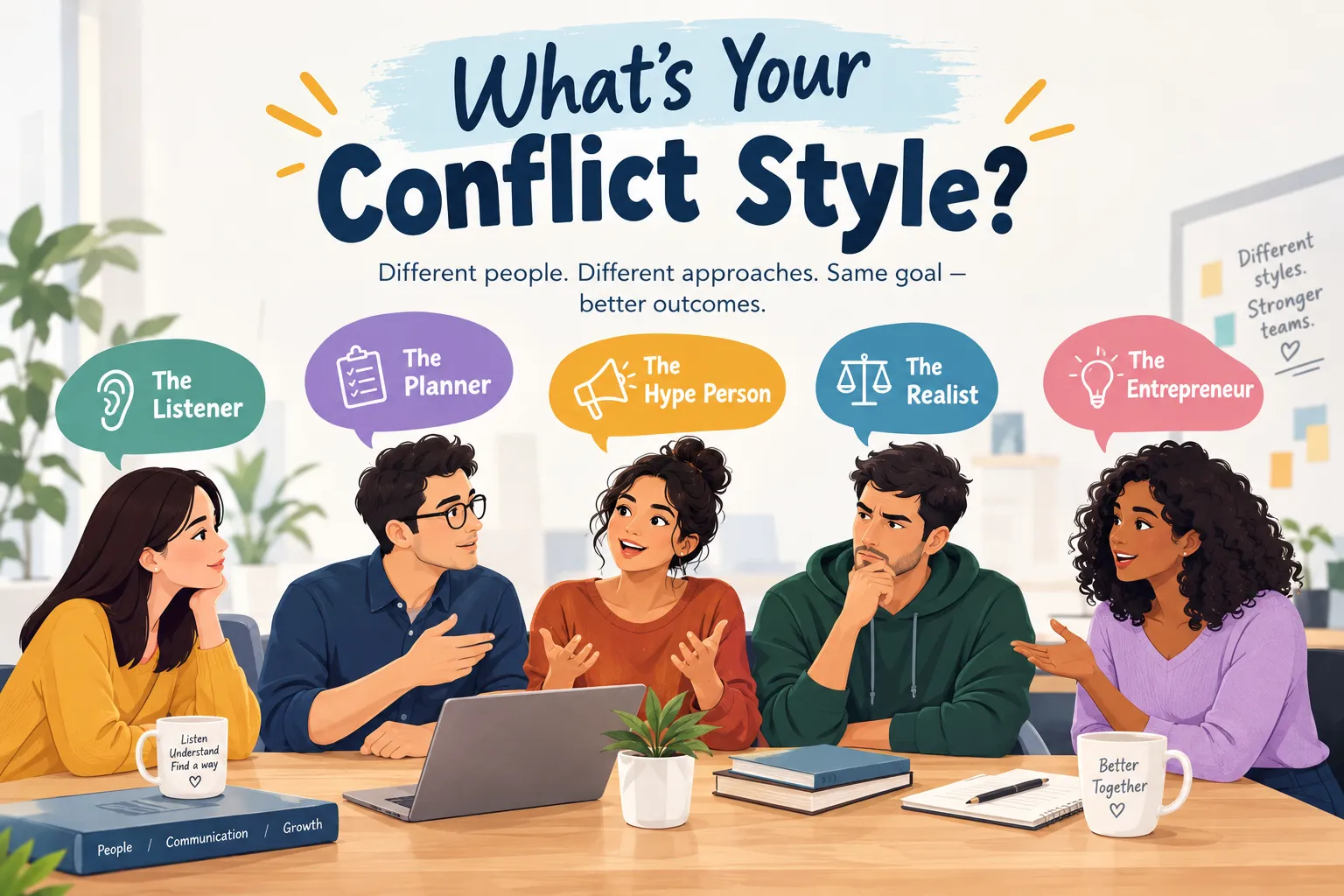
What's Your Conflict Style?
Find out how you really handle tension - before it handles you.
8 questions · About 3 min · Free
The truth is, most people have never stopped to think about how they actually handle conflict. They just react. Some people feel an immediate pull to name the problem and get it resolved as quickly as possible. Others instinctively soften the edges, looking for a way to keep the peace without making things worse. Some go quiet and wait for the storm to pass on its own. And others step back, try to understand every angle, and only act once they've found what feels fair.
None of these approaches is wrong. Each one reflects a genuine and deeply human way of protecting yourself, your relationships, and the things you value. The confronter isn't aggressive — they just can't stand unresolved tension. The peacemaker isn't a pushover — they genuinely believe harmony is worth protecting. The avoider isn't indifferent — they've learned that space can do what pressure can't. And the mediator isn't indecisive — they're trying to make sure everyone walks away with something real.
Understanding your conflict style is one of the most practical things you can do for your relationships. It helps you recognize why certain situations feel unbearable to you while others seem to roll off easily. It helps you understand why the people you care about sometimes handle things in ways that feel completely foreign. And it gives you a language for those moments when a conversation goes sideways and you're not sure why.
This quiz will ask you eight questions about how you respond to real, everyday situations involving tension, disagreement, and misunderstanding. There are no right answers — only honest ones. By the end, you'll have a clear picture of your dominant conflict style and what it means for the way you navigate the people and relationships in your life.
FAQ
What does my conflict style actually mean for my relationships?
Your conflict style is the pattern of behavior you default to when tension or disagreement arises. It shapes how quickly you address problems, how much emotional energy you spend on them, and what kind of resolution feels satisfying to you. Understanding your style helps you recognize where mismatches with others might be coming from — for example, a Confronter paired with an Avoider will often feel like one person is always chasing a conversation the other keeps dodging. Knowing this doesn't fix the gap, but it makes it much easier to talk about.
Can your conflict style change over time?
Yes — and it often does. Your default conflict style is shaped by your upbringing, past experiences, and the relationships you've been in. Someone who grew up in a household where conflict was loud and unpredictable might become an Avoider as a way of protecting themselves. With self-awareness, therapy, or simply the experience of being in healthier relationships, people do shift their patterns over time. Most people also have a secondary style they can draw on when the situation calls for it.
Is one conflict style better than the others?
No conflict style is objectively better than another — each has real strengths and real blind spots. Confronters get things resolved quickly but can overwhelm people who need more processing time. Peacemakers keep relationships smooth but can let important issues go unaddressed. Avoiders give space and perspective but can leave others feeling like nothing ever gets resolved. Mediators find fair outcomes but can sometimes delay necessary action by overthinking. The healthiest approach is understanding your default and knowing when a different style is needed.
What if I relate to more than one conflict style?
That's completely normal. Most people have a dominant style that shows up most of the time, and a secondary style that surfaces depending on the relationship or the stakes involved. You might be a Confronter at work but a Peacemaker with your family, or an Avoider with strangers but a Mediator with close friends. The quiz is designed to identify your most consistent pattern — the one you fall back on when you're not thinking about it. Think of it as your default setting, not your only setting.
Questions in this quiz
-
Someone close to you does something that genuinely upsets you. What's your first move?
- Bring it up with them directly as soon as you can
- Find a gentle way to mention it without making it a big deal
- Give it a few days and see if it still bothers you
- Think through both sides before deciding how to bring it up
-
You're in a group where two people are clearly in conflict. What do you do?
- Name what's happening out loud and push for it to get resolved
- Try to ease the tension and keep things from escalating
- Stay quiet and hope they sort it out between themselves
- Facilitate a calm conversation between them to find common ground
-
What does unresolved conflict feel like for you?
- Intolerable, you need it addressed or it consumes your thoughts
- Uncomfortable, you can't relax until the atmosphere is okay again
- Manageable, you can compartmentalize and wait it out
- Like an unsolved puzzle that keeps nagging at you
-
How do you feel right after a difficult but honest argument?
- Relieved, even if it was painful, at least it was real
- Drained, you'd much rather have avoided the intensity entirely
- Exhausted and wishing the whole thing hadn't happened
- Satisfied if both people walked away with something resolved
-
Someone misunderstands you and gets upset about it. You...
- Correct the record immediately and clearly, even if it causes friction
- Apologize quickly to restore the mood, even if it wasn't your fault
- Give them space to cool down and hope it sorts itself out
- Calmly explain your side and ask them to share theirs
-
What's your biggest frustration when dealing with conflict?
- When people dance around the issue instead of just saying it
- When people escalate things that could've been handled quietly
- When people force a conversation before you're ready for it
- When people aren't willing to consider the other side at all
-
How do you feel about saying "I was wrong" in a disagreement?
- Fine with it, as long as the other person is equally honest
- You'll say it quickly if it helps restore the peace
- You'll say it eventually, but only once you've had time to process
- You'll say it when the full picture has been fairly considered
-
What do you think is the most important part of resolving a conflict?
- Total honesty, even when it's hard to hear
- Making sure both people feel okay by the end of it
- Letting things settle naturally without forcing a resolution
- Making sure the outcome is genuinely fair to everyone
More personality quizzes
Keep exploring - each quiz takes about two minutes.
Which Country Should You Live In?
Ever wondered if your soul actually belongs somewhere else? From the food you crave to the way you spend a lazy Sunday, your everyday instincts reveal a lot abo
8 questions →
Which Animal Are You?
Answer 8 quick scenarios to reveal your spirit animal — Lion, Owl, Dolphin, or Bear.
8 questions →
Whats Your Inner Element?
Are you fiery and passionate, calm and adaptable, grounded and dependable, or free-spirited and adventurous? Take this quiz to uncover the natural element that
8 questions →
Which Decade Do You Belong In?
Every decade has its own unique style, culture, and way of life. Take this quiz to discover which era best matches your personality, preferences, and outlook on
8 questions →