
Introduction
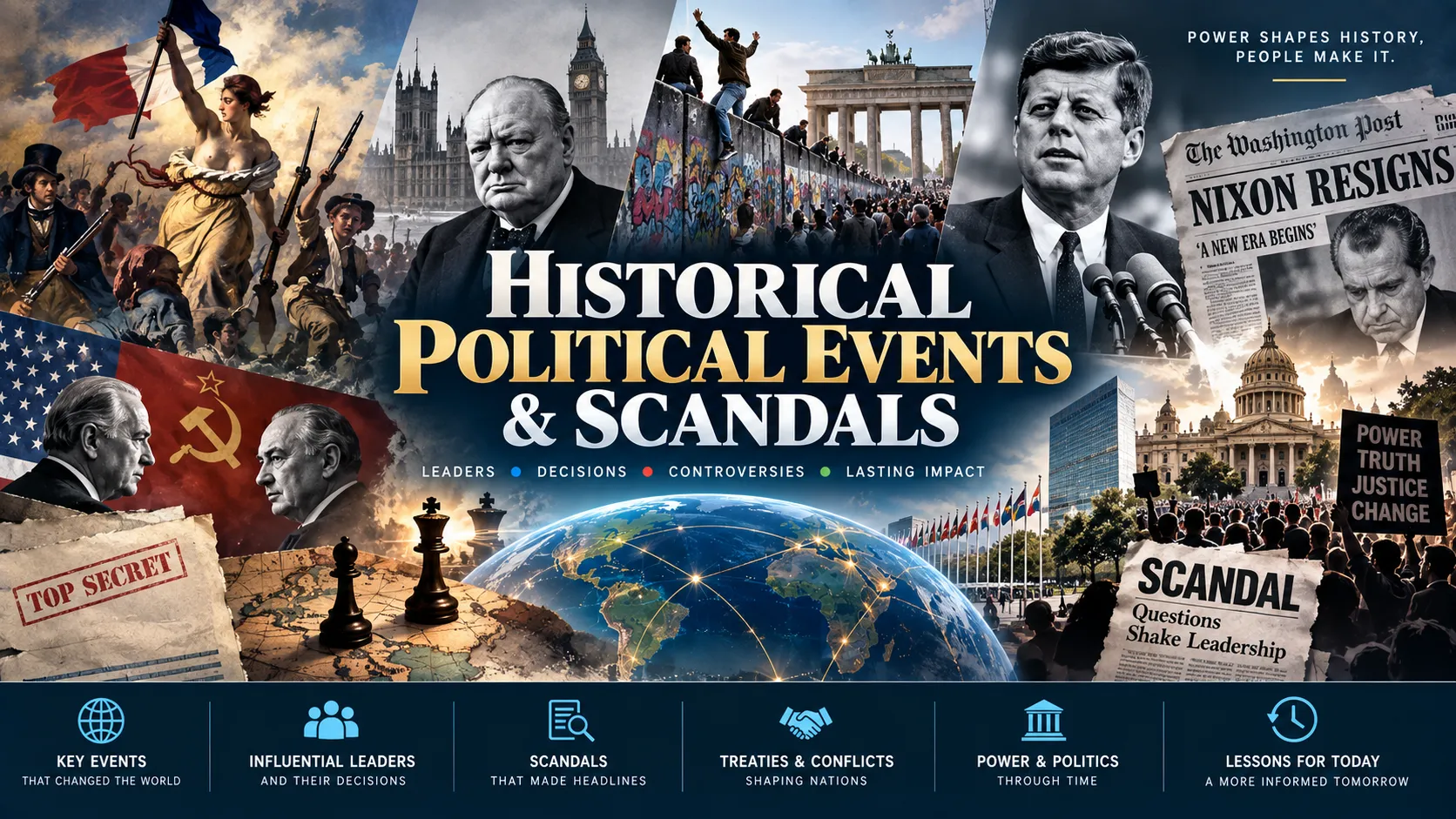
Political history is shaped not only by elections, laws, wars, and changes of government but also by scandals that reveal corruption, abuse of authority, deception, espionage, or failures of public institutions. Some scandals disappear quickly, while others lead to resignations, criminal trials, constitutional reforms, or lasting changes in public trust.
A political event is any important occurrence that affects government, political institutions, public policy, or relations between states. A political scandal occurs when alleged or proven conduct by public officials creates widespread controversy because it appears to violate laws, ethical standards, public duties, or accepted political norms.
Studying political scandals is not simply about memorizing sensational stories. It teaches how democratic institutions investigate wrongdoing, how evidence is evaluated, how journalists and whistleblowers contribute to accountability, and how governments respond when public confidence is damaged.
Learning Objectives
After studying this guide, you should be able to:
· Define major terms associated with political events and scandals.
· Distinguish an allegation from an established historical fact.
· Explain how corruption, cover-ups, espionage, and abuses of power can become political scandals.
· Describe several major historical scandals from different countries.
· Explain the roles of courts, legislatures, journalists, investigators, and public opinion.
· Evaluate the long-term political consequences of a scandal.
What Is a Political Event?
A political event is an occurrence that significantly affects government or political life.
Examples include:
· Elections
· Revolutions
· Coups
· Constitutional crises
· Wars and peace agreements
· Government resignations
· Impeachment proceedings
· Major court decisions
· Independence movements
· Political assassinations
· Legislative investigations
· Corruption scandals
Some political events happen suddenly, while others develop over years.
A political scandal can itself become a major political event when it changes governments, laws, elections, or public institutions.
What Makes Something a Political Scandal?
Not every controversy is a scandal.
A political scandal generally involves behavior that attracts serious public attention because it appears to violate an important rule, law, ethical expectation, or duty of public office.
Common sources of scandals include:
· Bribery
· Misuse of public money
· Election misconduct
· Conflicts of interest
· Abuse of government power
· Espionage
· Illegal surveillance
· Obstruction of investigations
· False statements to legislatures or courts
· Secret government operations
· Favoritism or patronage
A scandal may begin with an allegation, but historians must distinguish allegations from facts established by documents, investigations, court judgments, or other reliable evidence.
Key Political Terms
Corruption
Political corruption is the misuse of public power or office for improper private or political advantage.
Bribery is one form of corruption, but corruption can also include favoritism, misuse of funds, illegal contracting arrangements, or manipulation of government decisions.
Bribery
Bribery involves offering, giving, requesting, or receiving something valuable in exchange for improperly influencing an official action.
Cover-Up
A cover-up is an attempt to hide wrongdoing or prevent the truth from becoming known.
A cover-up may involve destroying evidence, making false statements, pressuring witnesses, or interfering with an investigation.
In some political scandals, the attempt to conceal the original misconduct becomes more damaging than the initial act.
Conflict of Interest
A conflict of interest exists when a person's private interests could improperly influence the performance of public duties.
A conflict does not automatically prove corruption, but governments commonly create disclosure and ethics rules to manage such risks.
Whistleblower
A whistleblower is a person who reports suspected wrongdoing within an organization.
Whistleblowers can help reveal corruption, fraud, safety problems, or abuses of authority.
Impeachment
Impeachment is a constitutional process used in some political systems to formally accuse a public official of serious misconduct.
Impeachment itself does not necessarily remove the official. The exact procedure differs between countries and constitutions.
Resignation
A politician may resign, or voluntarily leave office, because of political pressure, personal responsibility, loss of support, or evidence of misconduct.
Resignation and criminal guilt are different questions. A person may resign without being convicted of a crime.
How Political Scandals Usually Develop
Although every case is different, many major scandals follow a recognizable pattern.
An allegation or suspicious event first becomes known. Journalists, political opponents, investigators, auditors, courts, or whistleblowers then search for evidence.
If the evidence appears serious, legislatures or other institutions may begin formal investigations. Documents are examined and witnesses may testify.
The controversy can widen if investigators discover additional misconduct or evidence of a cover-up.
Political consequences may include resignations, prosecutions, elections, legislative reforms, or changes to oversight systems.
A useful sequence to remember is:
Allegation → Evidence → Investigation → Accountability → Consequences
Why Evidence Matters
Political scandals generate rumors quickly. Historical study therefore requires careful use of evidence.
Strong sources can include:
· Court decisions
· Government reports
· Legislative records
· Official correspondence
· Contemporary documents
· Archival material
· Reliable investigative journalism
· Scholarly historical research
Students should be cautious about judging an event only from political speeches, partisan claims, social media posts, or later retellings.
The key question should be:
What does the available evidence actually establish?
Major Historical Political Scandals
Teapot Dome Scandal
The Teapot Dome scandal became one of the most famous examples of government corruption in U.S. history.
During the administration of President Warren G. Harding, Interior Secretary Albert B. Fall secretly arranged leases involving federal naval petroleum reserves, including the Teapot Dome reserve in Wyoming.
The U.S. Senate began investigating the arrangement in 1922. The inquiry exposed improper dealings involving Fall, who eventually became the first former U.S. cabinet officer sent to prison. The investigation also helped establish the importance of congressional investigative authority.
Why It Matters
Teapot Dome demonstrated that legislative investigations could uncover corruption involving powerful executive officials.
It also became a lasting symbol of government officials placing private interests above public responsibilities.
The Dreyfus Affair
The Dreyfus Affair began in France in 1894 when Captain Alfred Dreyfus, a Jewish French army officer, was wrongly convicted of treason.
The case became much larger than a military trial. Evidence eventually pointed toward another officer, while authorities faced accusations of suppressing information that could have cleared Dreyfus.
The affair deeply divided French society and became connected with debates over antisemitism, military authority, justice, republican government, and civil rights. Dreyfus was ultimately exonerated in 1906.
Why It Matters
The case shows how prejudice, institutional self-protection, secrecy, and failures of justice can turn an individual prosecution into a national political crisis.
It also demonstrates why historians must examine both official claims and the evidence used to support them.
The Profumo Affair
The Profumo Affair shook British politics in 1963.
John Profumo, Britain's Secretary of State for War, had been associated with Christine Keeler, who also had connections to Soviet naval attaché Yevgeny Ivanov during the Cold War.
Profumo denied impropriety in a statement to the House of Commons in March 1963 but later admitted that part of his statement was untrue and resigned. Parliament formally treated his misleading statement as a grave contempt of the House.
Because of fears about national security, the British government ordered an inquiry led by Lord Denning. The resulting report concluded that there had not been the feared security breach, although the scandal seriously damaged the government's reputation.
Why It Matters
The Profumo Affair demonstrates an important principle of parliamentary government: ministers are expected to provide truthful information to the legislature.
The scandal was therefore about more than Profumo's private life. His misleading statement to Parliament became a central political issue.
Watergate
Watergate is one of the best-known political scandals of the twentieth century.
On June 17, 1972, burglars were arrested after breaking into the Democratic National Committee headquarters in the Watergate complex in Washington, D.C. Investigations eventually connected the affair to activities associated with President Richard Nixon's reelection operation and revealed efforts to obstruct investigation of the break-in.
The U.S. Senate created the Senate Watergate Committee in 1973. Its televised investigation brought testimony and evidence before a large national audience.
A major constitutional dispute developed over White House recordings. In United States v. Nixon, the U.S. Supreme Court unanimously required Nixon to surrender recordings sought by investigators. Evidence from the tapes strengthened the case that Nixon had participated in the cover-up.
The House Judiciary Committee approved articles of impeachment, but Nixon resigned on August 9, 1974, before the full House voted on impeachment.
Why It Matters
Watergate demonstrated the importance of checks and balances among Congress, the courts, investigators, the press, and the presidency.
It also produced reforms involving campaign finance, government ethics, transparency, and congressional oversight.
The suffix "-gate" later became widely used in popular language to label other scandals.
The Church Committee Investigations
Political scandals do not always involve personal enrichment. Some involve the improper use of government institutions.
After revelations concerning intelligence activities in the United States, the Senate established the Church Committee in January 1975.
Its investigation examined intelligence and domestic surveillance activities and disclosed controversial operations involving government agencies. The committee's work contributed to major changes in congressional oversight of intelligence organizations, including the creation of a permanent Senate intelligence committee.
Why It Matters
The episode illustrates the tension between national security and government accountability.
Democratic governments may need secrecy for legitimate security purposes, but secrecy can also make effective oversight more difficult.
Iran-Contra Affair
The Iran-Contra affair emerged publicly in 1986 during Ronald Reagan's presidency.
U.S. officials had secretly participated in arms sales involving Iran. Funds connected with the operation were then diverted to support Contra forces fighting Nicaragua's government despite congressional restrictions affecting such assistance.
The controversy triggered major investigations and televised congressional hearings. National Security Council official John Poindexter later testified that he had helped divert proceeds from the Iranian arms transactions to the Contras without informing President Reagan.
Why It Matters
Iran-Contra raised major constitutional and political questions concerning executive power, congressional authority, covert operations, and accountability for national-security decisions.
Tangentopoli and Mani Pulite
In 1992, Italian judicial investigations known as Mani Pulite, or "Clean Hands," began exposing widespread corruption involving politicians, public officials, and businesses.
The resulting scandal became known as Tangentopoli, a term associated with a system in which bribes and political financing were linked with government contracts and public decisions.
The investigations expanded well beyond Milan and contributed to the collapse or transformation of several parties that had dominated postwar Italian politics.
Why It Matters
Tangentopoli demonstrates how corruption can become systemic rather than being limited to one dishonest individual.
It also shows how judicial investigations can reshape an entire political party system.
Institutions That Expose Political Wrongdoing
Legislatures
Parliaments and congresses can investigate government activity through committees, hearings, subpoenas, reports, and oversight.
The U.S. Senate's investigations of Teapot Dome and Watergate are major historical examples.
Courts
Courts determine legal questions, hear evidence, and may limit government officials when their actions conflict with the law or constitution.
Judicial independence is therefore an important safeguard against abuse of power.
Journalists
Investigative journalism can uncover documents, locate witnesses, test official explanations, and bring information to the public.
Journalists do not decide legal guilt, however. Courts and other legal institutions have that role.
Auditors and Inspectors
Government auditors and inspectors can examine spending, contracting, management, and compliance with laws.
Their work may expose problems before they become major public scandals.
Elections
Ultimately, voters may reward or punish governments because of their response to corruption or misconduct.
Scandals can therefore affect elections even when they do not produce criminal convictions.
Political Consequences of Scandals
A major scandal can produce several consequences at the same time.
Officials may resign or be removed. Criminal investigations may lead to trials or convictions. Political parties can lose elections or reorganize. Governments may adopt new ethics, disclosure, campaign-finance, or oversight laws.
Scandals can also reduce public trust.
However, investigations can sometimes strengthen institutions by demonstrating that powerful officials are subject to oversight and law.
Scandal vs. Constitutional Crisis
A political scandal involves controversial misconduct.
A constitutional crisis occurs when political institutions seriously disagree about constitutional authority or when established rules cannot easily resolve a dispute.
The two can overlap.
Watergate, for example, began as a political and criminal scandal but developed constitutional dimensions when the presidency resisted demands for evidence from investigators.
Common Mistakes
Treating Allegations as Proven Facts
An accusation is not proof.
Use language such as alleged when an issue has not been established by reliable evidence.
Assuming Every Scandal Is Criminal
Conduct can be politically or ethically damaging without violating criminal law.
Assuming Resignation Proves Guilt
Officials resign for many reasons. Historical conclusions should depend on evidence rather than the fact of resignation alone.
Studying Only the Sensational Details
The most important historical question is often what the scandal changed.
Ask whether it altered laws, elections, institutions, political parties, public trust, or constitutional practices.
Assuming All Sources Are Neutral
Official reports, newspapers, politicians, memoirs, and historians may approach events from different perspectives.
Strong historical study compares sources.
Memory Tips
Use the sequence:
Act → Exposure → Investigation → Accountability → Reform
Remember these distinctions:
Corruption = misuse of public power
Bribery = improper exchange for influence
Cover-up = hiding wrongdoing
Whistleblower = reports wrongdoing
Impeachment = formal constitutional accusation
Resignation = voluntarily leaving office
For major examples:
Teapot Dome → oil leases
Dreyfus Affair → wrongful treason conviction
Profumo → misleading Parliament
Watergate → break-in and cover-up
Iran-Contra → secret arms dealings and Contra funding
Tangentopoli → widespread Italian corruption
Summary
Historical political scandals reveal how political systems respond when public officials are accused of misconduct or institutions fail to perform their duties properly.
Scandals can involve bribery, deception, abuse of authority, illegal surveillance, conflicts of interest, obstruction, or failures of justice. Some remain limited to individual officials, while others expose systemic problems.
Teapot Dome demonstrated congressional investigation of executive corruption. The Dreyfus Affair exposed problems involving prejudice and military justice. The Profumo Affair centered on ministerial truthfulness and security concerns. Watergate produced a confrontation over presidential accountability. Iran-Contra raised questions about covert executive activity, while Tangentopoli exposed extensive corruption in Italy's political system.
The central lesson is that political history should be studied through evidence, institutions, and consequences rather than rumor or partisan loyalty.
FAQ
1. What is a political scandal?
A political scandal is a major controversy involving alleged or proven misconduct by politicians, officials, parties, or public institutions.
2. Is every political controversy a scandal?
No. Political disagreements are normal. A scandal generally involves claims of serious ethical, legal, or institutional wrongdoing.
3. What was Watergate?
Watergate was a U.S. political scandal beginning with the 1972 break-in at Democratic Party headquarters and expanding through investigations of obstruction and abuses connected with President Nixon's administration.
4. Why did Richard Nixon resign?
Nixon resigned in August 1974 after evidence from the Watergate investigation and White House recordings seriously weakened his political position while impeachment proceedings were advancing.
5. What was Teapot Dome?
It was a 1920s U.S. corruption scandal involving federal oil reserves and Interior Secretary Albert Fall.
6. Why was the Profumo Affair politically important?
John Profumo's misleading statement to Parliament turned a private relationship and security controversy into an issue of ministerial honesty and accountability.
7. What was the Dreyfus Affair?
It was a French political and judicial crisis that began with the wrongful 1894 treason conviction of Jewish army officer Alfred Dreyfus.
8. What is a political cover-up?
A cover-up is an effort to conceal wrongdoing or interfere with attempts to discover the truth.
9. Can political scandals lead to reforms?
Yes. Scandals have led to new ethics rules, oversight systems, transparency laws, investigative institutions, and campaign regulations.
10. How should students evaluate claims about political scandals?
Check whether reliable documents, official investigations, court records, archival evidence, and reputable historical scholarship support the claim.
Key Takeaways
· Political scandals usually involve alleged or proven violations of laws, ethical standards, or public responsibilities.
· An allegation should never be treated automatically as an established fact.
· Legislatures, courts, journalists, investigators, and whistleblowers can all contribute to political accountability.
· Watergate, Teapot Dome, the Dreyfus Affair, Profumo, Iran-Contra, and Tangentopoli illustrate different forms of political crisis.
· The historical importance of a scandal often lies in the institutional and political changes that follow it.
Related Topics
· Political Corruption
· Democracy and Government
· Checks and Balances
· Impeachment and Constitutional Law
· Investigative Journalism
· Elections and Political Parties
· Government Ethics
· Espionage and Intelligence History
· Political Revolutions and Constitutional Crises
· Human Rights and the Rule of Law
References
1. U.S. Senate Historical Office. Select Committee on Presidential Campaign Activities (Watergate Committee).
2. U.S. Senate Historical Office. Senate Investigates the Teapot Dome Scandal.
3. U.S. Senate Historical Office. About Investigations: Historical Overview.
4. United States Holocaust Memorial Museum. Alfred Dreyfus and the Dreyfus Affair.
5. UK Parliament. Lord Denning's Report — Profumo Scandal.
6. UK Parliament, Hansard. Privilege (Mr. Profumo), 20 June 1963.
7. U.S. Department of State, Office of the Historian. Secretary Shultz Takes Charge.
8. Ronald Reagan Presidential Library. John M. Poindexter Files, 1981–1986.
9. Treccani, Dizionario di Storia. Tangentopoli.
10. Oxford University Press. Tangentopoli—More than 20 Years On, in The Oxford Handbook of Italian Politics.