
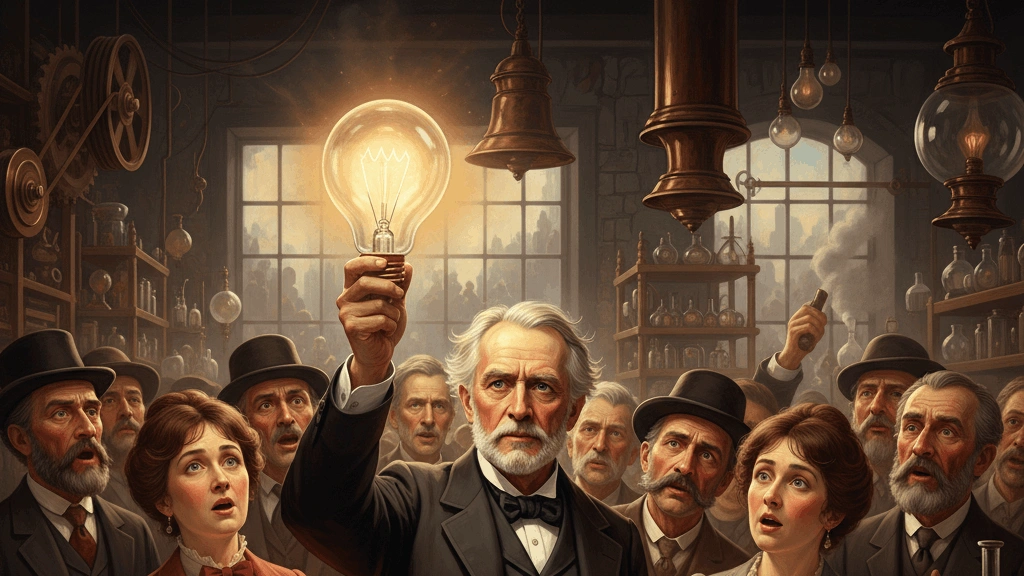
Introduction
Inventions and discoveries have transformed how people communicate, travel, produce food, treat disease, understand nature, and organize society. The wheel, printing, vaccination, telephones, electric lighting, antibiotics, computers, and the World Wide Web all changed everyday life, while scientific discoveries such as radioactivity, the periodic system, and the structure of DNA changed human understanding of the natural world.
An invention is generally something created or developed through human design, such as a machine, process, device, or technology. A discovery reveals something that already existed but was previously unknown or poorly understood.
The distinction is useful, although real scientific progress is often more complicated. Technologies usually develop through many improvements, and major discoveries often depend on work by several researchers rather than one isolated individual.
Learning Objectives
After studying this guide, you should be able to:
· Distinguish between an invention and a discovery.
· Identify major inventions that changed communication, transport, industry, medicine, and computing.
· Recognize major scientific discoveries and the people associated with them.
· Explain why many inventions cannot accurately be credited to only one person.
· Understand patents, experimentation, innovation, and accidental discovery.
· Correct common myths about famous inventors and discoveries.
Invention vs Discovery
Invention
An invention is a new device, process, method, or technological solution created through human ingenuity.
Examples include:
· Printing press
· Telephone
· Steam engine
· Electric lighting systems
· Airplane
· Computer
· World Wide Web
Discovery
A discovery identifies or explains something that already exists.
Examples include:
· Radioactivity
· Penicillin's antibacterial effects
· Previously unknown chemical elements
· Structure of DNA
· Scientific laws or natural phenomena
Easy Memory Tip
Invent → create
Discover → uncover
A telescope is an invention. A planet found using a telescope is a discovery.
Invention Is Usually a Process
Popular history often describes inventions as sudden moments of genius. In reality, most technologies develop through a chain of earlier ideas, experiments, failures, improvements, and contributions from several people.
A later inventor may make an existing idea:
· More reliable
· Cheaper
· Faster
· Safer
· Easier to manufacture
· Practical for mass use
This is why phrases such as "invented the light bulb" can oversimplify complicated histories.
Early Human Inventions
Some of humanity's most influential inventions are so old that their individual inventors are unknown.
Examples include:
· Stone tools
· Controlled fire technologies
· Pottery
· Agriculture
· Boats
· Writing
· The wheel
These developments often emerged gradually rather than being created in one documented event.
The Wheel
The wheel became one of history's most influential mechanical technologies because rotating objects reduce friction and make movement easier.
Wheels later became important in:
· Transportation
· Pottery
· Machinery
· Gears
· Water systems
Because the earliest development occurred before detailed written technological records, the wheel cannot reliably be credited to one named inventor.
Writing
Writing was itself a major technological innovation because it allowed information to survive beyond individual memory.
Early writing systems supported:
· Administration
· Trade
· Taxation
· Religion
· Law
· Historical records
Writing did not emerge everywhere at the same time. Several civilizations developed systems for recording language or information.
Paper and Printing
The ability to reproduce information dramatically increased the spread of knowledge.
Printing existed in East Asia centuries before Europe's printing revolution. By the 1450s, Johannes Gutenberg had developed a highly effective system of movable metal type printing in Europe that allowed large numbers of high-quality books to be produced more efficiently.
Printing contributed to the wider circulation of:
· Books
· Religious texts
· Scientific ideas
· Political arguments
· Educational material
Common Mistake
Gutenberg did not invent all printing.
Printing traditions already existed in Asia. His historical importance lies especially in developing a practical European movable-type printing system suited to large-scale book production.
The Scientific Revolution and Instruments
Scientific discovery often depends on better instruments.
Examples include:
· Telescope
· Microscope
· Thermometer
· Barometer
· Precision clocks
New instruments allowed researchers to observe phenomena that human senses could not investigate accurately on their own.
This demonstrates an important relationship:
New invention → better observation → new discovery
Scientific discoveries can then inspire additional inventions.
Steam Power
Steam engines helped drive the Industrial Revolution.
Early practical steam engines were developed to perform tasks such as pumping water from mines. Later engineers improved their efficiency and usefulness.
James Watt became especially famous for major improvements to existing steam-engine designs rather than for creating the concept of steam power entirely from nothing.
Steam power contributed to:
· Mechanized factories
· Mining
· Steamships
· Railways
· Industrial production
Common Mistake
James Watt did not invent the first steam engine.
His improvements made steam engines much more efficient and useful in many industrial settings.
Vaccination
One of history's most important medical innovations was vaccination.
Before vaccination, some societies practiced forms of variolation, deliberately exposing people to smallpox material in an attempt to create immunity.
In 1796, English physician Edward Jenner demonstrated vaccination against smallpox using material associated with cowpox. His work helped establish the principle that exposure to a safer related infection could protect against smallpox.
Vaccination later became central to public health.
In 1980, the World Health Organization declared smallpox eradicated after a worldwide vaccination campaign.
Quiz Connection
Edward Jenner → vaccination → smallpox → 1796
The Periodic Table
During the 19th century, chemists discovered increasing numbers of chemical elements.
In 1869, Russian chemist Dmitri Mendeleev introduced an influential periodic arrangement of the elements. More importantly, he recognized repeating patterns in their chemical properties and left spaces where undiscovered elements should exist.
Later discoveries helped confirm several of his predictions.
Why It Mattered
The periodic system turned chemistry from a collection of facts into a more organized science.
Scientists could use an element's position to predict characteristics of related elements.
Quiz Connection
Mendeleev → periodic table → 1869
The Telephone
The telephone converted sound into electrical signals that could be transmitted over distance and converted back into sound.
Alexander Graham Bell received a U.S. patent related to his telephone on March 7, 1876. Three days later, Bell and his assistant Thomas Watson successfully demonstrated transmitted speech.
Bell was not the only person experimenting with electrical speech transmission. Other inventors, including Elisha Gray and Thomas Edison, worked on related technologies and later improvements.
Quiz Connection
Alexander Graham Bell → telephone → 1876
Electric Lighting
Electric lighting existed before Thomas Edison, so saying simply that Edison invented the light bulb is misleading.
Edison's laboratory developed a practical incandescent lamp and, importantly, an entire electric-lighting system involving:
· Generators
· Wiring
· Switches
· Sockets
· Lamps
The Smithsonian records Edison's successful public demonstration of a practical incandescent lamp at Menlo Park in 1879.
His work also illustrates that invention can be a team process. Edison employed machinists, scientists, and other specialists at his laboratory.
Quiz Connection
Thomas Edison → practical incandescent lighting system → 1879
Radioactivity
In 1896, French physicist Henri Becquerel discovered spontaneous radioactivity while studying uranium compounds.
Marie and Pierre Curie expanded this research. Their work led to the identification of the radioactive elements polonium and radium.
Becquerel and the Curies shared the 1903 Nobel Prize in Physics for work relating to radiation phenomena.
Marie Curie later received the 1911 Nobel Prize in Chemistry.
Quiz Connection
Becquerel → discovery of radioactivity
Marie and Pierre Curie → radioactive substances
Penicillin
Some discoveries begin with unexpected observations.
In 1928, Alexander Fleming noticed that a Penicillium mould contaminating a bacterial culture inhibited nearby bacteria.
Instead of simply throwing the contaminated culture away, he investigated what had happened.
However, Fleming did not single-handedly turn penicillin into a widely usable medicine. Howard Florey, Ernst Boris Chain, and their colleagues later carried out essential work on its development and therapeutic use. Fleming, Florey, and Chain shared the 1945 Nobel Prize in Physiology or Medicine.
Why This Matters
Penicillin is often called an accidental discovery, but chance alone was not enough.
A useful formula is:
Unexpected event + careful observation + investigation = possible discovery
DNA Structure
DNA carries biological information used in inheritance and cellular function.
In 1953, James Watson and Francis Crick proposed the famous double-helix structure of DNA.
Their work depended heavily on existing chemical research and X-ray studies, including important results produced by Rosalind Franklin and Maurice Wilkins. Nobel Prize historical material specifically notes the importance of Franklin's X-ray diffraction work to determining the structure.
Watson, Crick, and Wilkins received the 1962 Nobel Prize in Physiology or Medicine.
Franklin had died in 1958; Nobel Prizes are not awarded posthumously under ordinary rules.
Quiz Connection
DNA → double helix → 1953
Computers
The modern computer was not invented in a single moment.
Its development depended on several earlier technologies, including:
· Mechanical calculating machines
· Punch cards
· Boolean logic
· Electronic circuits
· Vacuum tubes
· Transistors
· Integrated circuits
· Microprocessors
Different machines can be described as the "first computer" depending on the definition being used.
Possible criteria include:
· Mechanical vs electronic
· Analog vs digital
· Programmable vs fixed-purpose
· General-purpose vs specialized
Important Lesson
Be cautious with quiz questions asking simply:
"Who invented the computer?"
There is no single universally correct inventor without defining what kind of computer is meant.
The World Wide Web
The Internet and the World Wide Web are not the same thing.
The Internet is the underlying global network infrastructure.
The Web is a system that uses the Internet to connect hypertext documents and other resources.
British computer scientist Tim Berners-Lee invented the World Wide Web while working at CERN in 1989. By the end of 1990, he had developed the first Web server and browser.
In 1993, CERN made Web software freely available, helping the technology spread rapidly.
Quiz Connection
Tim Berners-Lee → World Wide Web → CERN → 1989
Invention vs Innovation
An invention creates or develops something new.
Innovation is broader. It involves introducing or applying new ideas, products, processes, or improvements in a useful way.
An invention may exist without becoming widely used.
Innovation often requires:
· Manufacturing
· Financing
· Marketing
· Distribution
· Further engineering
· User adoption
For example, building one experimental machine is different from creating a system capable of serving millions of people.
What Is a Patent?
A patent is a form of intellectual-property protection for inventions.
In the United States, a patent gives an inventor the legal right to exclude others from making, using, selling, offering to sell, or importing the patented invention for the applicable period and under the relevant conditions.
A patent is therefore not simply a certificate saying:
"This person invented something first."
Patent law involves specific legal requirements and jurisdictions.
Patents are also different from:
· Copyright
· Trademark
· Trade secrets
Accidental Discoveries
Some important discoveries involve chance.
Famous examples include:
· Penicillin
· X-rays
· Radioactivity
However, calling them "accidents" can hide the scientific work involved.
Many people encounter unexpected events. A discovery occurs when someone recognizes that the observation is important, investigates it, and produces evidence explaining it.
This is sometimes described as serendipity.
Major Milestones at a Glance
Development | Approximate Date | Main Association |
Wheel | Ancient | Transportation and machinery |
Writing | c. 4th millennium BCE onward | Recording information |
Movable-type printing in Europe | c. 1450 | Johannes Gutenberg |
Smallpox vaccination | 1796 | Edward Jenner |
Periodic system | 1869 | Dmitri Mendeleev |
Telephone | 1876 | Alexander Graham Bell |
Practical Edison incandescent lamp | 1879 | Thomas Edison and team |
Radioactivity | 1896 | Henri Becquerel |
Penicillin | 1928 | Alexander Fleming |
DNA double helix | 1953 | Watson, Crick, Franklin, Wilkins and others |
World Wide Web | 1989 | Tim Berners-Lee |
Common Mistakes
Edison Was Not the First Person to Create Electric Light
Edison and his team developed an important practical incandescent lamp and electrical lighting system, building on earlier work.
Gutenberg Did Not Invent Printing Everywhere
Printing existed in East Asia before Gutenberg. His major contribution was to European movable-type book production.
Fleming Did Not Develop Penicillin Alone
Fleming discovered its antibacterial effect, while Florey, Chain, and others played crucial roles in turning penicillin into an effective treatment.
The Internet and Web Are Not Synonyms
The Internet is the network infrastructure.
The World Wide Web is one major service that operates through it.
Discoveries Are Not Always Made by One Person
Scientific research is cumulative. Several teams may contribute evidence to the same breakthrough.
Memory Tips
Use these associations:
Jenner → vaccine
Mendeleev → periodic table
Bell → telephone
Edison → practical electric lighting
Becquerel → radioactivity
Curie → radium and polonium
Fleming → penicillin
DNA → double helix → 1953
Berners-Lee → Web → 1989
And remember:
Invent = create
Discover = reveal
Summary
Inventions create new technologies, while discoveries reveal previously unknown facts or phenomena. In practice, the two processes often support each other. New instruments can produce new discoveries, and discoveries can lead to new technologies.
Major inventions such as printing, telephones, electric lighting, computers, and the World Wide Web transformed communication and society. Discoveries involving vaccination, the periodic system, radioactivity, antibiotics, and DNA changed medicine and science.
Many famous achievements were collaborative and developed gradually. For this reason, studying the historical context behind an invention is usually more accurate than simply memorizing one inventor's name.
FAQ
What is the difference between an invention and a discovery?
An invention creates a new device, process, or technology. A discovery reveals something that already existed but was previously unknown.
Who invented the printing press?
Johannes Gutenberg is strongly associated with the development of movable-type printing in 15th-century Europe, although printing technologies had already existed in East Asia.
Who developed the first vaccine?
Edward Jenner demonstrated vaccination against smallpox in 1796 using cowpox material.
Who created the periodic table?
Dmitri Mendeleev introduced his influential periodic system in 1869.
Who invented the telephone?
Alexander Graham Bell received an important telephone patent in 1876 and demonstrated successful speech transmission that year, although several inventors contributed to early telephone technology.
Did Thomas Edison invent the light bulb?
Edison did not invent electric lighting from nothing. His team developed a practical incandescent lamp and an integrated electric-lighting system.
Who discovered penicillin?
Alexander Fleming discovered penicillin's antibacterial effect in 1928. Florey, Chain, and others later played crucial roles in developing it into a practical medicine.
Who discovered radioactivity?
Henri Becquerel discovered spontaneous radioactivity in 1896. Marie and Pierre Curie subsequently made major discoveries and advances in the field.
Who discovered the structure of DNA?
Watson and Crick proposed the double-helix model in 1953, drawing on important experimental work that included research by Rosalind Franklin and Maurice Wilkins.
Who invented the World Wide Web?
Tim Berners-Lee invented the World Wide Web at CERN in 1989.
Key Takeaways
· An invention creates something new, while a discovery reveals something that already exists.
· Major scientific and technological breakthroughs usually build on earlier work rather than appearing suddenly.
· Jenner, Mendeleev, Bell, Edison, Becquerel, Fleming, and Berners-Lee are useful names to connect with major milestones.
· Penicillin, DNA research, electric lighting, and other breakthroughs demonstrate that scientific achievement is often collaborative.
· Accurate history requires distinguishing popular inventor stories from the more complex process of experimentation, improvement, and innovation.
References
· World Health Organization — History of Smallpox Vaccination
Authoritative history of variolation, Edward Jenner's 1796 vaccination experiment, and the eventual eradication of smallpox.
WHO — History of Smallpox Vaccination
· Smithsonian Institution — Thomas Edison's Inventive Life
Historical overview of Edison, his Menlo Park laboratory, the phonograph, telephone improvements, and the development of a practical electric-lighting system.
Smithsonian — Thomas Edison's Inventive Life
· Smithsonian Institution — Alexander Graham Bell Experimental Telephone
Museum record documenting Bell's 1876 experimental telephone and associated U.S. patent.
Smithsonian — Bell Experimental Telephone
· Science History Institute — Mendeleev's Legacy: The Periodic System
Historical explanation of Mendeleev's 1869 periodic system and its importance to chemistry.
Science History Institute — Mendeleev's Legacy
· Nobel Prize — Penicillin and Medical Discovery
Nobel Prize historical material on Fleming, Florey, Chain, and the development of penicillin.
Nobel Prize — Medicine 1901–2000
· Nobel Prize — Radioactivity and Modern Physics
Historical overview of Becquerel's discovery of radioactivity and the work of Marie and Pierre Curie.
Nobel Prize — Physics 1901–2000
· Nobel Prize — Exploring Life's Smallest Details
Nobel Prize educational material on the 1953 DNA double-helix breakthrough and the contributions of Watson, Crick, Franklin, and Wilkins.
Nobel Prize — DNA Structure
· CERN — The Birth of the Web
Official CERN history of Tim Berners-Lee's invention of the World Wide Web in 1989 and its later public release.
CERN — The Birth of the Web
· United States Patent and Trademark Office — Patent Essentials
Official explanation of patents, intellectual property, and the legal rights granted by U.S. patents.
USPTO — Patent Essentials