
Introduction
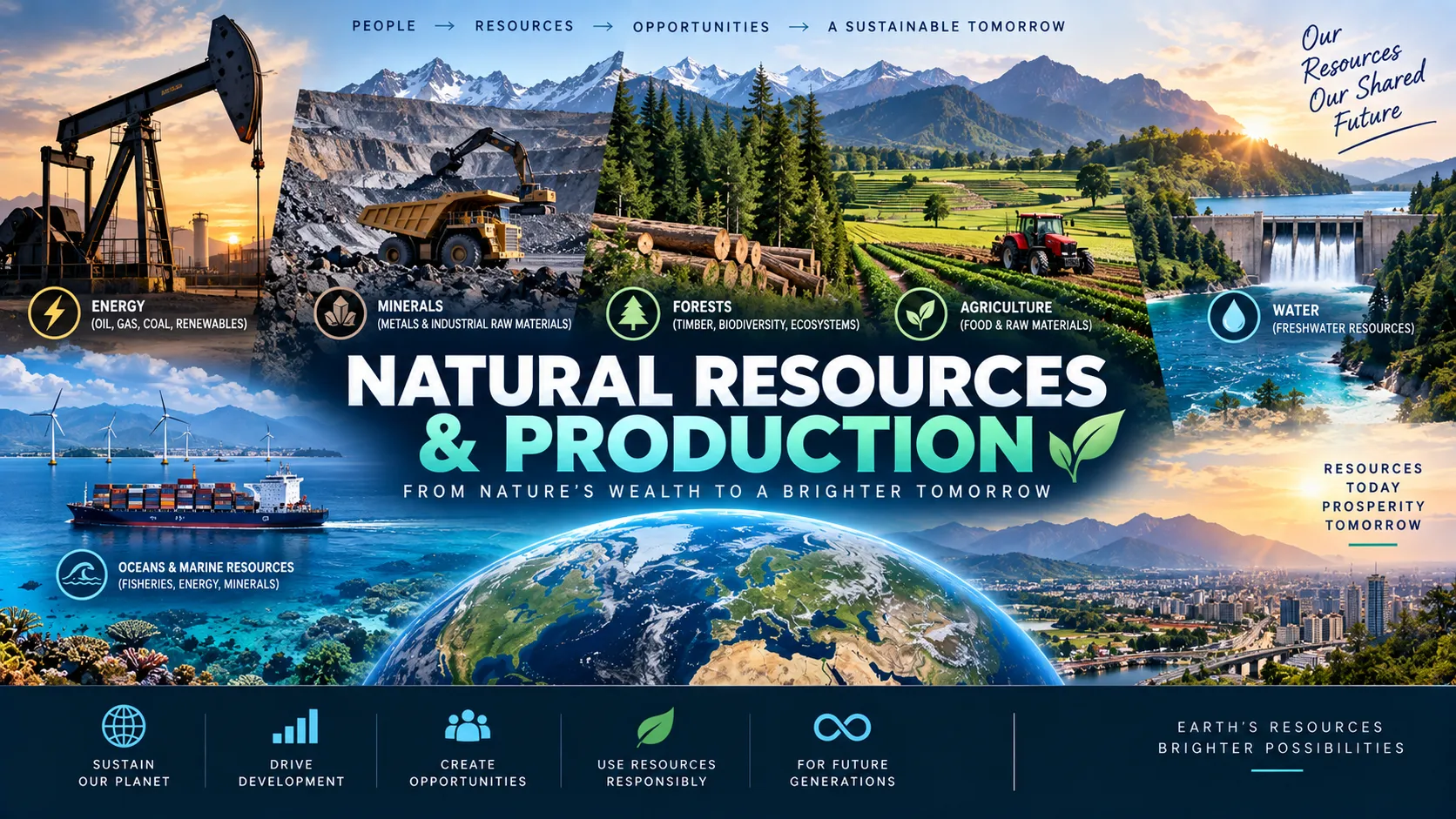
Natural resources are materials, substances, and environmental features that people obtain from nature and use to support life and economic activity. Water, soil, forests, fish, minerals, sunlight, coal, petroleum, and natural gas are all examples.
These resources provide the raw materials needed to produce food, energy, buildings, machines, clothing, transportation, and countless other goods. However, natural resources are not distributed evenly across Earth, and some can be depleted or damaged when they are used faster than natural systems can replace them.
Studying natural resources and production connects physical geography with economics and environmental science. It helps explain why industries develop in particular places, why countries trade with one another, how raw materials become finished products, and why sustainable resource management matters.
Learning Objectives
After studying this guide, you should be able to:
· Define natural resources and classify their major types.
· Distinguish renewable, non-renewable, and potentially renewable resources.
· Explain how agriculture, forestry, fishing, mining, and energy production use natural resources.
· Describe how raw materials move through stages of production.
· Explain why resources are unevenly distributed around the world.
· Understand conservation, recycling, resource efficiency, and sustainable production.
What Are Natural Resources?
A natural resource is something found in the natural environment that has value or usefulness to humans.
Natural resources include physical materials such as timber and iron ore, biological resources such as fish and crops, and energy sources such as sunlight and fossil fuels.
Examples include:
· Fresh water
· Soil
· Forests
· Wildlife
· Fish
· Minerals
· Coal
· Petroleum
· Natural gas
· Wind
· Sunlight
· Rivers
· Geothermal heat
The usefulness of a resource can change over time. Technological advances can make previously unusable materials economically valuable, while changing consumer demand can increase or reduce the importance of particular resources.
Renewable and Non-Renewable Resources
One of the most important ways to classify natural resources is according to how quickly they can be replaced.
Renewable Resources
A renewable resource can be naturally replenished over relatively short periods when it is managed properly.
Examples include:
· Solar energy
· Wind energy
· Flowing water
· Forests
· Fish populations
· Biomass
However, renewable does not mean unlimited.
A forest can regenerate, but not if trees are permanently removed faster than new trees grow. Fish populations can reproduce, but excessive fishing can reduce a population faster than it can recover.
Non-Renewable Resources
A non-renewable resource exists in a limited supply or forms so slowly that it cannot be replaced on a human timescale.
Examples include:
· Coal
· Petroleum
· Natural gas
· Copper
· Iron ore
· Gold
· Uranium
· Phosphate rock
Once a mineral deposit or fossil-fuel reserve is extracted and used, the same deposit cannot quickly regenerate.
Potentially Renewable Resources
Resources such as soil, forests, groundwater, and fisheries are sometimes described as potentially renewable.
Natural processes can replace them, but only if human use does not exceed their rate of regeneration.
This makes management especially important.
Resource vs. Reserve
The terms resource and reserve are not always interchangeable.
A resource is a concentration or supply of material that may have potential value.
A reserve generally refers to the portion of a known resource that can be economically and technically extracted under defined conditions.
As technology, prices, knowledge, and regulations change, the amount considered economically recoverable can also change.
Why Natural Resources Are Unevenly Distributed
Natural resources are not spread evenly across Earth because geological, biological, and climatic conditions vary.
Mineral deposits depend on geological processes that occurred over millions or billions of years. Fossil fuels developed where ancient organic material accumulated under suitable conditions. Forests depend heavily on climate, while agricultural productivity depends on soil, temperature, rainfall, water availability, and terrain.
As a result, one region may contain large petroleum reserves while another has abundant forests or fertile farmland.
This uneven distribution encourages trade.
A country with little petroleum may import oil while exporting agricultural products, manufactured goods, or minerals that it possesses in greater quantities.
Natural Resources and the Production Process
What Is Production?
Production is the process of creating goods or services.
Natural resources often begin the production chain as raw materials.
For example:
Tree → timber → lumber → furniture
Iron ore → iron → steel → automobile
Wheat → flour → bread
Crude oil → refinery → fuel and petrochemical products
Production therefore connects natural environments with farms, mines, factories, transportation systems, businesses, and consumers.
The Factors of Production
Economics commonly identifies several resources needed for production.
Land
In economics, land includes natural resources used in production, not just physical land.
It can include water, forests, minerals, agricultural soils, and energy resources.
Labor
Labor is human effort used to produce goods and services.
Farm workers, miners, engineers, factory employees, drivers, and technicians all provide labor.
Capital
Capital includes tools, equipment, factories, machines, transportation infrastructure, and other manufactured assets used to produce goods and services.
Entrepreneurship
Entrepreneurship involves organizing resources, making business decisions, accepting risks, and developing products or services.
Production usually requires several factors working together.
Primary, Secondary, and Tertiary Production
Economic activities are often grouped into sectors.
Primary Sector
The primary sector obtains resources directly from nature.
Examples include:
· Farming
· Fishing
· Forestry
· Mining
· Quarrying
· Oil and gas extraction
A farmer harvesting wheat and a mine extracting copper both operate mainly in the primary sector.
Secondary Sector
The secondary sector converts raw materials into manufactured or processed products.
Examples include:
· Food processing
· Steelmaking
· Automobile manufacturing
· Construction
· Textile production
· Furniture manufacturing
Turning iron ore into steel is secondary production.
Tertiary Sector
The tertiary sector provides services rather than mainly extracting or manufacturing physical resources.
Examples include:
· Transportation
· Banking
· Retail
· Tourism
· Education
· Healthcare
· Communications
The sectors depend on one another. A supermarket, for example, depends on farmers, food processors, transport companies, warehouses, and retail workers.
Agriculture and Food Production
Agriculture is one of humanity's most important uses of natural resources.
Crop production depends on soil, water, sunlight, nutrients, climate, seeds, labor, and technology. Livestock production also requires land, water, feed, and other resources.
Agricultural systems produce:
· Grains
· Fruits
· Vegetables
· Meat
· Milk
· Eggs
· Fibers
· Oils
· Animal feed
· Industrial crops
Good land and water management can help maintain agricultural productivity. Poor management can contribute to erosion, soil degradation, water shortages, habitat loss, and pollution.
The Food and Agriculture Organization promotes management approaches designed to maintain natural resources and biodiversity while supporting food and agricultural production.
Soil as a Resource
Healthy soil supports crops, stores water, cycles nutrients, and provides habitat for many organisms.
Soil forms slowly. Severe erosion can therefore remove productive soil much faster than natural processes replace it.
Farmers may reduce soil degradation through practices such as crop rotation, erosion control, careful irrigation, maintaining vegetation cover, and appropriate nutrient management.
Water in Production
Fresh water is essential for agriculture, households, industry, mining, electricity generation, and ecosystems.
Agriculture can require large quantities of water, especially in irrigated regions.
Industry may use water for:
· Cooling
· Washing
· Processing
· Manufacturing
· Steam generation
Because water has many competing uses, managing its quality and quantity is an important resource challenge.
Forestry
Forests provide both resources and ecological services.
Products obtained from forests include:
· Timber
· Paper
· Fuelwood
· Fibers
· Resins
· Fruits and nuts
· Medicines and other biological products
Forests also store carbon, regulate water systems, protect soils, and provide wildlife habitat.
Sustainable forestry aims to obtain forest products while maintaining the forest's ability to regenerate and continue supporting ecological functions.
Deforestation occurs when forest is permanently converted to another land use or otherwise removed without sufficient regeneration.
Fisheries and Aquatic Resources
Fish and other aquatic organisms provide food, employment, and income to communities around the world.
Fishing can occur in:
· Oceans
· Seas
· Rivers
· Lakes
· Estuaries
Aquaculture is the farming of aquatic organisms such as fish, shellfish, and seaweed.
Wild fish populations are renewable only when harvesting remains compatible with reproduction and ecosystem health.
Overfishing occurs when fish are removed faster than populations can sustainably replace themselves over time.
Minerals and Mining
Minerals are essential raw materials for modern economies.
Different minerals are used to make buildings, vehicles, electronics, electrical systems, tools, batteries, fertilizers, and industrial machinery.
Examples include:
Resource | Common Uses |
Iron ore | Steel |
Copper | Electrical wiring and electronics |
Bauxite | Aluminum production |
Limestone | Cement and construction |
Phosphate rock | Fertilizer |
Lithium | Batteries and other industrial uses |
Gold | Electronics, jewelry, finance |
Sand and gravel | Concrete and construction |
Mining involves more than simply digging material from the ground. A typical mineral-development process can include exploration, evaluating deposits, extraction, processing, transportation, use, and eventual mine-site reclamation. USGS educational material describes this sequence as part of the life cycle of a mineral deposit.
Surface and Underground Mining
Surface mining removes material from deposits located relatively close to Earth's surface.
Methods include open-pit mining and quarrying.
Underground mining accesses deeper deposits through shafts, tunnels, or other underground workings.
The appropriate method depends on geology, cost, safety, technology, environmental conditions, and the resource being extracted.
Fossil Fuels
Coal, petroleum, and natural gas are fossil fuels.
They formed from ancient organic material transformed by geological processes over extremely long periods.
Because these processes take millions of years, fossil fuels are classified as non-renewable.
Coal
Coal has historically been important for electricity generation and industry.
Petroleum
Petroleum, or crude oil, is refined into products including gasoline, diesel fuel, jet fuel, and petrochemical feedstocks.
Natural Gas
Natural gas is used for heating, electricity generation, industry, and chemical production.
Burning fossil fuels releases carbon dioxide and other pollutants, creating major environmental and climate concerns.
Renewable Energy Resources
Renewable energy comes from naturally replenishing sources.
Major examples include:
Solar Energy
Solar panels can convert sunlight directly into electricity.
Wind Energy
Wind turbines convert the kinetic energy of moving air into electrical energy.
Hydroelectric Power
Hydroelectric facilities use moving or falling water to generate electricity.
Geothermal Energy
Geothermal systems use heat from within Earth.
Biomass
Biomass energy uses biological material, including certain plant and organic resources.
Renewable energy technologies reduce dependence on finite fossil fuels, although their construction still requires land, minerals, infrastructure, and manufacturing.
The global energy system therefore involves both energy resources and the material resources needed to build energy technologies.
Resource Extraction and Environmental Impacts
Extracting natural resources can provide jobs, government revenue, infrastructure, energy, and useful products.
It can also produce environmental costs.
Possible impacts include:
· Habitat destruction
· Soil erosion
· Water contamination
· Air pollution
· Waste generation
· Greenhouse gas emissions
· Biodiversity loss
· Landscape alteration
· Depletion of resources
The scale of an impact depends on the resource, location, extraction method, technology, regulation, and management.
The goal of resource management is therefore not simply to stop production. It is to meet human needs while reducing unnecessary environmental damage.
Sustainable Production
Sustainable production aims to produce goods and services while using resources efficiently and limiting long-term environmental harm.
UNEP describes sustainable consumption and production as increasing resource efficiency and reducing environmental degradation and pollution across the life cycle of products and services.
That life cycle can include:
Extraction → Processing → Manufacturing → Transportation → Use → Reuse/Recycling → Disposal
Looking at the whole life cycle prevents a company or country from reducing environmental damage at one stage while simply shifting it somewhere else.
Conservation
Conservation means protecting and carefully managing natural resources so they remain available and ecosystems continue functioning.
Examples include:
· Protecting watersheds
· Managing forests
· Preventing soil erosion
· Establishing fishing limits
· Restoring damaged land
· Improving irrigation efficiency
Recycling
Recycling processes used materials so they can become inputs for new products.
Recycling metals can reduce the need for some new mining, while recycling paper can reduce demand for virgin wood fiber.
However, recycling also requires collection, sorting, processing, energy, and transportation. It therefore complements rather than completely eliminates the need for resource management.
Reuse
Reuse keeps a product or material in service rather than immediately discarding it.
Examples include refilling containers, repairing machinery, reusing construction materials, and refurbishing electronics.
Resource Efficiency
Resource efficiency means producing greater value while using fewer materials, less energy, or less water and generating less waste.
A factory that produces the same amount of product using less raw material has improved its material efficiency.
UNEP links improved resource efficiency with the broader goal of reducing the connection between economic growth and environmental degradation.
The Circular Economy
A traditional production model is sometimes described as:
Take → Make → Use → Dispose
A circular economy seeks to keep materials and products useful for longer.
Strategies include:
· Designing durable products
· Repairing damaged goods
· Reusing components
· Remanufacturing equipment
· Recycling materials
· Reducing unnecessary waste
A perfectly waste-free economy is difficult to achieve, but circular strategies can reduce demand for newly extracted resources.
Natural Resources and International Trade
Countries often specialize partly according to their resources, infrastructure, technology, labor force, and economic systems.
Resource-rich countries may export:
· Petroleum
· Natural gas
· Minerals
· Timber
· Agricultural commodities
· Fish
Other countries may import these resources and transform them into higher-value manufactured products.
Natural-resource trade can create economic opportunities but may also make economies dependent on changing commodity prices.
This is why many resource-producing countries attempt to diversify their economies by developing additional industries.
Resource Depletion and Scarcity
Resource depletion occurs when a resource is used faster than it can be replaced or when the remaining supply becomes increasingly difficult to obtain.
Scarcity exists when available resources are insufficient to satisfy all desired uses.
Scarcity does not always mean a resource is physically disappearing. It may result from:
· Limited supply
· Growing demand
· Unequal distribution
· High extraction costs
· Political restrictions
· Transportation difficulties
· Environmental limits
Economic decisions often involve choosing how scarce resources should be allocated among competing uses.
Common Mistakes
Mistake 1: Renewable Means Unlimited
False. Forests, fisheries, and freshwater systems can be depleted or damaged when use exceeds regeneration.
Mistake 2: All Natural Resources Are Raw Materials
Not exactly. Many resources become raw materials, but natural services such as flowing water, sunlight, and wind can provide energy without becoming a material component of the final product.
Mistake 3: Mining Produces Finished Consumer Goods
Mining mainly extracts raw mineral resources. Manufacturing usually occurs later in the production chain.
Mistake 4: Resources Are Distributed Equally
False. Geology, climate, ecosystems, and physical geography create major differences between regions.
Mistake 5: Recycling Creates Resources Without Cost
Recycling saves resources in many circumstances, but it still requires energy, equipment, labor, and transportation.
Mistake 6: Economic Production and Environmental Protection Are Always Opposites
Not necessarily. Efficient technology, careful management, recycling, restoration, and sustainable harvesting can reduce the environmental impact of production.
Memory Tips
Remember:
Renewable = can replenish
Non-renewable = finite on human timescales
Primary = extract
Secondary = manufacture
Tertiary = serve
For production:
Resource → Raw material → Processing → Product → Consumer
For sustainability:
Reduce → Reuse → Repair → Recycle
And remember the key rule:
A renewable resource stays renewable only when its use does not continually exceed its ability to recover.
Summary
Natural resources are materials and environmental features that people obtain from nature. They include water, soil, forests, fish, minerals, fossil fuels, sunlight, wind, and many other resources. Renewable resources can regenerate, while non-renewable resources exist in limited quantities or form extremely slowly. Renewable resources can still become depleted when they are poorly managed. The primary economic sector extracts resources through agriculture, fishing, forestry, mining, and similar activities. Secondary industries transform raw materials into products, while tertiary industries provide services.
Natural-resource production supports food systems, energy supplies, infrastructure, manufacturing, transportation, and trade. At the same time, extraction and production can cause pollution, habitat destruction, climate impacts, and resource depletion.
Sustainable production attempts to balance human needs with long-term resource availability. Conservation, efficient production, reuse, recycling, renewable energy, sustainable agriculture, and responsible resource management are important parts of that effort.
FAQ
1. What is a natural resource?
A natural resource is a material, organism, energy source, or environmental feature found in nature that humans can use.
2. What is the difference between renewable and non-renewable resources?
Renewable resources can naturally replenish over relatively short periods, while non-renewable resources are finite or form too slowly to be replaced on a human timescale.
3. Is water a renewable resource?
The water cycle continually renews freshwater, but usable freshwater can still become locally scarce through overuse, pollution, drought, or poor management.
4. Why are minerals non-renewable?
Useful mineral deposits form through geological processes that generally take extremely long periods, so extracted deposits cannot quickly regenerate.
5. What is primary production?
In economic geography, primary production involves obtaining natural resources directly from the environment through activities such as farming, fishing, forestry, and mining.
6. What is sustainable production?
Sustainable production aims to meet human needs while using natural resources efficiently and reducing environmental damage over a product's life cycle.
7. Why do countries trade natural resources?
Resources are unevenly distributed, so countries often import materials they lack and export resources or products they can produce more effectively.
8. What is resource depletion?
Resource depletion occurs when a resource supply declines because it is extracted or used faster than it is replaced or economically replaced.
9. How does recycling conserve resources?
Recycling returns materials to production, reducing some demand for newly extracted raw materials and often reducing waste.
10. What is the circular economy?
The circular economy is an approach that aims to keep products and materials in use longer through durability, reuse, repair, remanufacturing, and recycling.
Key Takeaways
· Natural resources include renewable resources such as sunlight and forests and non-renewable resources such as minerals and fossil fuels.
· Primary industries extract resources, secondary industries transform them, and tertiary industries provide services.
· Agriculture, forestry, fisheries, mining, and energy production all depend on natural resources.
· Resource distribution influences settlement, industry, international trade, and economic development.
· Sustainable production uses conservation, efficiency, reuse, repair, recycling, and careful management to reduce environmental pressure.
References
1. Food and Agriculture Organization of the United Nations (FAO). Natural Resources, Biodiversity and Green Production.
2. U.S. Geological Survey (USGS). The Life Cycle of a Mineral Deposit: A Teacher's Guide for Hands-on Mineral Education Activities.
3. United Nations Environment Programme (UNEP). Sustainable Consumption and Production Policies.
4. United Nations Environment Programme. Global Resources Outlook 2024. The report examines global resource extraction, consumption, environmental impacts, and pathways toward sustainable resource use.
5. International Energy Agency (IEA). Global Energy Review 2026. Provides data and analysis on global energy supply, demand, fuels, electricity, and energy technologies.