
Introduction
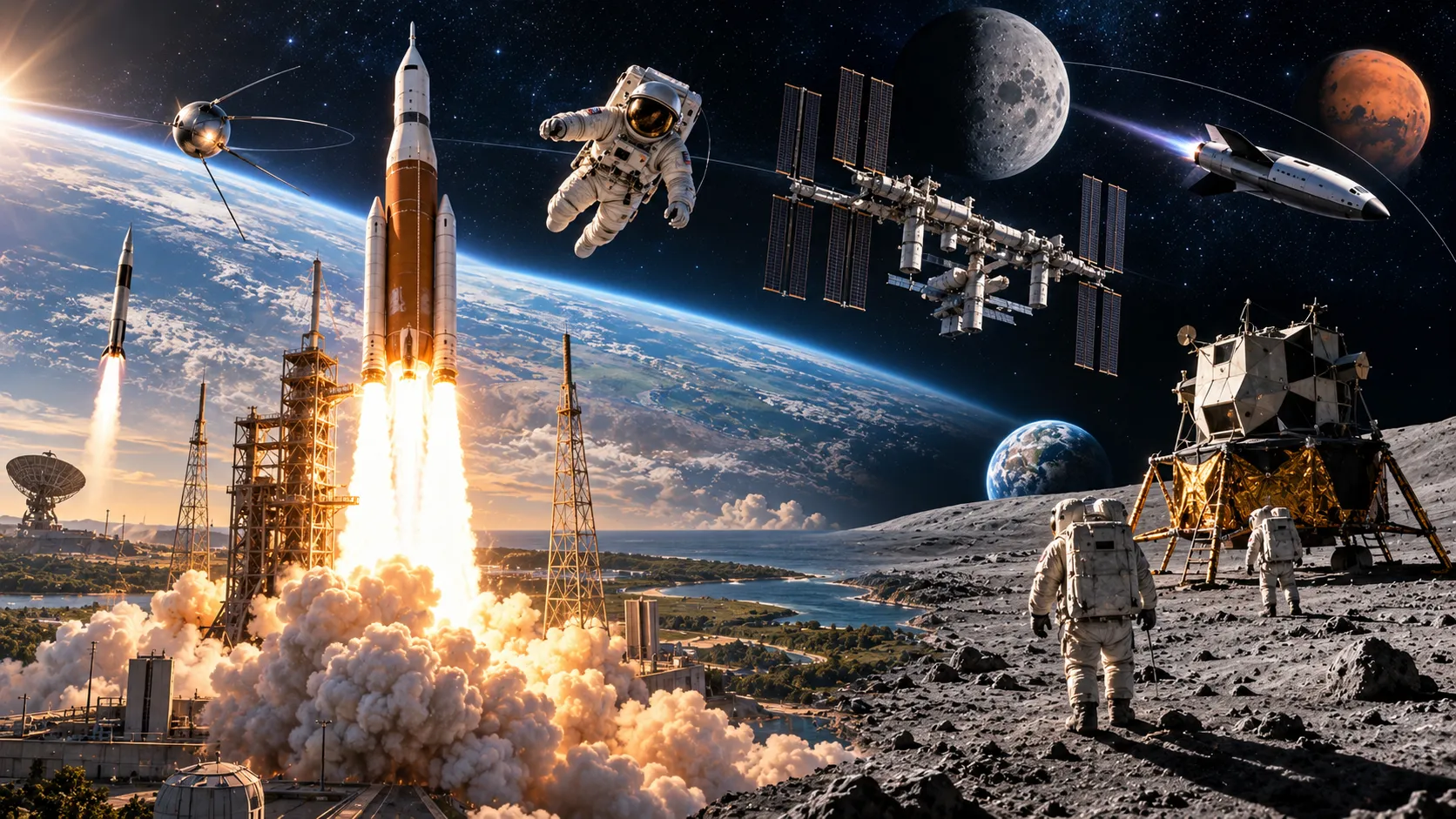
Space travel, also called spaceflight, is the movement of spacecraft beyond Earth's atmosphere. It includes journeys by robotic probes, satellites, cargo vehicles, and crewed spacecraft. Some missions remain in orbit around Earth, while others travel to the Moon, planets, asteroids, comets, or deeper into the Solar System.
Space travel depends on several branches of science and engineering working together. Rockets must generate enough thrust to lift a spacecraft, orbital mechanics determines its trajectory, navigation systems guide it, communications systems maintain contact with Earth, and thermal-control systems protect it from extreme environments. Human missions require additional systems for air, water, food, temperature control, radiation protection, and crew health.
NASA's Basics of Space Flight covers gravity, trajectories, planetary orbits, spacecraft systems, navigation, launch, cruise, planetary encounters, and deep-space communication as interconnected parts of spaceflight. (NASA Science)
Learning Objectives
After studying this guide, you should be able to:
Explain how rockets produce thrust and reach space.
Distinguish between reaching space, entering orbit, and escaping Earth's gravity.
Identify major spacecraft systems and mission types.
Explain basic orbital mechanics, gravity assists, and propulsion.
Describe the challenges of human spaceflight.
Identify major milestones from Sputnik to the International Space Station.
Explain atmospheric re-entry and thermal protection.
What is Space Travel?
Space travel begins when a launch vehicle carries a spacecraft away from Earth's surface. However, simply reaching a high altitude is not enough to remain in space.
A spacecraft intended to orbit Earth must also gain enormous sideways velocity. NASA explains that a launch vehicle rises through the atmosphere while accelerating until the spacecraft has sufficient orbital velocity; after powered flight ends, an orbiting spacecraft continues largely in free fall. (NASA Science)
A typical mission can be simplified as:
Launch
↓
Powered Ascent
↓
Orbit or Escape Trajectory
↓
Cruise
↓
Destination / Mission Operations
↓
Return or Extended Mission
Not every mission follows every step. A satellite might remain in Earth orbit for years, while an interplanetary probe may never return.
Rockets and Launch Vehicles
A rocket produces thrust by expelling material at high speed.
A launch vehicle is a rocket system designed to transport a payload such as a satellite, probe, cargo vehicle, or crewed spacecraft toward its required trajectory.
ESA describes a launcher as the vehicle used to place satellites, probes, and other payloads into space. Modern launchers commonly contain propulsion, structures, guidance and control systems, electrical systems, and multiple stages. (European Space Agency)
How Does a Rocket Work?
Rocket propulsion follows Newton's third law of motion:
When the rocket accelerates exhaust in one direction, the rocket accelerates in the opposite direction.
A chemical rocket burns propellants to produce high-temperature, high-pressure gas. A nozzle accelerates that gas outward, producing thrust. Unlike a jet engine, a rocket carries its own oxidizer, so it can operate where there is no atmospheric oxygen. (NASA Science)
The basic process is:
Fuel + Oxidizer
↓
Combustion
↓
Hot High-Pressure Gas
↓
Rocket Nozzle
↓
Fast Exhaust
↓
Thrust
Why Rockets Have Stages
Launch vehicles commonly contain multiple stages.
When a stage uses most of its propellant, it can be discarded. The remaining rocket no longer needs to accelerate the empty tanks, engines, and structure of that stage.
This improves efficiency.
Launch
↓
Stage 1 burns
↓
Stage 1 separates
↓
Stage 2 burns
↓
Payload reaches required trajectory
ESA notes that launch vehicles commonly use several stages to optimize the amount of payload they can deliver to orbit. (European Space Agency)
The Rocket Equation
One of the fundamental equations of astronautics is the ideal rocket equation:
Δv=veln(m0mf)\Delta v = v_e \ln\left(\frac{m_0}{m_f}\right)
Where:
Δv\Delta v = possible change in velocity
vev_e = effective exhaust velocity
m0m_0 = initial mass including propellant
mfm_f = final mass after propellant is used
ln\ln = natural logarithm
NASA explains that a rocket's mass constantly decreases as propellant is expelled, which is why the changing mass must be included in the calculation. (NASA)
What is Delta-v?
Delta-v, written Δv\Delta v, means change in velocity.
Space missions can be thought of as having a delta-v budget. Maneuvers such as launch, changing orbit, landing, or departing a planet require particular amounts of delta-v.
A spacecraft with insufficient propellant or propulsion capability may not be able to perform all required maneuvers.
Reaching Space vs Reaching Orbit
A common mistake is assuming that traveling upward far enough automatically places a spacecraft in orbit.
It does not.
An object could travel straight upward into space and then fall back to Earth. To remain in orbit, it needs sufficient horizontal velocity.
ESA gives a speed of more than approximately 7.9 km/s for establishing very low Earth orbit conditions. (European Space Agency)
Orbit therefore depends heavily on speed, not merely altitude.
How an Orbit Works
An orbiting spacecraft is continually falling toward the body it orbits.
However, it is moving sideways so quickly that the surface curves away beneath it at approximately the same rate.
The result is continuous free fall around the planet.
Gravity pulls spacecraft inward
↓
● Spacecraft →
↘
↘
🌍
If the spacecraft moves too slowly, its path can intersect the atmosphere or surface.
With the correct velocity and trajectory, it continues around the planet.
NASA's explanation of orbital mechanics traces this concept to Newton's famous thought experiment involving a projectile launched horizontally from a sufficiently high location. (NASA Science)
Major Types of Earth Orbit
Spacecraft use different orbits depending on their mission.
Orbit | Main Characteristic | Common Uses |
Low Earth Orbit (LEO) | Relatively close to Earth | Crewed missions, Earth observation, many satellites |
Polar orbit | Passes over or near the poles | Earth mapping and observation |
Sun-synchronous orbit | Passes locations at similar local solar times | Imaging and environmental monitoring |
Geosynchronous orbit | Orbital period matches Earth's rotation | Communications and weather |
Geostationary orbit | Circular equatorial geosynchronous orbit | Fixed-position communications/weather coverage |
Low Earth Orbit
LEO is the region where many satellites and crewed spacecraft operate.
The International Space Station travels at roughly 5 miles (8 km) per second and circles Earth approximately every 90 minutes. (NASA)
Polar Orbit
A polar-orbiting satellite travels over or near Earth's poles.
As Earth rotates underneath, the spacecraft can eventually observe large portions of the planet.
Geosynchronous and Geostationary Orbits
A geosynchronous orbit has an orbital period equal to Earth's rotation period.
A geostationary orbit is a special geosynchronous orbit that is circular and lies over the equator. From the ground, a geostationary spacecraft appears to remain almost fixed above one longitude. (NASA Science)
Spacecraft vs Launch Vehicle
These terms should not be confused.
Launch Vehicle | Spacecraft |
Provides the initial transportation | Performs the mission |
Produces enormous launch thrust | Carries instruments, cargo, or crew |
Often discarded in stages | May operate for months or years |
Carries the spacecraft | Becomes the payload during launch |
For example, the rocket used to launch a planetary probe is not necessarily the probe itself.
Types of Space Missions
Flyby
A spacecraft passes a target without entering orbit.
Flybys can collect images and scientific measurements while moving past a planet, moon, asteroid, or comet.
Orbiter
An orbiter enters orbit around a target.
Orbiting allows repeated observations over an extended period.
Lander
A lander reaches the surface of another body and operates from one location.
Rover
A rover is designed to move across a planetary or lunar surface.
Sample-Return Mission
A sample-return spacecraft collects material and returns it to Earth for laboratory study.
Crewed Spacecraft
A crewed spacecraft transports humans and therefore needs life-support, environmental-control, safety, and return systems in addition to normal spacecraft equipment.
Main Spacecraft Systems
Spacecraft consist of interconnected subsystems.
NASA identifies typical spacecraft systems including structure, thermal control, data handling, attitude control, telecommunications, electrical power, and propulsion. (NASA Science)
System | Function |
Structure | Supports and protects spacecraft components |
Power | Generates, stores, and distributes electricity |
Propulsion | Changes velocity or trajectory |
Guidance, Navigation and Control | Determines and controls position and orientation |
Communications | Exchanges commands and data with Earth |
Thermal control | Keeps components within safe temperatures |
Command and data handling | Runs onboard computing and processes data |
Life support | Supports crew on human missions |
Power in Space
Many spacecraft use solar panels to convert sunlight into electricity.
Batteries store energy for periods when sunlight is unavailable.
Spacecraft traveling far from the Sun or operating in environments where solar power is difficult may use other sources, including radioisotope power systems.
Energy must support instruments, communications, computers, heaters, propulsion systems, and other equipment.
Communication With Earth
Spacecraft communicate mainly using electromagnetic signals.
A spacecraft typically has:
Transmitters
Receivers
Antennas
Data-processing equipment
Long-distance missions often use high-gain antennas pointed accurately toward Earth. (NASA Science)
Communication becomes more difficult as distance increases because signals become weaker and transmission delays grow.
Chemical Propulsion
Chemical rockets produce relatively high thrust, making them essential for launching spacecraft from Earth.
NASA notes that chemical propulsion remains the practical method for supplying the enormous energy required for launch from Earth's surface. (NASA Science)
Chemical propulsion is also useful for:
Major spacecraft maneuvers
Orbit insertion
Landing
Rapid course corrections
Its major limitation is the amount of propellant required.
Electric and Ion Propulsion
Ion propulsion works differently.
Instead of producing a short period of very high thrust, an ion engine electrically accelerates charged atoms, or ions, to extremely high exhaust velocities.
The thrust is very small, but the engine can operate for extremely long periods.
NASA's Dawn spacecraft used ion propulsion extensively while exploring Vesta and Ceres. NASA describes electric propulsion as much more propellant-efficient than conventional chemical propulsion for suitable long-duration missions. (NASA Science)
Chemical vs Ion Propulsion
Feature | Chemical Rocket | Ion Propulsion |
Thrust | High | Very low |
Propellant efficiency | Lower | High |
Suitable for Earth launch | Yes | No |
Long continuous operation | Usually limited | Excellent |
Common use | Launch and major maneuvers | Long-duration space travel |
Trajectories Between Planets
Spacecraft do not usually aim directly at where a planet appears to be when they launch.
Both the spacecraft and planets are moving around the Sun. Engineers therefore calculate trajectories that intercept the target at a future position.
Interplanetary missions can spend months or years mostly coasting in free fall after initial propulsion maneuvers.
Gravity Assists
A gravity assist uses a close planetary or lunar flyby to modify a spacecraft's trajectory and speed relative to the Sun.
NASA explains that gravity assists can increase or decrease a spacecraft's orbital energy while reducing the amount of propellant required. Voyager 2, Galileo, and Cassini are examples of spacecraft that used planetary gravity assists. (NASA Science)
Simplified:
Spacecraft approaches planet
↓
Planet bends trajectory
↓
Spacecraft leaves on a different
speed and direction relative to Sun
A gravity assist is sometimes informally called a gravitational slingshot.
Atmospheric Entry and Re-entry
Returning to a planet with an atmosphere creates another major engineering challenge.
A spacecraft may enter an atmosphere at several kilometres per second. Gas compressed around the vehicle becomes extremely hot.
A thermal protection system, commonly called a heat shield, protects the spacecraft.
NASA explains that some heat shields use ablation: part of the material intentionally chars or burns away, carrying heat away from the spacecraft. (NASA Science)
After slowing sufficiently, spacecraft may use:
Parachutes
Engines
Wings
Airbags
A combination of systems
The exact landing method depends on the destination and spacecraft.
Human Spaceflight
Sending humans into space is significantly more complicated than sending robotic spacecraft.
Humans require:
Breathable air
Water
Food
Waste management
Temperature regulation
Suitable atmospheric pressure
Radiation protection
Exercise
Medical support
Emergency systems
A spacecraft must function simultaneously as a vehicle, workplace, and temporary habitat.
Five Major Hazards of Human Spaceflight
NASA groups the major hazards of human spaceflight into five categories. (NASA)
Hazard | Why It Matters |
Space radiation | Can damage biological tissue |
Isolation and confinement | Can affect health and crew performance |
Distance from Earth | Delays communication and assistance |
Altered gravity | Affects bones, muscles, balance, and other systems |
Hostile/closed environment | Requires careful control of air, temperature, microbes, and habitat conditions |
Microgravity
Astronauts in orbit often appear "weightless," but Earth's gravity has not disappeared.
They experience microgravity because the spacecraft and everyone inside it are falling around Earth together.
Long-duration exposure can affect bones, muscles, balance, cardiovascular function, and other body systems. (NASA)
Radiation
Earth's atmosphere and magnetic environment provide considerable protection from space radiation.
Travel beyond this protection increases exposure to energetic particles from the Sun and from galactic cosmic rays. (NASA)
The International Space Station
The International Space Station (ISS) is a large crewed research facility in low Earth orbit.
Continuous human occupation began in November 2000. It serves as a microgravity laboratory for research in biology, physics, technology, human health, and other fields. (NASA)
The ISS demonstrates many technologies required for long-duration human spaceflight, including:
Life support
Solar power
Docking
Spacewalking
International mission operations
Long-duration crew habitation
Major Milestones in Space Travel
Year | Milestone | Importance |
1957 | Sputnik 1 | First artificial satellite |
1961 | Yuri Gagarin aboard Vostok 1 | First human in space and first human Earth orbit |
1969 | Apollo 11 | First humans to land on the Moon |
1970s | Deep-space planetary probes expand | Exploration beyond Earth and Moon |
1977 | Voyager missions launched | Major exploration of the outer planets |
2000 | Continuous ISS habitation begins | Long-duration international human presence in orbit |
Sputnik 1
The Soviet Union launched Sputnik 1 on October 4, 1957. It became the world's first artificial satellite and is widely regarded as the event that opened the Space Age. (NASA)
Yuri Gagarin
On April 12, 1961, Soviet cosmonaut Yuri Gagarin became the first human to travel into space and orbit Earth.
His Vostok 1 mission lasted 108 minutes. (NASA)
Apollo 11
Apollo 11 launched on July 16, 1969, carrying Neil Armstrong, Buzz Aldrin, and Michael Collins.
Armstrong and Aldrin landed on the Moon on July 20 while Collins remained in lunar orbit. Armstrong became the first person to step onto the lunar surface, followed by Aldrin. The crew safely returned to Earth on July 24. (NASA)
Robotic vs Human Space Exploration
Robotic Missions | Human Missions |
No crew life-support required | Require extensive life-support systems |
Can tolerate some environments humans cannot | Must protect human health |
Can operate for many years | Crew duration creates additional constraints |
Generally lower mass | Usually much greater mass |
No risk to human crew | Human safety is a primary requirement |
Limited by instruments and automation | Humans can adapt and make complex decisions |
Robotic and human missions are complementary rather than interchangeable. Each is useful for different objectives.
Common Mistakes
1. Spacecraft Stop Experiencing Gravity in Orbit
False. Gravity is what keeps an orbiting spacecraft in orbit.
2. Astronauts Float Because There Is No Gravity
Astronauts float because they and their spacecraft are in continuous free fall.
3. Going High Enough Automatically Creates an Orbit
Orbit requires suitable horizontal velocity as well as altitude.
4. Rockets Need Air to Push Against
They do not. Rockets generate thrust by expelling mass and can operate in a vacuum.
5. The Rocket and Spacecraft Are Always the Same Vehicle
A launch vehicle typically carries the spacecraft and may be discarded in stages.
6. Ion Engines Are Better for Launching From Earth
Ion propulsion is efficient but produces far too little thrust for launching a conventional spacecraft from Earth's surface. (NASA Science)
7. The Internet Works Instantly With Distant Spacecraft
Radio signals travel at the speed of light, but interplanetary distances create significant delays. Deep-space crews and robotic systems therefore require considerable autonomy.
Memory Tips
Remember the broad mission sequence:
L-O-C-E-R
Launch
Orbit
Cruise
Encounter
Return
For spacecraft systems, remember:
Power → Control → Communication → Propulsion → Protection
For NASA's human-spaceflight hazards, remember:
R-I-D-G-E
Radiation
Isolation
Distance
Gravity changes
Enclosed/hostile environment
Summary
Space travel combines rocket propulsion, orbital mechanics, spacecraft engineering, communications, navigation, and environmental protection. Rockets create thrust by accelerating exhaust in the opposite direction of travel. Launch vehicles commonly use several stages because discarding empty components improves performance. Reaching orbit requires not only altitude but also extremely high sideways velocity.
Once in space, spacecraft may operate as satellites, flyby probes, orbiters, landers, rovers, sample-return vehicles, or crewed spacecraft. Their essential systems include electrical power, propulsion, communications, guidance and control, computing, structural support, and thermal management.
Interplanetary spacecraft often coast through space along carefully planned trajectories. Gravity assists can alter their energy and direction without consuming large quantities of propellant, while electric propulsion can provide highly efficient thrust over long periods.
Crewed spaceflight adds major challenges involving radiation, altered gravity, isolation, distance from Earth, and the need to maintain a safe closed environment. From Sputnik in 1957 and Gagarin's flight in 1961 to the Apollo 11 Moon landing and decades of continuous human presence aboard the International Space Station, space travel has developed from short experimental missions into sustained scientific exploration.
FAQ
1. How do rockets work in space without air?
Rockets carry propellant and expel mass at high speed. The reaction force accelerates the rocket in the opposite direction. They do not need air to push against. (NASA Science)
2. Why do astronauts float in orbit?
Astronauts and their spacecraft are continually falling around Earth together, creating the condition known as microgravity.
3. How fast must a spacecraft travel to orbit Earth?
The exact speed depends on altitude and orbit. Very low Earth orbital speeds are roughly 7.9 km/s, although real launch trajectories and orbital requirements vary. (European Space Agency)
4. What is delta-v?
Delta-v measures the change in velocity a spacecraft can produce. Mission planners use delta-v requirements to determine whether a spacecraft has enough propulsion capability for its planned maneuvers.
5. Why are rockets built in stages?
Staging allows a rocket to discard empty tanks, engines, and structures so later stages accelerate less unnecessary mass.
6. What is a gravity assist?
A gravity assist is a close flyby of a planet or moon used to alter a spacecraft's trajectory and velocity relative to another reference body such as the Sun. (NASA Science)
7. Why do spacecraft need heat shields?
Atmospheric entry creates extreme heating. Thermal protection systems prevent this heat from destroying the spacecraft or its payload. (NASA Science)
8. What was the first artificial satellite?
Sputnik 1, launched by the Soviet Union on October 4, 1957. (NASA)
9. Who was the first human in space?
Yuri Gagarin, who orbited Earth aboard Vostok 1 on April 12, 1961. (NASA Science)
10. Who were the first humans to walk on the Moon?
Neil Armstrong and Buzz Aldrin walked on the Moon during Apollo 11 in July 1969. Michael Collins remained in lunar orbit aboard the command module. (NASA)
Key Takeaways
Rockets generate thrust by expelling mass at high speed and can operate in a vacuum.
Reaching orbit requires enormous horizontal velocity, not simply traveling high above Earth.
Space missions use specialized spacecraft such as orbiters, landers, rovers, probes, and crew vehicles.
Gravity assists, chemical rockets, and electric propulsion provide different ways of changing spacecraft trajectories.
Human spaceflight requires protection against radiation, altered gravity, isolation, distance, and hazardous closed environments.
References
NASA Science — Basics of Space Flight. A broad educational reference covering gravity, trajectories, planetary orbits, spacecraft, navigation, launch, mission operations, and deep-space communication. (NASA Science)
NASA: Basics of Space FlightNASA Glenn Research Center — Beginner's Guide to Rockets. Educational material covering rocket physics, forces, aerodynamics, propulsion, and rocket flight. (NASA)
NASA: Beginner's Guide to RocketsNASA Glenn Research Center — Ideal Rocket Equation. Technical explanation and derivation of the rocket equation and the relationship between propellant mass and velocity change. (NASA)
NASA: Ideal Rocket EquationEuropean Space Agency — What Is a Launcher? Explains launch vehicles, orbital velocity, payload delivery, and satellite launch. (European Space Agency)
ESA: What Is a Launcher?NASA — Five Hazards of Human Spaceflight. Describes radiation, isolation and confinement, distance from Earth, altered gravity fields, and hostile closed environments. (NASA)
NASA: Human Spaceflight HazardsNASA — International Space Station Facts and Figures. Official information about the station's orbit, speed, occupation, dimensions, crews, and research role. (NASA)
NASA: ISS Facts and FiguresNASA History — The Dawn of the Space Age. Historical account of Sputnik 1 and the beginning of the Space Age in 1957. (NASA)
NASA: Dawn of the Space AgeNASA — Yuri Gagarin: First Human in Space. Official historical resource on Gagarin's 1961 Vostok 1 flight. (NASA Science)
NASA: Yuri GagarinNASA — Apollo 11. Official mission resource covering the first crewed lunar landing, its crew, launch, landing, and return. (NASA)
NASA: Apollo 11NASA Science — Gravity Assist Primer. Explains how planetary flybys can change spacecraft trajectory and energy while reducing propulsion requirements. (NASA Science)
NASA: Gravity Assist PrimerNASA Science — Dawn Ion Propulsion. Explains ion engines, xenon propellant, electrical acceleration of ions, and the advantages of electric propulsion. (NASA Science)
NASA: Ion PropulsionNASA — Thermal Protection Materials. Describes the technologies that protect spacecraft from severe aerodynamic heating during atmospheric entry and re-entry. (NASA)
NASA: Thermal Protection Materials