✈️ Transport & Travel

Space Travel

61 questions 30 flashcards 16 min read

Named quizzes

Jump into a focused set for Space Travel.

About Space Travel

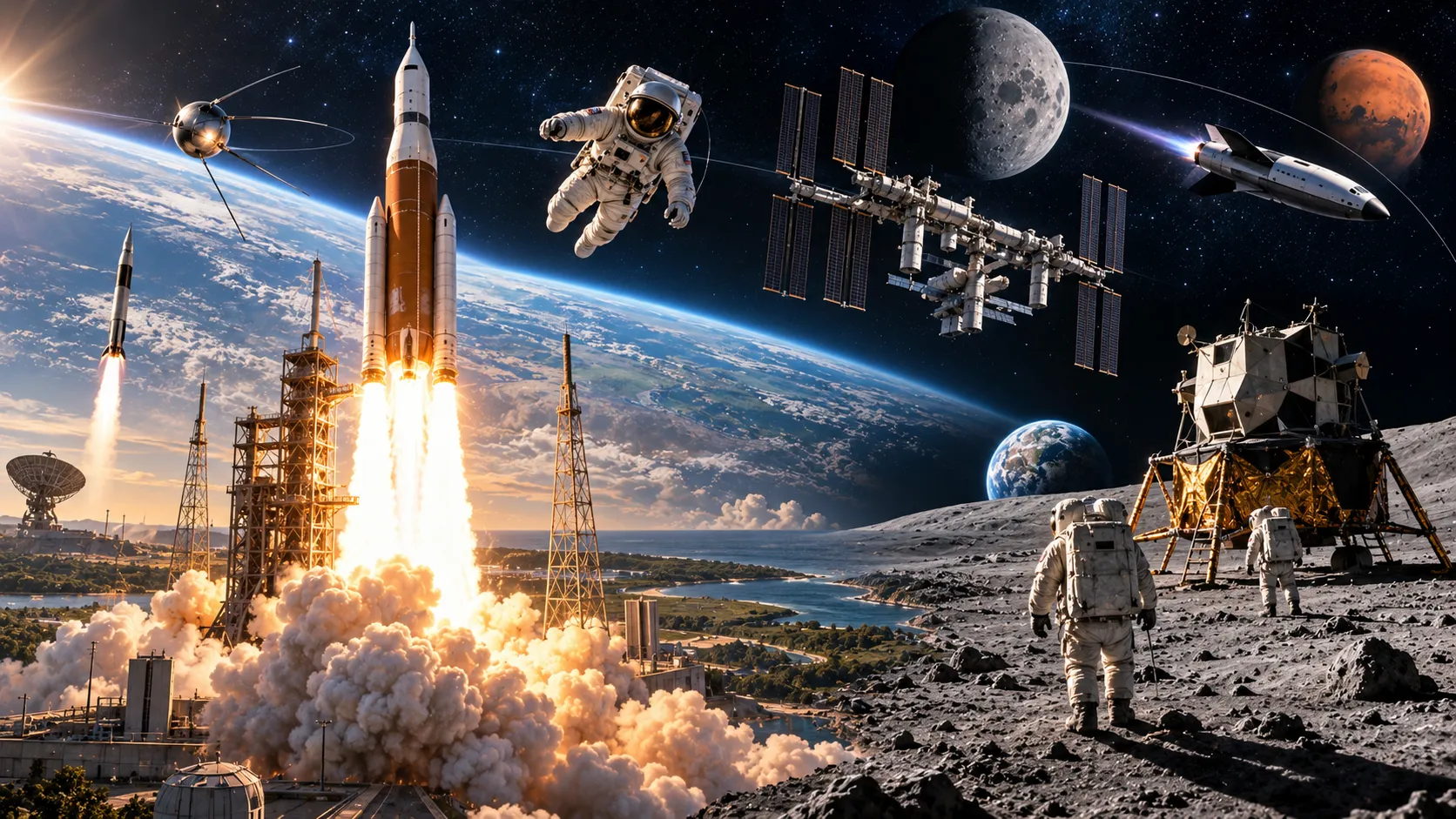
Explore the history and future of space travel, from the first rockets and pioneering astronauts to Moon landings, space stations, reusable spacecraft, and missions beyond Earth. Discover the technologies, people, risks, and milestones that have shaped humanity’s journey into space.

This topic is part of Transport & Travel. Explore the guide, then practice with flashcards and quizzes to lock in what you learn.

Read more about Space Travel

Browse Travel Modes

Choose how you explore the world of transport.

View all →
✈️
Aviation
Aircraft & airports
Start →
🚗
Cars
Autos & brands
Start →
🚆
Rail
Trains & metro
Start →
🚢
Ships
Sea travel
Start →
🚌
Transit
City systems
Start →
🧳
Travel
Destinations · 6 questions
Start · 6 Q →

Quick Facts

Questions
61
Difficulty
Mixed
Category
Transport & Travel

Study Guide

1 guide for Space Travel
Available
Browse all guides →

Flashcards

Who was the first human to journey into outer space?

1 / 30

Study Flashcards

Practice Quiz

Test your knowledge with multiple choice questions.

61 Questions 15 min Time Unlimited Attempts

Practice Tests

Take a practice test and improve your score.

View all practice modes →

Frequently asked questions

Yuri Gagarin, a Soviet cosmonaut, became the first human to travel into space on 12 April 1961. He completed one orbit of Earth aboard Vostok 1.
Neil Armstrong and Buzz Aldrin became the first humans to walk on the Moon during the Apollo 11 mission on 20 July 1969. Michael Collins remained in lunar orbit aboard the command module.
The International Space Station is a large research facility in low Earth orbit. It has supported long-duration human missions and scientific research in areas including biology, medicine, physics, technology, and Earth observation.
Astronauts travel into space aboard spacecraft launched by powerful rockets. The rocket provides the thrust needed to overcome gravity and accelerate the spacecraft to the speed required for its mission, such as reaching orbit.
Future space travel is expected to include continued operations in Earth orbit, renewed human exploration of the Moon, more reusable spacecraft, increased commercial activity, and preparation for possible crewed missions to Mars. Robotic exploration will continue to play a major role alongside human missions.