🔬 Science

Physics

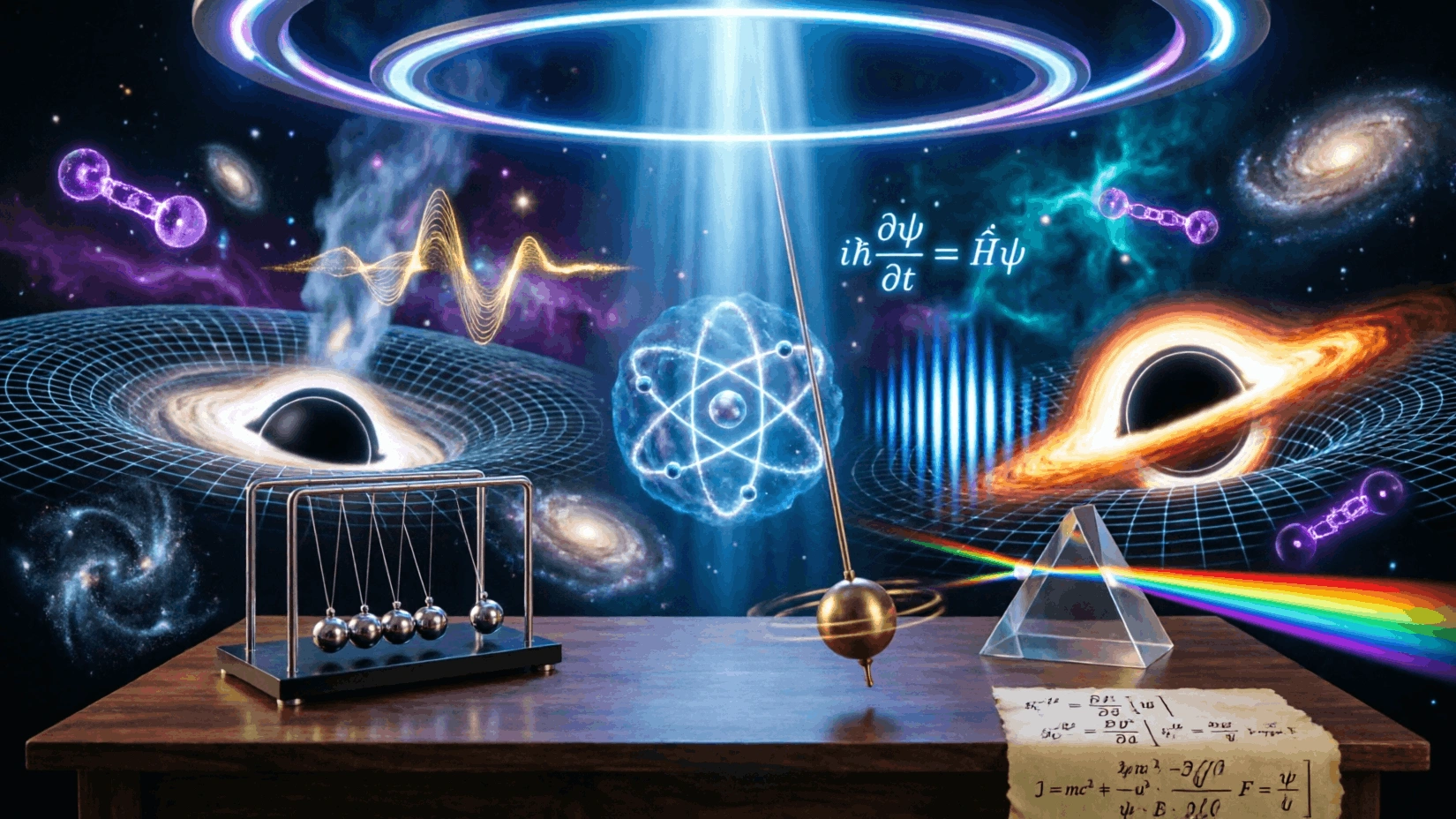
Physics is the fundamental science that explains how the universe works, from the smallest subatomic particles to the largest galaxies. It explores matter, energy, motion, forces, space, and time, helping us understand the laws that govern everything around us and driving many of the technological advances of the modern world.
109 Questions
🃏
54 Flashcards
⏱️
12 min Reading
📶
Beginner Difficulty

About Physics

Physics is the fundamental science that explains how the universe works, from the smallest subatomic particles to the largest galaxies. It explores matter, energy, motion, forces, space, and time, helping us understand the laws that govern everything around us and driving many of the technological advances of the modern world.

Read full about Physics →

This topic is part of Science - use the lab and fields tools below, then practice with flashcards and quizzes.

🔬 Did you know?

Physics includes 109 curated questions across Science.

🔬 Science

Concept Lab

Visual diagrams and core science concepts to explore.

Open full view →
🧬
DNA
⚛️
Atoms
🌋
Earth
🌌
Space
🧪
Reactions
🫀
Body

Science Fields

Browse major branches of science.

View all →
🧬
Biology
Life sciences
⚗️
Chemistry
Matter & reactions
⚛️
Physics
Forces & energy
🌌
Astronomy
Space & cosmos
🌋
Earth Science
Planet systems
🫀
Human Body
Anatomy & health

4. Study Guide

1 guide for Physics

Available
Browse all guides →

Flashcards

Which fundamental constant of nature relates the energy of a photon to its frequency?

1 / 54

Study Flashcards

Practice Quiz

Test your knowledge with multiple choice questions.

❓ 109 Questions ⏱️ 15 min Time 🔁 Unlimited Attempts

Practice Tests

Take a practice test and improve your score.

View all practice modes →

Latest Articles

View all →

Frequently asked questions

Physics is the branch of science that studies matter, energy, motion, forces, space, and time. It explains how the universe works through scientific laws, experiments, and mathematical principles.
The major branches of physics include mechanics, thermodynamics, electromagnetism, optics, acoustics, quantum mechanics, atomic physics, nuclear physics, particle physics, astrophysics, and relativity.
Physics helps us understand natural phenomena and forms the foundation of many technologies, including electricity, electronics, telecommunications, transportation, renewable energy, medical equipment, and space exploration.
Some of the most influential physicists include Isaac Newton, Albert Einstein, Galileo Galilei, James Clerk Maxwell, Marie Curie, Niels Bohr, Richard Feynman, and Stephen Hawking, whose discoveries transformed our understanding of the physical universe.
Learning physics improves logical reasoning, mathematical thinking, and problem-solving skills while helping you understand how the natural world operates. It also provides a strong foundation for careers in science, engineering, medicine, technology, astronomy, and many other fields.

Discussion

Ask questions, share knowledge and help others.

View all →
Log in to join the discussion about Physics.

Be the first to start a discussion about Physics.