
Introduction
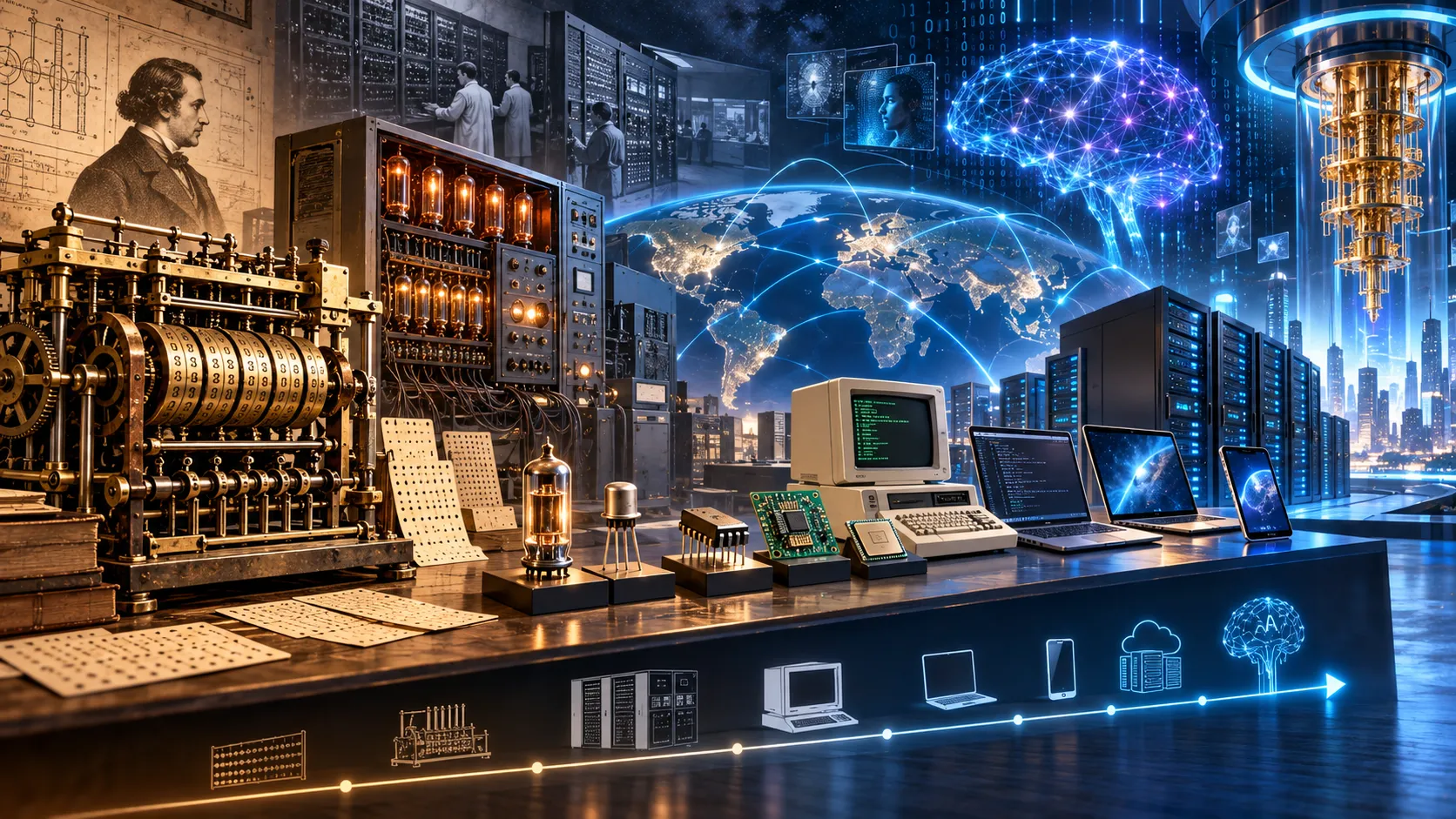
The history of computing is the story of how humans developed tools to calculate, store information, automate instructions, communicate across networks, and solve increasingly complex problems. Computing evolved from mechanical calculating devices into electronic computers, microprocessors, personal computers, smartphones, cloud systems, and artificial intelligence.
No single machine can be called the unquestioned “first computer” because the answer depends on the definition. Historians distinguish between mechanical calculators, programmable machines, electromechanical computers, and fully electronic general-purpose computers. Charles Babbage's nineteenth-century Analytical Engine introduced several concepts found in later computers, while machines such as ENIAC demonstrated large-scale electronic computing in the 1940s. (CHM)
Studying computing history helps explain why modern computers use processors, memory, stored instructions, graphical interfaces, networks, and software. It also shows how innovations often build on earlier inventions rather than appearing suddenly.
Learning Objectives
After studying this guide, you should be able to:
Explain the major stages in the development of computing.
Identify important computing inventions and innovators.
Describe the transition from mechanical to electronic computers.
Explain the importance of transistors, integrated circuits, and microprocessors.
Understand the development of personal computers, networking, and the World Wide Web.
Connect historical innovations with modern technologies such as smartphones, cloud computing, and artificial intelligence.
What is Computing?
Computing is the use of machines and logical procedures to process information or perform calculations.
Modern computing commonly involves:
Input
Processing
Memory
Storage
Output
Software
Networking
A computer accepts information, processes it according to instructions, and produces a result.
A simplified model is:
Input
↓
Processing
↓
Storage / Memory
↓
Output
Modern computers add networking, sensors, graphics, databases, and many other capabilities, but the basic concept of processing information remains central.
Major Eras of Computing History
1. Early Calculation Tools
Long before electronic computers, people used physical tools to assist with arithmetic.
Early calculation methods included:
Counting stones
Tally marks
Counting boards
Abacuses
Mechanical calculators
These tools were not computers in the modern sense because they generally required a human operator to control each step.
Their importance lies in the idea that calculation could be assisted by a physical device.
2. Mechanical Computing
During the seventeenth through nineteenth centuries, inventors developed increasingly sophisticated mechanical calculators.
These machines used components such as:
Gears
Wheels
Levers
Cams
Mechanical counters
The major conceptual breakthrough came when inventors began considering machines that could perform sequences of operations automatically.
Charles Babbage and the Difference Engine
English mathematician and inventor Charles Babbage began designing the Difference Engine in the 1820s.
The machine was intended to calculate and automatically print mathematical tables. This was valuable because tables used in navigation, engineering, astronomy, and commerce were calculated manually and could contain errors. (CHM)
Babbage's Difference Engine used the mathematical method of finite differences, which allowed certain calculations to be performed primarily through repeated addition. (CHM)
Babbage never completed the full machine during his lifetime. However, the Science Museum later constructed Difference Engine No. 2 from his original designs, demonstrating that the design worked. (Science Museum Group Collection)
The Analytical Engine
Babbage later designed a much more ambitious machine called the Analytical Engine.
Unlike the Difference Engine, which was intended for specialized calculations, the Analytical Engine was designed as a general-purpose programmable machine.
Its proposed architecture included concepts comparable to:
A processor, called the mill
Memory, called the store
Input
Output
Programmable instructions
Punched-card control
The Computer History Museum notes that the Analytical Engine's logical organization included separation between memory and processing, a principle that remains fundamental in electronic computers. (CHM)
Ada Lovelace and Early Programming
Mathematician Ada Lovelace studied Babbage's Analytical Engine and recognized that its possibilities extended beyond ordinary arithmetic.
Her published notes included an algorithm designed for the machine. She also understood that numbers could represent things other than quantities, including symbols and musical information. (Science Museum Blog)
For this reason, Lovelace is frequently associated with the earliest published ideas of computer programming.
Punch Cards and Automated Data Processing
Herman Hollerith
By the late nineteenth century, governments and businesses faced another problem: processing large quantities of information.
Herman Hollerith developed an electric tabulating system that encoded information using holes punched into cards.
His system was selected for processing the 1890 United States census. The Census Bureau reports that Hollerith's design greatly accelerated data capture and tabulation compared with competing approaches. (Census.gov)
Punch-card systems became important in business and government data processing for decades.
Hollerith later founded the Tabulating Machine Company. Through later mergers and organizational changes, that business became part of what eventually became IBM. (Census.gov)
Electronic Computing
Vacuum Tubes
Early twentieth-century electronic computers relied heavily on vacuum tubes.
Vacuum tubes could act as electronic switches and amplifiers. Because electronic switching was much faster than mechanical switching, they enabled major improvements in calculation speed.
However, vacuum tubes had serious disadvantages:
Large physical size
High electricity consumption
Heat generation
Limited reliability
Frequent maintenance
These limitations encouraged researchers to develop better electronic components.
ENIAC
One of the most famous early electronic computers was ENIAC, the Electronic Numerical Integrator and Computer.
Development began during World War II at the University of Pennsylvania under John Mauchly and J. Presper Eckert. ENIAC was publicly unveiled in 1946. (CHM)
ENIAC contained roughly 18,000 vacuum tubes, occupied more than 1,000 square feet, and weighed about 30 tons. It was dramatically faster than earlier electromechanical systems. (CHM)
Programming ENIAC initially involved configuring switches and cables. This made changing programs much less convenient than loading software onto a modern computer.
Stored-Program Computing
A critical innovation was the idea of storing program instructions in electronic memory instead of manually rewiring a machine for each new task.
This concept helped establish the architecture followed by most later general-purpose computers:
Input
↓
Memory ↔ Processor
↓
Output
Program instructions and data could both be represented electronically, making computers far more flexible.
The Transistor Revolution
What Is a Transistor?
A transistor is a semiconductor device that can control or amplify electrical signals.
In 1947, John Bardeen and Walter Brattain demonstrated a semiconductor amplifier at Bell Laboratories, while William Shockley subsequently developed important transistor designs. The three shared the 1956 Nobel Prize in Physics for research on semiconductors and discovery of the transistor effect. (Nobel Prize)
Why Transistors Changed Computing
Compared with vacuum tubes, transistors could be:
Much smaller
More energy efficient
More reliable
Faster
Easier to integrate into compact electronics
The transistor helped computers become smaller and more practical.
Vacuum Tubes vs Transistors
Feature | Vacuum Tubes | Transistors |
Size | Large | Small |
Power consumption | High | Lower |
Heat | High | Lower |
Reliability | Lower | Higher |
Computer size | Very large | Much smaller |
Era | Early electronic computers | Later electronic systems |
Integrated Circuits
Using individual transistors still required large numbers of separate components and electrical connections.
The next major innovation was the integrated circuit, or IC.
An integrated circuit places multiple electronic components onto a single piece of semiconductor material.
Jack Kilby demonstrated an early integrated circuit in 1958, while Robert Noyce independently developed important integrated-circuit technology. Kilby later received part of the 2000 Nobel Prize in Physics for his role in the invention.
Integrated circuits allowed electronic systems to become:
Smaller
Faster
Cheaper
More reliable
More complex
Modern processors can contain enormous numbers of semiconductor devices on individual chips.
Storage Innovation
Computers need ways to keep information even when it is not currently being processed.
In 1956, IBM introduced the 305 RAMAC, which incorporated an early commercial random-access magnetic disk system. Unlike sequential storage such as tape, the disk system allowed quicker direct access to different stored records. (IBM)
Storage technology later developed through:
Magnetic disks
Floppy disks
Optical discs
Flash memory
Solid-state drives
Network storage
Cloud storage
The Microprocessor
One of the most important innovations in computing was placing the essential CPU functions onto a small integrated circuit.
Intel 4004
In 1971, Intel introduced the 4004, a 4-bit microprocessor developed by a team including Federico Faggin, Ted Hoff, Stanley Mazor, and Masatoshi Shima.
The Computer History Museum reports that the 4004 contained about 2,300 transistors and helped demonstrate how processor functions could be integrated into a single chip. (CHM)
Microprocessors made it possible to build far smaller and less expensive computers.
They eventually became central components in:
Personal computers
Smartphones
Vehicles
Appliances
Game systems
Industrial equipment
Embedded systems
Personal Computing
Altair 8800
The Altair 8800, introduced to hobbyists in 1975, became an important milestone in the early personal-computer movement.
The Computer History Museum notes that the machine attracted strong interest after appearing in Popular Electronics. Bill Gates and Paul Allen supplied a BASIC programming-language implementation for the system. (CHM)
Apple and Consumer Computing
During the late 1970s, companies increasingly produced computers intended for individuals rather than large institutions.
The Apple II, introduced in 1977, became one of the important early mass-market personal computers. (CHM)
IBM PC
IBM introduced the IBM Personal Computer Model 5150 in 1981.
Its use of widely available components and published design information encouraged the creation of compatible machines, commonly called PC clones. The platform also helped MS-DOS become widely used in business computing. (CHM)
Graphical User Interfaces and the Mouse
Early computer users often interacted with machines by entering text commands.
Researchers sought easier ways for people to communicate with computers.
Computer Mouse
Engineer Bill English built an early computer mouse based on ideas developed with Douglas Engelbart at the Stanford Research Institute. (CHM)
A famous 1968 demonstration by Engelbart's research group showed technologies including a mouse, windows, document sharing, and collaborative computing concepts. (CHM)
Xerox Alto
During the 1970s, researchers at Xerox PARC developed the Alto, which combined technologies such as:
A mouse
Graphical display
Windows and icons
Networking
WYSIWYG document editing
These ideas strongly influenced later personal-computer interfaces. (CHM)
Graphical interfaces eventually became standard in consumer computing.
Computer Networking
Networking transformed computers from isolated machines into communication systems.
ARPANET
One of the most significant early computer networks was ARPANET.
On October 29, 1969, researchers attempted to send the word LOGIN between computers at UCLA and the Stanford Research Institute. The system crashed after receiving the first two letters, producing the famous first transmission: “lo.” (CHM)
ARPANET became an important experimental foundation for later Internet technologies.
Networking innovations eventually enabled:
Email
File sharing
Remote computing
Online communities
Internet services
The World Wide Web
The Internet and the World Wide Web are related but are not the same thing.
The Internet is the underlying network infrastructure.
The World Wide Web is a system of linked documents and resources accessed across networks.
At CERN, Tim Berners-Lee developed the foundations of the Web, including the first Web server and browser. By the end of 1990, the first server and browser were operating at CERN. (CERN)
The Web made Internet information much easier for ordinary users to navigate and publish.
Key Computing Timeline
Period / Year | Innovation | Importance |
1820s | Babbage Difference Engine | Automatic mechanical calculation |
1830s | Analytical Engine | General-purpose programmable-computer concepts |
1840s | Ada Lovelace's notes | Early published programming concepts |
1890 | Hollerith tabulator | Automated large-scale data processing |
1940s | Electronic computers | High-speed electronic calculation |
1946 | ENIAC publicly unveiled | Major electronic-computing milestone |
1947 | Transistor breakthrough | Smaller, more reliable electronics |
1956 | IBM RAMAC | Random-access magnetic disk storage |
1958–1959 | Integrated circuit | Multiple components on one chip |
1968 | Engelbart demonstration | Mouse and interactive-computing concepts |
1969 | Early ARPANET communication | Networked computing milestone |
1971 | Intel 4004 | Early commercial microprocessor |
1973 | Xerox Alto era | GUI, mouse, networking innovations |
1975 | Altair 8800 | Personal-computer hobbyist revolution |
1981 | IBM PC | Expansion of business personal computing |
1990 | First Web server and browser | Foundation of the World Wide Web |
Sources for timeline milestones include the Computer History Museum, Science Museum, U.S. Census Bureau, Nobel Prize, IBM, and CERN. (CHM)
Generations of Electronic Computers
Computing history is sometimes taught using five broad generations.
Generation | Main Technology | General Development |
First | Vacuum tubes | Large electronic computers |
Second | Transistors | Smaller, more reliable computers |
Third | Integrated circuits | Greater miniaturization |
Fourth | Microprocessors | Personal and embedded computing |
Fifth | Advanced parallel and AI-oriented computing | Intelligent and highly connected systems |
This generation model is a useful teaching aid, but the boundaries are approximate. Computing technologies often overlap rather than changing at one exact date.
Major Innovations That Changed Computing
Semiconductor Electronics
The transition from vacuum tubes to transistors and integrated circuits dramatically reduced the size, cost, and power requirements of computing systems.
Microprocessors
Putting CPU functions onto increasingly compact chips made personal computers and embedded electronic devices practical. (CHM)
Digital Storage
Magnetic disks and later solid-state technologies made large quantities of information rapidly accessible.
Graphical Interfaces
Windows, icons, pointers, and visual controls helped make computers usable by people without specialized command-line training.
Networks
Networks allowed computers to exchange information, transforming computing into a communications technology.
The Web
The Web made publishing, linking, and retrieving information across the Internet far easier.
Mobile Computing
Miniaturized processors, wireless communication, batteries, touchscreens, and sensors eventually made powerful computing portable.
Cloud Computing
Rather than requiring every program and data set to remain on a local machine, cloud systems allow remote servers and data centers to provide computing resources over networks.
Artificial Intelligence
Artificial intelligence allows computers to perform tasks involving capabilities such as pattern recognition, language processing, prediction, planning, and automated decision support.
Modern AI depends heavily on earlier innovations in processors, memory, large-scale data storage, networking, and software.
How Computer Size Changed
The evolution of computing can be summarized as a long trend toward increased processing capability in smaller systems.
Room-sized electronic computers
↓
Mainframes
↓
Minicomputers
↓
Personal computers
↓
Laptops
↓
Smartphones
↓
Wearables and embedded devices
A modern handheld device can perform tasks that would have required specialized, room-sized equipment during earlier computing eras.
Hardware and Software Evolved Together
Computing history is not only a story about hardware.
Better hardware enabled more sophisticated software, while software created demand for more capable hardware.
For example:
Faster processors
↓
More sophisticated software
↓
Greater computing demands
↓
New hardware innovations
Operating systems, programming languages, databases, graphical interfaces, networking software, and applications were all essential to the growth of computing.
Common Mistakes
Mistake 1: Calling One Device the Unquestioned First Computer
Different historical machines qualify under different definitions.
The Difference Engine was mechanical and specialized. The Analytical Engine was designed to be programmable and general purpose but was not completed. ENIAC was electronic but originally required substantial physical reconfiguration for programming.
Mistake 2: Saying Babbage Built the Analytical Engine
Babbage designed it extensively, but a complete Analytical Engine was not constructed during his lifetime.
Mistake 3: Calling Ada Lovelace the Inventor of the Computer
Lovelace worked primarily on the conceptual and programming possibilities of Babbage's machine. Babbage designed the engines.
Mistake 4: Confusing the Internet with the Web
The Internet is the networking infrastructure. The Web is one system that operates over it.
Mistake 5: Thinking Personal Computing Began with the IBM PC
Personal and hobby computers already existed before 1981. The IBM PC was especially important for the growth and standardization of business personal computing. (CHM)
Memory Tips
Remember this technological progression:
Mechanical → Electromechanical → Vacuum Tube → Transistor → Integrated Circuit → Microprocessor
For major information technologies, remember:
Calculate → Store → Program → Connect → Communicate
Key names:
Charles Babbage — mechanical computing designs
Ada Lovelace — early programming concepts
Herman Hollerith — punched-card data processing
Eckert and Mauchly — ENIAC
Bardeen, Brattain, Shockley — transistor
Kilby and Noyce — integrated circuit
Faggin, Hoff, Mazor, Shima — Intel 4004 development
Douglas Engelbart and Bill English — mouse and interactive computing
Tim Berners-Lee — World Wide Web
Summary
Computing developed through centuries of innovation rather than a single invention. Mechanical calculating machines demonstrated that arithmetic could be automated. Charles Babbage developed designs containing concepts similar to processors, memory, input, and programmable instructions, while Ada Lovelace considered how such machines could manipulate more than numbers. Herman Hollerith demonstrated the value of machine-readable punched cards for large-scale data processing. Electronic computers such as ENIAC then brought enormous improvements in calculation speed. The transistor replaced bulky vacuum tubes in many applications, while integrated circuits placed increasing numbers of components onto small semiconductor chips. Microprocessors pushed miniaturization even further and helped make personal computing possible.
Graphical interfaces, the mouse, storage systems, computer networks, the Internet, and the World Wide Web changed computers from specialized calculating machines into general communication and information platforms. Modern technologies—including smartphones, cloud computing, embedded systems, and artificial intelligence—continue to build on these earlier innovations.
FAQ
1. Who invented the computer?
There is no single answer because computers developed through many stages. Charles Babbage designed important early programmable-computing concepts, while later researchers developed electromechanical and electronic computers.
2. Why is Charles Babbage important?
He designed the Difference Engine and Analytical Engine. The Analytical Engine included concepts resembling memory, processing, input, output, and programmable control. (CHM)
3. Why is Ada Lovelace important?
Her writings about Babbage's Analytical Engine included an early published algorithm and discussed the broader possibilities of programmable machines. (Science Museum Blog)
4. What was ENIAC?
ENIAC was a large-scale electronic computing system developed during the 1940s and publicly revealed in 1946. (CHM)
5. Why was the transistor important?
The transistor enabled electronic circuits that were smaller and more efficient than vacuum-tube systems, helping drive computer miniaturization. (Nobel Prize)
6. What is an integrated circuit?
An integrated circuit places multiple electronic components onto a semiconductor chip. This dramatically increased the density and practicality of electronic systems.
7. Why was the microprocessor revolutionary?
It integrated important CPU functions into a very small number of chips, eventually enabling inexpensive personal and embedded computers.
8. What was ARPANET?
ARPANET was an early packet-switched computer network and an important experimental predecessor in the development of Internet networking. (CHM)
9. Who invented the World Wide Web?
Tim Berners-Lee developed the Web at CERN, where the first Web server and browser were operating by the end of 1990. (CERN)
10. What invention had the greatest effect on computer miniaturization?
Several related inventions were essential, particularly the transistor, integrated circuit, and microprocessor. Each allowed greater computing capability to fit into smaller physical spaces.
Key Takeaways
Computing evolved from mechanical calculation to programmable electronic systems.
Transistors, integrated circuits, and microprocessors drove major improvements in computer size, speed, cost, and reliability.
Personal computers and graphical interfaces made computing accessible to much larger populations.
Networking, ARPANET, the Internet, and the World Wide Web transformed computers into global communication systems.
Modern mobile, cloud, and AI systems are built on generations of earlier hardware and software innovations.
References
Computer History Museum — Babbage Engine. Covers Charles Babbage's Difference and Analytical Engines and their importance in automatic computation. Computer History Museum: Babbage Engine (CHM)
Science Museum — Ada Lovelace: Visionary of the Computer Age. Discusses Lovelace's work with Babbage and her ideas about programmable computing. Science Museum: Ada Lovelace (Science Museum Blog)
U.S. Census Bureau — The Hollerith Machine. Documents Hollerith's punched-card tabulating technology and its use for the 1890 census. U.S. Census Bureau: Hollerith Machine (Census.gov)
Computer History Museum — ENIAC. Provides historical information on the development and operation of ENIAC. Computer History Museum: ENIAC (CHM)
Nobel Prize — Walter Brattain and the Transistor. Describes the semiconductor research that led to the transistor and the 1956 Nobel Prize. Nobel Prize: Transistor History (Nobel Prize)
Nobel Prize — Physics Prize 2000. Covers Jack Kilby's contribution to the invention of the integrated circuit. Nobel Prize: Integrated Circuit (Nobel Prize)
IBM — RAMAC. Explains the development of early random-access magnetic disk storage. IBM: RAMAC History (IBM)
Computer History Museum — Intel's Microprocessor. Covers development and introduction of the Intel 4004 and early microprocessor technology. Computer History Museum: Intel 4004 (CHM)
Computer History Museum — Internet and ARPANET History. Documents early networking developments and the first ARPANET communication. Computer History Museum: ARPANET History (CHM)
CERN — A Short History of the Web. Describes Tim Berners-Lee's development of the first Web server, browser, and website at CERN. CERN: A Short History of the Web (CERN)