


Planets in Order: Complete Solar System Guide
Pramesh Koirala · Aug 18, 2026 · 5 min read

Summary
Our Solar System has eight officially recognized planets: Mercury, Venus, Earth, Mars, Jupiter, Saturn, Uranus, and Neptune. They orbit the Sun in this order, moving outward from the star at the center of our planetary system. The first four are rocky terrestrial planets, while Jupiter and Saturn are gas giants and Uranus and Neptune are ice giants. Pluto is not one of the eight planets; it is classified as a dwarf planet.
Planets in Order From the Sun
If you want to remember the planets in our Solar System, start with their distance from the Sun.
The eight planets, in order from the Sun outward, are:
Mercury → Venus → Earth → Mars → Jupiter → Saturn → Uranus → Neptune
NASA identifies these as the eight planets of our Solar System.
The first four: Mercury, Venus, Earth, and Mars are terrestrial or rocky planets. They have solid surfaces and are relatively small compared with the outer planets.
The next four are giant planets. Jupiter and Saturn are gas giants, while Uranus and Neptune are ice giants.
The order at a glance
Order | Planet | Type | Approx. average distance from Sun |
1 | Mercury | Rocky | 58 million km |
2 | Venus | Rocky | 108 million km |
3 | Earth | Rocky | 149.7 million km |
4 | Mars | Rocky | 227.9 million km |
5 | Jupiter | Gas giant | 778 million km |
6 | Saturn | Gas giant | 1.4 billion km |
7 | Uranus | Ice giant | 2.9 billion km |
8 | Neptune | Ice giant | 4.5 billion km |
The distances are average distances because planetary orbits are elliptical rather than perfect circles. NASA's planetary reference gives these approximate distances from the Sun.
1. Mercury
Mercury is the first planet from the Sun and the smallest planet in the Solar System.
Because Mercury is closest to the Sun, it travels around the Sun faster than any other planet. One Mercury year lasts only about 88 Earth days.
Mercury has a heavily cratered, rocky surface and essentially no substantial atmosphere like Earth's. Its proximity to the Sun does not mean it is always the hottest planet, however. Venus holds that distinction because of its extremely strong greenhouse effect.
Key facts about Mercury
Position: 1st
Type: Rocky planet
Largest: No
Moons: None
Rings: None
Year: About 88 Earth days
Notable feature: Closest planet to the Sun
Mercury's small size and proximity to the Sun make it one of the most extreme environments among the inner planets.

2. Venus
Venus is the second planet from the Sun and is similar to Earth in size, but its surface environment is radically different. NASA describes Venus as approximately Earth-sized, although it is slightly smaller.
Venus has a dense atmosphere dominated by carbon dioxide and thick clouds. Its powerful greenhouse effect makes it the hottest planet in the Solar System, with surface temperatures hot enough to melt lead.
Venus also rotates unusually slowly and in the opposite direction from most planets.
Key facts about Venus
Position: 2nd
Type: Rocky planet
Moons: None
Rings: None
Year: About 225 Earth days
Notable feature: Hottest planet in the Solar System
Common nickname: Earth's twin, because of its similar size
The similarity in size between Earth and Venus can be misleading. Their atmospheres and surface conditions are dramatically different.

3. Earth
Earth is the third planet from the Sun and the only place where life is currently known to exist.
Earth has abundant liquid water on its surface, a nitrogen- and oxygen-rich atmosphere, and a magnetic field that helps protect the planet from charged particles from the Sun.
Earth is also the fifth-largest planet in the Solar System by diameter. Its average distance from the Sun is about 149.7 million kilometers, a distance defined as approximately one astronomical unit (AU).
Key facts about Earth
Position: 3rd
Type: Rocky planet
Known moons: 1
Rings: None
Year: About 365.25 days
Surface: Oceans, continents, mountains, deserts, ice, and other environments
Notable feature: Only world currently known to support life
Earth occupies the region around the Sun where temperatures can allow liquid water to exist on the surface under suitable atmospheric conditions.

4. Mars
Mars is the fourth planet from the Sun and the second-smallest planet in the Solar System after Mercury.
Mars is often called the Red Planet because iron minerals in its surface material have oxidized, giving much of the planet a reddish appearance.
Mars has a thin atmosphere, polar ice caps, enormous volcanoes, deep valleys, impact craters, and evidence that liquid water existed on its surface in the distant past.
Key facts about Mars
Position: 4th
Type: Rocky planet
Moons: 2
Rings: None
Year: About 687 Earth days
Notable feature: Red appearance
Major landmarks: Olympus Mons and Valles Marineris
Mars has been a major focus of planetary exploration because it preserves evidence about its geological and climatic history.

5. Jupiter
Jupiter is the fifth planet from the Sun and the largest planet in the Solar System.
It is a gas giant composed primarily of hydrogen and helium. Unlike Earth and the other rocky planets, Jupiter does not have a solid surface that spacecraft could land on like a terrestrial planet.
Jupiter's atmosphere contains powerful storms, including the famous Great Red Spot, a huge storm system that has been observed for centuries.
Jupiter also has a large collection of moons and a faint ring system.
Key facts about Jupiter
Position: 5th
Type: Gas giant
Largest planet: Yes
Rings: Yes
Moons: Many
Year: About 12 Earth years
Notable feature: Great Red Spot
Jupiter's enormous mass strongly influences the dynamics of many objects in the Solar System.

6. Saturn
Saturn is the sixth planet from the Sun and the second-largest planet.
Like Jupiter, Saturn is a gas giant composed mainly of hydrogen and helium.
Saturn is best known for its spectacular ring system. Its rings consist primarily of particles of ice, rock, and dust ranging from tiny grains to much larger pieces.
Key facts about Saturn
Position: 6th
Type: Gas giant
Second-largest planet: Yes
Rings: Prominent ring system
Moons: Many
Year: About 29.5 Earth years
Notable feature: Extensive rings
Saturn's rings are not a single solid disk. They are made of enormous numbers of individual particles orbiting the planet.

7. Uranus
Uranus is the seventh planet from the Sun and an ice giant.
It is different from Jupiter and Saturn because its composition contains a much larger proportion of substances such as water, methane, and ammonia in addition to hydrogen and helium. NASA classifies Uranus and Neptune as ice giants.
Uranus is famous for its extreme axial tilt. Its axis is tilted roughly 98 degrees, meaning the planet essentially rotates on its side relative to its orbital plane.
Key facts about Uranus
Position: 7th
Type: Ice giant
Rings: Yes
Moons: Many
Year: About 84 Earth years
Notable feature: Extreme axial tilt
Color: Blue-green due largely to methane in its atmosphere
Because of its unusual orientation, Uranus experiences highly unusual seasonal patterns during its long trip around the Sun.

8. Neptune
Neptune is the eighth and farthest recognized planet from the Sun.
It is an ice giant like Uranus and has a deep blue appearance associated with methane in its atmosphere.
Neptune has some of the fastest winds measured in the Solar System and experiences a dynamic atmosphere with storms and cloud systems.
Key facts about Neptune
Position: 8th
Type: Ice giant
Rings: Yes
Moons: Many
Year: About 165 Earth years
Notable feature: Extremely strong atmospheric winds
Distance: Farthest of the eight planets from the Sun
Because Neptune is so far away, it takes approximately 165 Earth years to complete one orbit around the Sun.

Inner Planets vs. Outer Planets
The eight planets can be divided into two broad groups.
Inner Planets
The four planets closest to the Sun are:
Mercury, Venus, Earth, and Mars
They are known as terrestrial planets because they have relatively compact, rocky surfaces.
They are:
Smaller than the giant planets
Rocky
Relatively dense
Located inside the asteroid belt
Without planetary ring systems
Outer Planets
The four planets beyond the asteroid belt are:
Jupiter, Saturn, Uranus, and Neptune
They are giant planets.
Jupiter and Saturn are generally classified as gas giants, while Uranus and Neptune are ice giants.
They are much larger than the terrestrial planets and have extensive systems of moons. The giant planets also have ring systems.
Planet Size Comparison
Planet size changes dramatically across the Solar System.
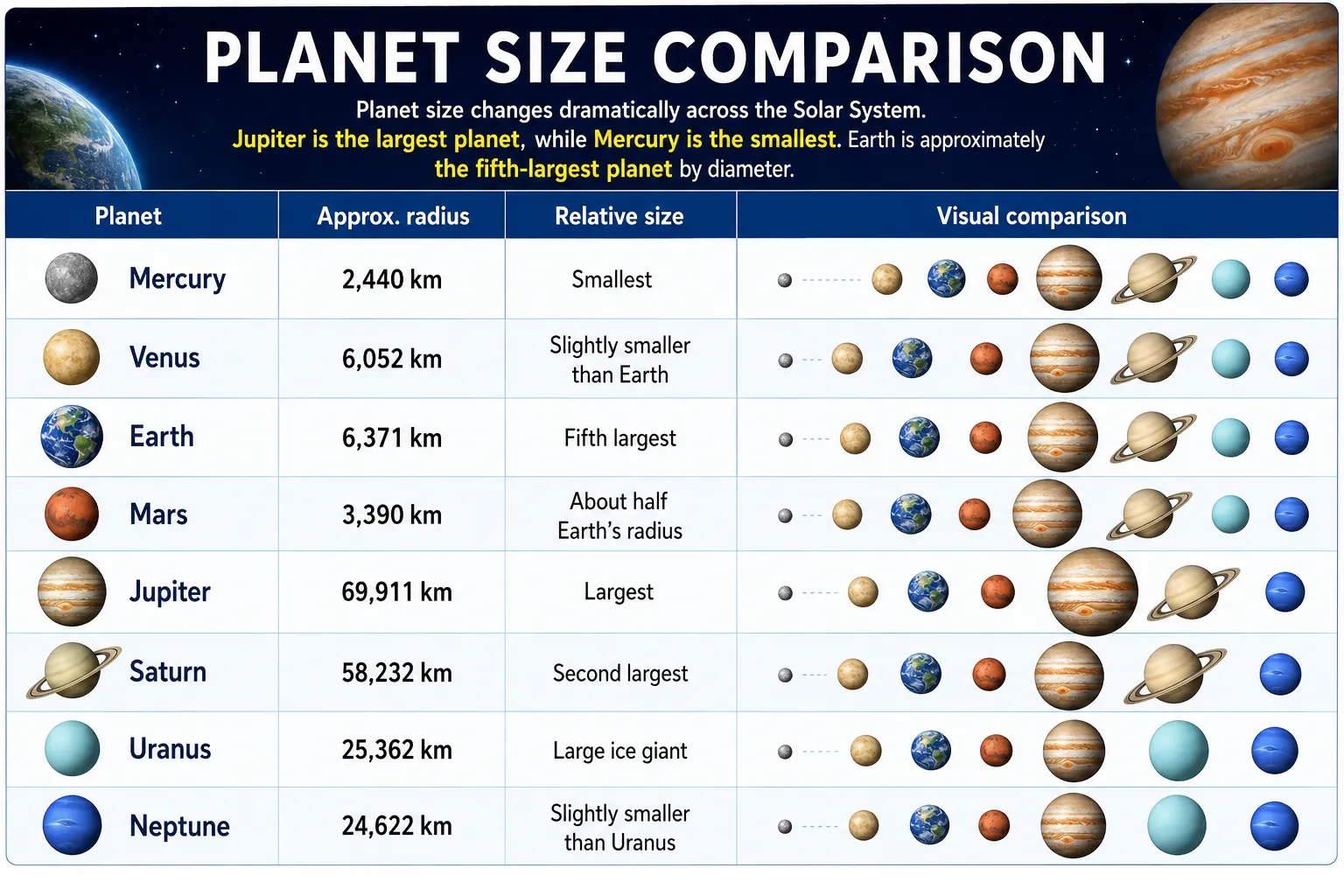 NASA's planetary size data shows that Jupiter's diameter is roughly 11 times Earth's, while Saturn's diameter is roughly nine times Earth's.
Which Planets Have Rings?
All four giant planets have ring systems:
Jupiter
Saturn
Uranus
Neptune
Saturn's rings are by far the most visually prominent, but the other giant planets also possess rings.
The four terrestrial planets: Mercury, Venus, Earth, and Mars — do not have planetary ring systems.
This distinction is useful because many people associate rings exclusively with Saturn.
Which Planets Have Moons?
The number of known moons changes as new objects are discovered and confirmed.
The four terrestrial planets have relatively few moons:
Mercury — none
Venus — none
Earth — one
Mars — two
The giant planets have much larger satellite systems.
Because moon counts are updated as new discoveries are confirmed, a static number can become outdated. NASA directs readers to the NASA/JPL Solar System Dynamics database for the latest tally of planetary satellites.
Why Is Pluto Not a Planet?
Pluto was discovered in 1930 and was originally classified as the ninth planet.
That changed in 2006, when the International Astronomical Union adopted a formal definition of a planet. Under that definition, a planet must:
Orbit the Sun.
Have enough gravity to become nearly round.
Have cleared the neighborhood around its orbit of other objects of comparable size.
Pluto satisfies the first two conditions but does not satisfy the third. It is therefore classified as a dwarf planet.
Pluto remains an important member of the Solar System. It is located in the Kuiper Belt, a distant region beyond Neptune containing many icy objects. NASA's New Horizons spacecraft conducted the first close flyby of Pluto in 2015.
So the modern list is:
Mercury → Venus → Earth → Mars → Jupiter → Saturn → Uranus → Neptune
Not:
Mercury → Venus → Earth → Mars → Jupiter → Saturn → Uranus → Neptune → Pluto
Pluto is a dwarf planet rather than one of the eight planets.
The Five Officially Recognized Dwarf Planets
NASA currently identifies five officially recognized dwarf planets in the Solar System:
Dwarf planet | General location |
Ceres | Asteroid Belt |
Pluto | Kuiper Belt |
Haumea | Kuiper Belt |
Makemake | Kuiper Belt |
Eris | Distant outer Solar System |
NASA notes that these are the five officially recognized dwarf planets, although there may be many additional dwarf-planet candidates.
Ceres is particularly interesting because it is the only officially recognized dwarf planet located in the inner Solar System. It lies in the asteroid belt between Mars and Jupiter.
How Did the Solar System Form?
The Solar System formed approximately 4.6 billion years ago from a cloud of gas and dust.
Gravity caused this material to collapse and form a rotating disk known as the solar nebula. Material concentrated toward the center eventually formed the Sun, while material in the surrounding disk collided and accumulated into increasingly large bodies. Some eventually became planets.
The arrangement of the planets is partly related to conditions in the early Solar System.
Close to the young Sun, temperatures were high enough that mainly rocky materials could remain solid. This helped produce the four inner rocky planets.
Farther from the Sun, colder conditions allowed more volatile materials to accumulate, contributing to the formation of the giant planets.
The result is the broad planetary arrangement we see today:
Rocky planets → Asteroid Belt → Gas giants → Ice giants → Kuiper Belt and distant Solar System
How to Remember the Planets in Order
The first letters of the eight planets are:
M V E M J S U N
A simple mnemonic can help:
My Very Educated Mother Just Served Us Noodles.
The first letter of each word corresponds to:
M — Mercury
V — Venus
E — Earth
M — Mars
J — Jupiter
S — Saturn
U — Uranus
N — Neptune
However, understanding the groups is often more useful than memorizing a sentence.
Think of the Solar System as:
4 rocky planets + 4 giant planets
Then remember the order within each group.
A Simple Way to Visualize the Solar System
From the Sun outward:
☀️ Sun
↓
1. Mercury — rocky
↓
2. Venus — rocky
↓
3. Earth — rocky
↓
4. Mars — rocky
↓
Asteroid Belt
↓
5. Jupiter — gas giant
↓
6. Saturn — gas giant
↓
7. Uranus — ice giant
↓
8. Neptune — ice giant
↓
Kuiper Belt
↓
Pluto and other distant objects
The distances in such diagrams are normally not shown to scale because the Solar System is enormous. NASA notes that educational Solar System illustrations often place the planets much closer together than they really are so that they can be displayed together.
Frequently Asked Questions
How many planets are in the Solar System?
There are eight officially recognized planets: Mercury, Venus, Earth, Mars, Jupiter, Saturn, Uranus, and Neptune.
What is the order of the planets?
From the Sun outward, the order is:
Mercury, Venus, Earth, Mars, Jupiter, Saturn, Uranus, Neptune.
Which planet is closest to the Sun?
Mercury is the closest planet to the Sun.
Which planet is farthest from the Sun?
Neptune is the farthest of the eight planets from the Sun.
Which is the largest planet?
Jupiter is the largest planet in the Solar System.
Which is the smallest planet?
Mercury is the smallest planet.
Which planet is hottest?
Venus is the hottest planet because its dense atmosphere produces an extremely strong greenhouse effect.
Which planet is known as the Red Planet?
Mars is known as the Red Planet because iron-bearing materials on its surface have oxidized, producing its characteristic reddish appearance.
Which planet has the most prominent rings?
Saturn is famous for its extensive and easily visible ring system. Jupiter, Uranus, and Neptune also have rings.
Is Pluto a planet?
No. Pluto is classified as a dwarf planet. The International Astronomical Union changed its classification in 2006.
Is Earth the only planet with life?
Earth is currently the only place where scientists have confirmed life. NASA's current Solar System overview states that Earth is the only place where life as we know it has been found.
Which planets are rocky?
The four rocky planets are:
Mercury, Venus, Earth, and Mars.
They are also called terrestrial planets.
Which planets are gas giants?
Jupiter and Saturn are gas giants.
Which planets are ice giants?
Uranus and Neptune are ice giants.
Test Your Knowledge
After reading this guide, try answering these questions without looking at the answers:
What is the first planet from the Sun?
Which planet is the largest?
Which planet is known as the Red Planet?
What is the third planet from the Sun?
Which two planets are gas giants?
Which two planets are ice giants?
Which planet has the most famous ring system?
Why is Pluto classified as a dwarf planet?
What is the farthest planet from the Sun?
Which planet is the hottest?
How many planets are officially recognized in the Solar System?
Which four planets are terrestrial planets?
A Solar System and Planets Quiz on can turn these facts into active-recall practice. Pairing a quiz with flashcards or a visual planet-order activity can make the information easier to retain.
Useful Quick Reference
Question | Answer |
Number of planets | 8 |
Closest planet to Sun | Mercury |
Farthest planet from Sun | Neptune |
Smallest planet | Mercury |
Largest planet | Jupiter |
Hottest planet | Venus |
Red Planet | Mars |
Planet with life currently known | Earth |
Planet famous for rings | Saturn |
Gas giants | Jupiter, Saturn |
Ice giants | Uranus, Neptune |
Rocky planets | Mercury, Venus, Earth, Mars |
Former ninth planet | Pluto |
Pluto's current classification | Dwarf planet |
Number of officially recognized dwarf planets | 5 |
Sources and References
NASA Science — About the Planets. Provides the current list of eight planets and information about terrestrial and giant planets.
NASA Science — Planet Sizes and Locations in Our Solar System. Provides the order of the planets and approximate distances from the Sun.
NASA Science — Solar System Facts. Provides information about Solar System formation, structure, terrestrial planets, gas giants, and ice giants.
NASA Science — Dwarf Planets. Explains the planetary definition and the five officially recognized dwarf planets.
NASA Science — Pluto. Provides information about Pluto's classification, location in the Kuiper Belt, moons, and New Horizons mission.
NASA Science — Solar System Sizes. Provides comparative planetary size information.
Practice Astronomy & Space
Keep learning with the topic hub tools after this article.