
Introduction
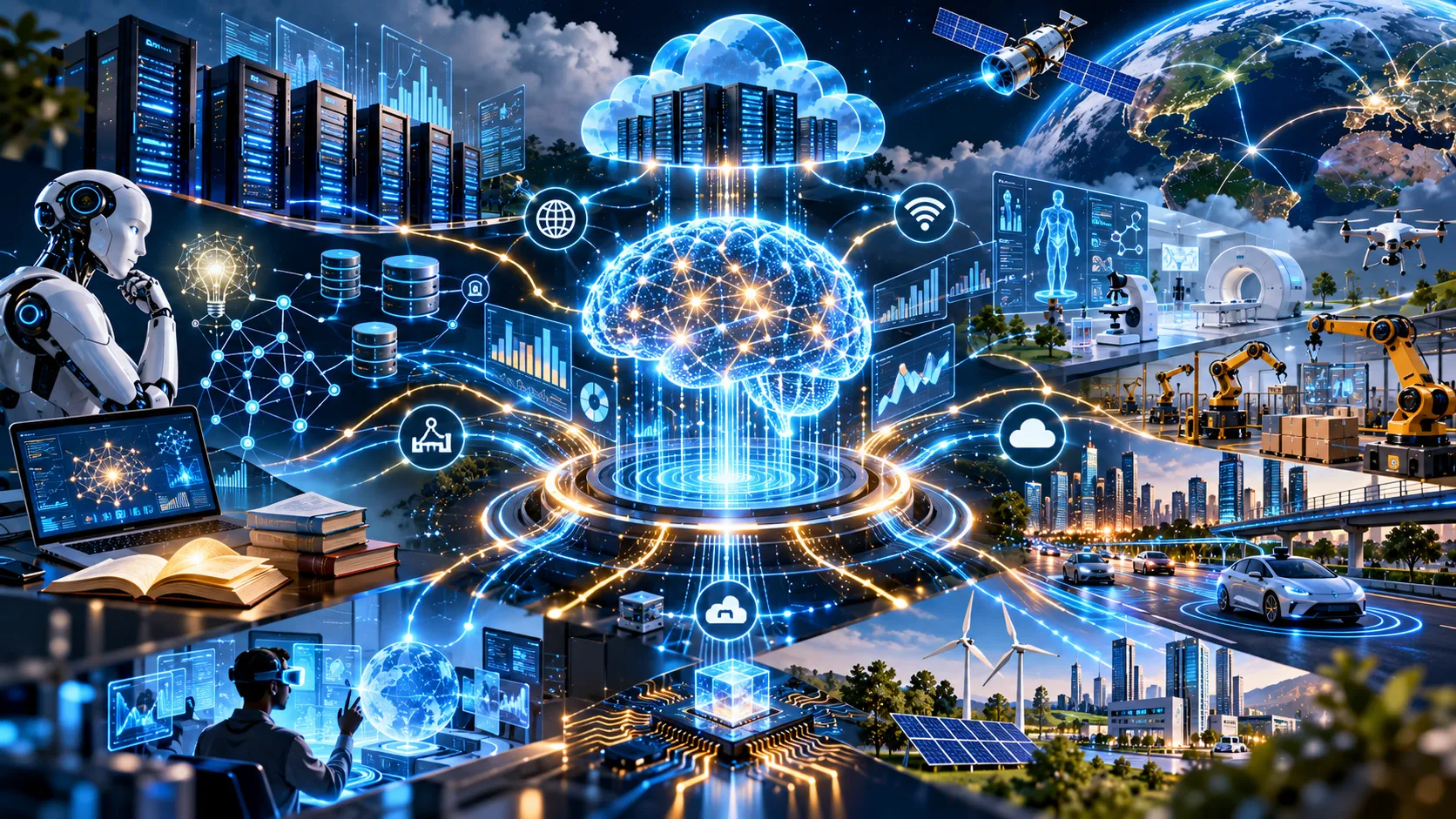
Artificial intelligence, data science, cloud computing, robotics, quantum computing, connected devices, and immersive technologies are changing how computers interact with people and the physical world. Although these technologies are often discussed separately, they increasingly work together.
An artificial-intelligence system may learn from large datasets stored in the cloud. Sensors in Internet of Things devices can continuously generate new data. Edge computers can process some of that information near where it is produced, while robots use software, sensors, and AI to interact with physical environments.
Understanding emerging technology requires more than memorizing fashionable terms. Students should know what each technology actually does, what problems it can solve, what limitations it has, and what risks can arise when it is deployed.
Learning Objectives
After studying this guide, you should be able to:
Distinguish artificial intelligence, machine learning, deep learning, and generative AI.
Explain how data is collected, stored, processed, analyzed, and used.
Describe cloud computing, edge computing, IoT, robotics, and blockchain.
Explain the basic idea behind quantum computing.
Compare virtual reality, augmented reality, and mixed reality.
Recognize important issues involving privacy, cybersecurity, bias, reliability, and responsible technology use.
What Is Artificial Intelligence?
Artificial intelligence, or AI, refers broadly to machine-based systems that perform tasks involving capabilities such as prediction, classification, recommendation, decision-making, language processing, perception, or content generation.
The OECD defines an AI system as a machine-based system that infers from inputs how to generate outputs such as predictions, content, recommendations, or decisions that can influence physical or virtual environments. Different systems can have different levels of autonomy and adaptability.
AI is therefore not one specific program or technique.
AI can appear in:
Search engines
Recommendation systems
Fraud detection
Medical-image analysis
Translation
Speech recognition
Autonomous machines
Generative AI tools
AI, Machine Learning, and Deep Learning
These terms are related but are not interchangeable.
Artificial Intelligence
AI is the broadest category.
It includes different techniques designed to make computer systems perform tasks associated with intelligent behavior.
Machine Learning
Machine learning, or ML, is a major branch of AI in which systems learn patterns from data rather than having every rule individually programmed.
The OECD describes machine learning as techniques that improve system performance through exposure to training data and can automatically produce models that identify patterns or regularities.
For example, instead of programming every possible feature of spam email, developers can train a model using examples of spam and legitimate messages.
Deep Learning
Deep learning is a form of machine learning based on multilayer artificial neural networks.
Deep-learning systems have become important in areas such as:
Computer vision
Speech recognition
Natural-language processing
Generative AI
A useful relationship is:
Artificial Intelligence → Machine Learning → Deep Learning
Deep learning is machine learning, but not all machine learning uses deep neural networks.
Training and Inference
Two important AI terms are training and inference.
Training
During training, a machine-learning model learns patterns from data.
The process may involve adjusting large numbers of numerical parameters so that the model performs a task more successfully.
Inference
Inference occurs when a trained model processes new input and generates an output.
For example:
Training: A model studies many labeled images of animals.
Inference: The trained model receives a new image and predicts whether it contains a cat or dog.
Generative AI
Generative AI produces new content based on patterns learned during training.
Possible outputs include:
Text
Images
Audio
Video
Computer code
Synthetic data
A generative model does not normally retrieve one memorized answer for every request. Instead, it uses learned statistical patterns to generate an output.
This flexibility is powerful, but it also creates risks. Generated information can be inaccurate, misleading, biased, or inappropriate.
NIST has developed a specialized Generative AI Profile as part of its AI Risk Management Framework to help organizations identify and manage risks associated with generative systems.
Large Language Models
A large language model, or LLM, is a machine-learning model trained on large quantities of language-related data.
LLMs learn statistical relationships among tokens, words, phrases, structures, and concepts.
They can perform tasks such as:
Answering questions
Summarizing text
Translating
Writing code
Classifying information
Generating documents
However, fluent language does not guarantee factual accuracy.
An AI-generated answer should therefore be checked when accuracy matters.
Data: The Foundation of Digital Systems
Data consists of recorded facts, measurements, symbols, observations, or other representations that computers can store and process.
Examples include:
Numbers
Text
Images
Video
Audio
GPS coordinates
Sensor readings
Transaction records
Data becomes valuable when it can be organized, interpreted, and used to answer questions or make decisions.
Structured and Unstructured Data
Structured Data
Structured data follows a predefined organization.
A database table containing customer IDs, dates, and prices is structured.
Unstructured Data
Unstructured data does not fit neatly into traditional rows and columns.
Examples include:
· Photographs
· Videos
· Emails
· Documents
· Audio recordings
Semi-Structured Data
Semi-structured data contains some organizational markers without using a rigid table structure.
Formats such as JSON are common examples.
Big Data
Big data refers to datasets whose scale or complexity creates challenges for traditional data-processing methods.
NIST describes big data in terms of the enormous quantities of data created by increasingly networked, digitized, sensor-rich systems, with major challenges involving volume, velocity, and variety.
These are often called the three Vs:
Volume = how much data
Velocity = how quickly data arrives
Variety = how many different forms it takes
Other frameworks sometimes add characteristics such as veracity and value.
The Data Lifecycle
Data generally passes through several stages.
A simplified lifecycle is:
Collect → Store → Clean → Process → Analyze → Use → Preserve or Delete
Collection
Data may come from surveys, sensors, websites, business transactions, experiments, or applications.
Cleaning
Real datasets often contain:
· Missing values
· Duplicate records
· Errors
· Inconsistent formats
Data cleaning improves quality before analysis.
Analysis
Analysts look for patterns, relationships, trends, and anomalies.
Interpretation
The final question is not simply what the data contains but what conclusions the evidence reasonably supports.
Poor-quality data can produce poor-quality results even when sophisticated AI is used.
Databases
A database is an organized system for storing and retrieving information.
Traditional relational databases often organize information into tables containing rows and columns.
A language such as SQL can be used to query and modify relational data.
Different applications may instead use document databases, graph databases, key-value stores, or other systems.
The appropriate technology depends on the structure and intended use of the data.
Data Science
Data science combines computing, statistics, mathematics, and subject-matter knowledge to extract useful information from data.
A data scientist might:
Identify a question.
Gather data.
Clean the dataset.
Explore patterns.
Build statistical or machine-learning models.
Evaluate results.
Communicate findings.
AI and data science overlap, but they are not identical.
A data-science project might use ordinary statistics without AI, while an AI system depends heavily on data during development or operation.
Cloud Computing
Cloud computing allows users to access computing resources through networks rather than owning and maintaining every physical system themselves.
NIST defines cloud computing around on-demand network access to a shared pool of configurable resources that can be rapidly provided and released.
Cloud resources can include:
Servers
Storage
Databases
Networking
Software
AI computing resources
IaaS, PaaS, and SaaS
Three traditional cloud service models are:
IaaS — Infrastructure as a Service
Provides computing infrastructure such as virtual machines and storage.
PaaS — Platform as a Service
Provides a platform for developing and running applications.
SaaS — Software as a Service
Provides complete software applications through network access.
Memory Tip
IaaS = infrastructure
PaaS = development platform
SaaS = finished software
Edge Computing
Edge computing moves some computation closer to where data is generated.
Suppose a factory has hundreds of sensors.
Instead of transmitting every raw measurement to a distant data center, an edge computer can analyze information locally and send only important results elsewhere.
Benefits can include:
Lower latency
Reduced network traffic
Faster responses
Greater local control
Cloud and edge computing are not necessarily competitors. Many systems use both.
Internet of Things
The Internet of Things, or IoT, refers to networks of connected physical devices containing computing, communication, sensing, or control capabilities.
NIST definitions include devices such as sensors, controllers, and household appliances that connect and exchange data.
Examples include:
Smart thermostats
Fitness trackers
Industrial sensors
Smart meters
Connected vehicles
Agricultural monitoring systems
IoT connects the physical world with digital networks.
Robotics
Robotics combines mechanical engineering, electronics, computing, sensing, and control.
A robot usually interacts physically with its environment.
Robots may contain:
Sensors
Motors
Cameras
Controllers
Software
AI systems
AI and robotics are related but different.
A chatbot can use AI without being a robot.
A traditional factory robot can perform programmed movements without using advanced AI.
Memory Tip
AI = intelligent information processing
Robot = physical machine capable of action
Autonomous Systems
An autonomous system can perform some tasks with reduced direct human control.
Possible examples include:
Warehouse robots
Drones
Automated vehicles
Industrial systems
Autonomy exists on a spectrum.
Some systems simply follow predefined rules, while others use sensors and AI to adapt their behavior.
Greater autonomy also increases the importance of safety testing, monitoring, accountability, and human oversight.
Blockchain
A blockchain is a distributed digital ledger in which records are grouped into blocks and cryptographically linked.
NIST describes blockchain as a shared, tamper-evident and tamper-resistant ledger maintained across participating systems according to agreed validation rules.
Blockchain became widely known because of cryptocurrencies, but the technology can also be applied to areas such as:
Record management
Supply-chain systems
Digital identity
Registries
Blockchain does not make information automatically true.
If false information is entered into a ledger, cryptography does not magically verify the real-world fact behind it.
Quantum Computing
Traditional computers use bits, which represent values such as 0 or 1. Quantum computers use quantum bits, or qubits. Qubits use quantum-mechanical properties such as superposition and entanglement.
Superposition
A quantum system can exist in combinations of states before measurement.
Entanglement
Quantum systems can have strongly linked states that cannot be completely described independently.
These properties allow specially designed quantum algorithms to approach some calculations very differently from conventional computers.
Quantum computers are not simply faster versions of normal computers.
They are designed for particular kinds of problems. Potential applications include simulations of molecules and materials, optimization, and certain mathematical calculations. Significant challenges remain in creating reliable, scalable quantum computers because quantum information is highly sensitive to noise.
Virtual, Augmented, and Mixed Reality
These technologies alter how users experience digital and physical environments.
Virtual Reality
Virtual reality, or VR, places the user inside a largely computer-generated environment.
Augmented Reality
Augmented reality, or AR, adds digital information to the user's view of the physical world.
Mixed Reality
Mixed reality, or MR, combines physical and digital elements so virtual objects can appear integrated with real environments.
NIST groups virtual, augmented, and mixed reality under the broader category of immersive technologies and notes applications in areas such as workforce development, accessibility, and healthcare.
How Emerging Technologies Work Together
Modern systems often combine several technologies.
Consider a smart factory:
IoT sensors collect measurements.
Edge computers analyze urgent information locally.
Cloud platforms store and process large datasets.
Data science identifies trends.
Machine learning predicts equipment failures.
Robots perform physical tasks.
AR systems may help technicians see repair instructions.
The important lesson is that emerging technologies increasingly form ecosystems rather than operating alone.
AI and Technology Risks
Powerful technologies can provide benefits while also introducing risks.
Bias
An AI model can produce unfair or inaccurate outcomes because of problems in:
Training data
Model design
Testing
Deployment context
Privacy
Large datasets can contain sensitive information about individuals.
Organizations must consider how information is collected, stored, shared, and protected.
Cybersecurity
Connected devices and cloud systems can become targets for unauthorized access and attack.
IoT devices can be especially challenging because large numbers of connected products may operate for years with different security capabilities.
Reliability
AI systems can produce incorrect outputs.
Robots and autonomous systems may face unexpected physical conditions.
Software therefore needs testing appropriate to the consequences of failure.
Transparency
Complex systems can make it difficult to understand why a particular result occurred.
Human Oversight
Automating a decision does not eliminate the need for human responsibility.
NIST's AI Risk Management Framework is designed to help organizations manage risks to individuals, organizations, and society throughout AI development and use.
Common Mistakes
Mistake 1: AI and Machine Learning Mean Exactly the Same Thing
False.
Machine learning is one major approach within the broader field of artificial intelligence.
Mistake 2: AI Understands Everything It Generates
False.
An AI system can produce convincing outputs without possessing human-style understanding or guaranteed factual accuracy.
Mistake 3: More Data Always Produces Better AI
False.
Data quality, relevance, representation, labeling, model design, and evaluation all matter.
Mistake 4: Cloud Computing Means Information Exists Somewhere Nonphysical
False.
Cloud services run on physical computing infrastructure located in data centers.
Mistake 5: All Robots Use Artificial Intelligence
False.
Some robots follow fixed programmed instructions without advanced AI.
Mistake 6: Blockchain and Cryptocurrency Are the Same
False.
Cryptocurrencies may use blockchains, but blockchain is a broader distributed-ledger technology.
Mistake 7: Quantum Computers Will Replace Ordinary Computers
Unlikely as a general rule.
Quantum systems are designed to provide advantages for certain specialized problems, while classical computing remains suitable for most everyday computing tasks.
Memory Tips
Remember the AI hierarchy:
AI → Machine Learning → Deep Learning
For AI operation:
Training = learn patterns
Inference = use the learned model
For data:
Collect → Clean → Analyze → Interpret
For infrastructure:
Cloud = remote shared computing
Edge = computing near the data source
IoT = connected physical devices
For immersive technology:
VR = replace the environment
AR = add to the environment
For computing:
Classical computer = bits
Quantum computer = qubits
Summary
Artificial intelligence, data, and emerging technologies form a connected technological ecosystem.
AI systems generate predictions, recommendations, decisions, or content from inputs. Machine learning allows systems to learn patterns from data, while deep learning uses multilayer neural networks. Generative AI extends these techniques to produce new text, images, audio, code, and other content.
Data science turns raw information into useful evidence through collection, cleaning, analysis, modeling, and interpretation. Cloud computing provides scalable remote computing resources, while edge computing processes information closer to where it originates.
IoT connects physical devices to digital networks, and robotics allows machines to act in the physical world. Blockchain provides distributed tamper-evident ledgers. Quantum computing applies principles of quantum mechanics to specialized computational problems, while VR, AR, and mixed reality change how people interact with digital information.
These technologies can improve productivity, scientific research, healthcare, communication, transportation, and many other fields. They also raise important questions involving security, privacy, bias, transparency, reliability, and human oversight.
Understanding emerging technology therefore requires knowing both what technology can do and how it should be evaluated and managed.
FAQ
1. What is artificial intelligence?
Artificial intelligence broadly refers to machine-based systems that generate outputs such as predictions, recommendations, decisions, or content from inputs.
2. What is machine learning?
Machine learning is an AI approach in which systems learn patterns from data instead of relying entirely on explicitly programmed rules.
3. What is generative AI?
Generative AI produces new content such as text, images, audio, video, or computer code based on patterns learned during training.
4. What is big data?
Big data refers to data whose scale, speed, or variety creates challenges that require scalable technologies and analytical methods.
5. What is cloud computing?
Cloud computing provides on-demand access to shared computing resources such as servers, storage, applications, and networks.
6. What is the Internet of Things?
IoT is the network of connected physical devices that can collect, exchange, or act upon data.
7. Is a robot the same as AI?
No. A robot is a physical machine capable of action, while AI refers to computational capabilities. Robots may or may not use AI.
8. What is blockchain?
Blockchain is a distributed ledger technology in which records are grouped and cryptographically linked to make unauthorized changes easier to detect and resist.
9. What is a qubit?
A qubit is a quantum unit of information used by quantum computers.
10. What is the difference between VR and AR?
VR replaces most of the user's perceived environment with a digital one, while AR adds digital content to a view of the physical world.
Key Takeaways
AI is the broad field; machine learning and deep learning are important subsets within it.
Data quality is essential because AI and analytics depend on reliable, relevant information.
Cloud, edge computing, IoT, robotics, and AI increasingly work together in connected systems.
Blockchain, quantum computing, and immersive technologies solve different problems and should not be treated as interchangeable forms of "advanced technology."
Emerging technologies bring opportunities as well as risks involving security, privacy, fairness, reliability, and human oversight.
References
OECD. Explanatory Memorandum on the Updated OECD Definition of an AI System. OECD — Definition of an AI System
National Institute of Standards and Technology. Artificial Intelligence Risk Management Framework (AI RMF 1.0). NIST — AI Risk Management Framework
National Institute of Standards and Technology. NIST Big Data Interoperability Framework: Volume 1, Definitions. NIST — Big Data Definitions
National Institute of Standards and Technology. The NIST Definition of Cloud Computing. NIST — Cloud Computing Definition
National Institute of Standards and Technology. Internet of Things — CSRC Glossary. NIST — Internet of Things
National Institute of Standards and Technology. Blockchain. NIST — Blockchain Technology
National Institute of Standards and Technology. Blockchain Technology Overview. NIST — Blockchain Technology Overview
National Institute of Standards and Technology. Quantum Information Science. NIST — Quantum Information Science
U.S. Department of Energy, Office of Science. DOE Explains...Quantum Computing. U.S. Department of Energy — Quantum Computing
National Institute of Standards and Technology. Securing Emerging Technologies. NIST — Emerging and Immersive Technologies