
How Many Countries Are There in the World?
The United Nations has 193 Member States. South Sudan became the 193rd UN Member State on July 14, 2011.
In addition, two entities have UN non-member observer-state status:
Holy See
State of Palestine
The UN identifies both as non-member states with standing invitations to participate as observers in the work of the General Assembly. Palestine received non-member observer-state status through General Assembly Resolution 67/19 in 2012.
Therefore:
193 UN Member States + 2 UN observer states = 195
This is the convention used throughout this article.
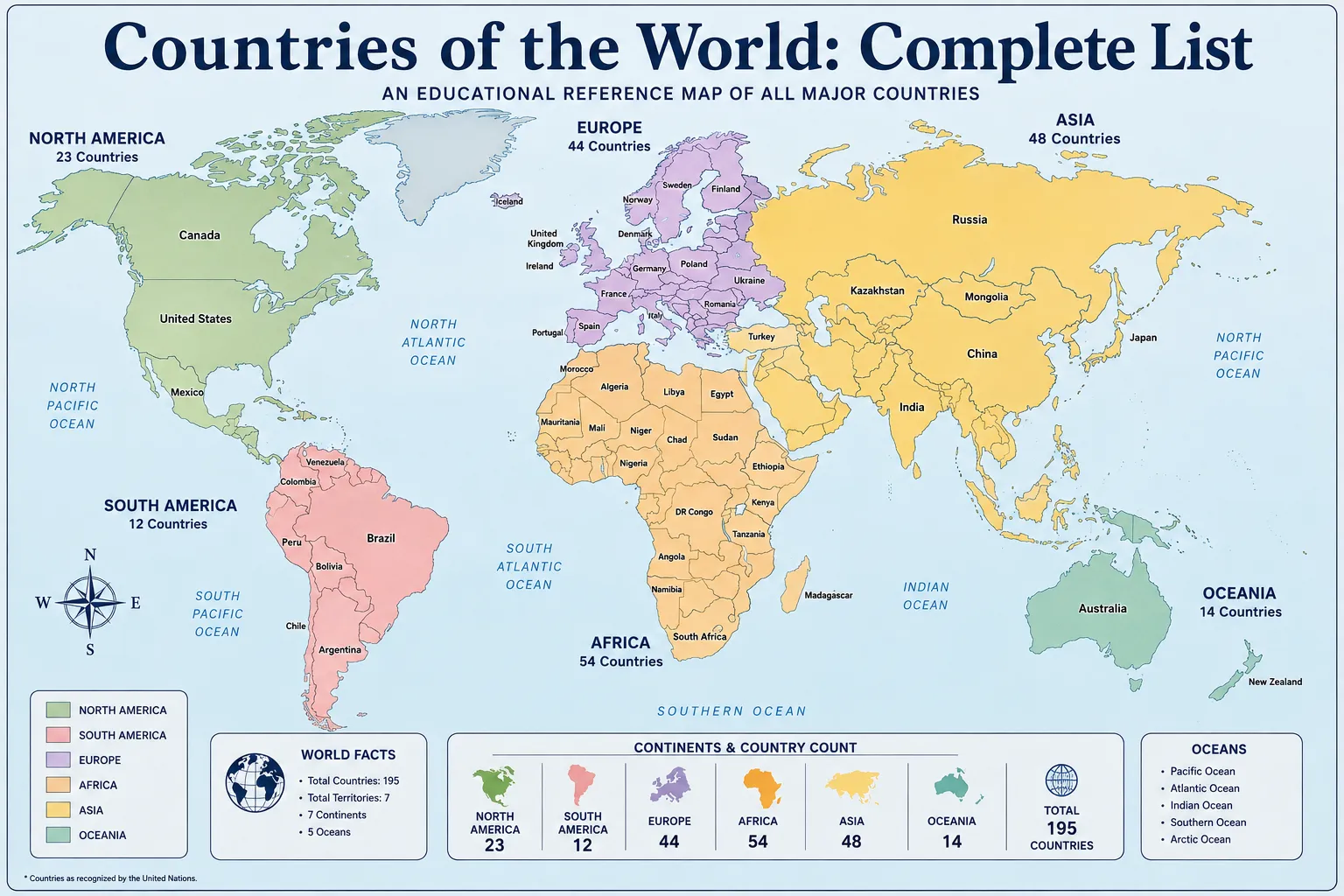
Complete List of 195 Countries
The following list is arranged alphabetically for easy reference.
SN | Country |
1 | Afghanistan |
2 | Albania |
3 | Algeria |
4 | Andorra |
5 | Angola |
6 | Antigua and Barbuda |
7 | Argentina |
8 | Armenia |
9 | Australia |
10 | Austria |
11 | Azerbaijan |
12 | Bahamas |
13 | Bahrain |
14 | Bangladesh |
15 | Barbados |
16 | Belarus |
17 | Belgium |
18 | Belize |
19 | Benin |
20 | Bhutan |
21 | Bolivia |
22 | Bosnia and Herzegovina |
23 | Botswana |
24 | Brazil |
25 | Brunei |
26 | Bulgaria |
27 | Burkina Faso |
28 | Burundi |
29 | Cabo Verde |
30 | Cambodia |
31 | Cameroon |
32 | Canada |
33 | Central African Republic |
34 | Chad |
35 | Chile |
36 | China |
37 | Colombia |
38 | Comoros |
39 | Congo, Democratic Republic of the |
40 | Congo, Republic of the |
41 | Costa Rica |
42 | Côte d'Ivoire |
43 | Croatia |
44 | Cuba |
45 | Cyprus |
46 | Czechia |
47 | Denmark |
48 | Djibouti |
49 | Dominica |
50 | Dominican Republic |
51 | Ecuador |
52 | Egypt |
53 | El Salvador |
54 | Equatorial Guinea |
55 | Eritrea |
56 | Estonia |
57 | Eswatini |
58 | Ethiopia |
59 | Fiji |
60 | Finland |
61 | France |
62 | Gabon |
63 | Gambia |
64 | Georgia |
65 | Germany |
66 | Ghana |
67 | Greece |
68 | Grenada |
69 | Guatemala |
70 | Guinea |
71 | Guinea-Bissau |
72 | Guyana |
73 | Haiti |
74 | Honduras |
75 | Hungary |
76 | Iceland |
77 | India |
78 | Indonesia |
79 | Iran |
80 | Iraq |
81 | Ireland |
82 | Israel |
83 | Italy |
84 | Jamaica |
85 | Japan |
86 | Jordan |
87 | Kazakhstan |
88 | Kenya |
89 | Kiribati |
90 | Kuwait |
91 | Kyrgyzstan |
92 | Laos |
93 | Latvia |
94 | Lebanon |
95 | Lesotho |
96 | Liberia |
97 | Libya |
98 | Liechtenstein |
99 | Lithuania |
100 | Luxembourg |
101 | Madagascar |
102 | Malawi |
103 | Malaysia |
104 | Maldives |
105 | Mali |
106 | Malta |
107 | Marshall Islands |
108 | Mauritania |
109 | Mauritius |
110 | Mexico |
111 | Micronesia |
112 | Moldova |
113 | Monaco |
114 | Mongolia |
115 | Montenegro |
116 | Morocco |
117 | Mozambique |
118 | Myanmar |
119 | Namibia |
120 | Nauru |
121 | Nepal |
122 | Netherlands |
123 | New Zealand |
124 | Nicaragua |
125 | Niger |
126 | Nigeria |
127 | North Korea |
128 | North Macedonia |
129 | Norway |
130 | Oman |
131 | Pakistan |
132 | Palau |
133 | Palestine |
134 | Panama |
135 | Papua New Guinea |
136 | Paraguay |
137 | Peru |
138 | Philippines |
139 | Poland |
140 | Portugal |
141 | Qatar |
142 | Romania |
143 | Russia |
144 | Rwanda |
145 | Saint Kitts and Nevis |
146 | Saint Lucia |
147 | Saint Vincent and the Grenadines |
148 | Samoa |
149 | San Marino |
150 | São Tomé and Príncipe |
151 | Saudi Arabia |
152 | Senegal |
153 | Serbia |
154 | Seychelles |
155 | Sierra Leone |
156 | Singapore |
157 | Slovakia |
158 | Slovenia |
159 | Solomon Islands |
160 | Somalia |
161 | South Africa |
162 | South Korea |
163 | South Sudan |
164 | Spain |
165 | Sri Lanka |
166 | Sudan |
167 | Suriname |
168 | Sweden |
169 | Switzerland |
170 | Syria |
171 | Tajikistan |
172 | Tanzania |
173 | Thailand |
174 | Timor-Leste |
175 | Togo |
176 | Tonga |
177 | Trinidad and Tobago |
178 | Tunisia |
179 | Türkiye |
180 | Turkmenistan |
181 | Tuvalu |
182 | Uganda |
183 | Ukraine |
184 | United Arab Emirates |
185 | United Kingdom |
186 | United States |
187 | Uruguay |
188 | Uzbekistan |
189 | Vanuatu |
190 | Vatican City |
191 | Venezuela |
192 | Vietnam |
193 | Yemen |
194 | Zambia |
195 | Zimbabwe |
The UN's official Member States list confirms the 193-member total, while the UN separately identifies the Holy See and State of Palestine as non-member observer states.
Countries of the World by Continent
Continental classifications can vary for a few transcontinental countries. The grouping below follows a conventional geography approach rather than treating continent boundaries as political classifications.
Africa
Africa is home to 54 countries under the commonly used sovereign-country count.
Algeria
Angola
Benin
Botswana
Burkina Faso
Burundi
Cabo Verde
Cameroon
Central African Republic
Chad
Comoros
Côte d'Ivoire
Democratic Republic of the Congo
Djibouti
Egypt
Equatorial Guinea
Eritrea
Eswatini
Ethiopia
Gabon
Gambia
Ghana
Guinea
Guinea-Bissau
Kenya
Lesotho
Liberia
Libya
Madagascar
Malawi
Mali
Mauritania
Mauritius
Morocco
Mozambique
Namibia
Niger
Nigeria
Republic of the Congo
Rwanda
São Tomé and Príncipe
Senegal
Seychelles
Sierra Leone
Somalia
South Africa
South Sudan
Sudan
Tanzania
Togo
Tunisia
Uganda
Zambia
Zimbabwe
Asia
Asia contains the world's largest and most populous countries, including China and India.
Afghanistan
Armenia
Azerbaijan
Bahrain
Bangladesh
Bhutan
Brunei
Cambodia
China
Cyprus
Georgia
India
Indonesia
Iran
Iraq
Israel
Japan
Jordan
Kazakhstan
Kuwait
Kyrgyzstan
Laos
Lebanon
Malaysia
Maldives
Mongolia
Myanmar
Nepal
North Korea
Oman
Pakistan
Palestine
Philippines
Qatar
Saudi Arabia
Singapore
South Korea
Sri Lanka
Syria
Tajikistan
Thailand
Timor-Leste
Türkiye
Turkmenistan
United Arab Emirates
Uzbekistan
Vietnam
Yemen
Russia is geographically transcontinental, spanning Europe and Asia, while countries such as Armenia, Azerbaijan, Georgia, Kazakhstan, and Türkiye may be classified differently depending on the geographic convention used.
The UN's M49 system uses its own statistical regional classifications and explicitly notes that these groupings are intended for statistical convenience rather than expressing political or territorial judgments.
Europe
Albania
Andorra
Austria
Belarus
Belgium
Bosnia and Herzegovina
Bulgaria
Croatia
Czechia
Denmark
Estonia
Finland
France
Germany
Greece
Hungary
Iceland
Ireland
Italy
Latvia
Liechtenstein
Lithuania
Luxembourg
Malta
Moldova
Monaco
Montenegro
Netherlands
North Macedonia
Norway
Poland
Portugal
Romania
Russia
San Marino
Serbia
Slovakia
Slovenia
Spain
Sweden
Switzerland
Ukraine
United Kingdom
Vatican City
North America
For this article, North America includes the countries of Central America and the Caribbean as well as the northern part of the continent.
Antigua and Barbuda
Bahamas
Barbados
Belize
Canada
Costa Rica
Cuba
Dominica
Dominican Republic
El Salvador
Grenada
Guatemala
Haiti
Honduras
Jamaica
Mexico
Nicaragua
Panama
Saint Kitts and Nevis
Saint Lucia
Saint Vincent and the Grenadines
Trinidad and Tobago
United States
South America
Argentina
Bolivia
Brazil
Chile
Colombia
Ecuador
Guyana
Paraguay
Peru
Suriname
Uruguay
Venezuela
Oceania
Australia
Fiji
Kiribati
Marshall Islands
Micronesia
Nauru
New Zealand
Palau
Papua New Guinea
Samoa
Solomon Islands
Tonga
Tuvalu
Vanuatu
Why Do Some Lists Have More Than 195 Countries?
The number 195 is a useful convention, but it is not the only number readers may encounter.
The main reason is that "country" does not have one universally applicable definition for every purpose.
The UN M49 database, for example, is a statistical classification of "countries or areas." Its list includes sovereign states alongside territories and other areas used for statistical reporting. The UN specifically cautions that these classifications do not imply a position on the legal status of a country, territory, city, or area.
Consequently, a database designed for statistics may contain considerably more entries than a geography quiz asking for sovereign countries.
Why Isn't Every Territory a Country?
Many places have their own governments, populations, flags, currencies, or geographical identities but are not generally counted as independent sovereign countries.
Examples include:
Puerto Rico
Greenland
Bermuda
Guam
Aruba
Hong Kong
Macao
Faroe Islands
These places can appear in international datasets, but including them in a "countries of the world" list would mix sovereign states with territories and special administrative regions.
That is why a well-designed geography resource should state its definition before giving a number.
Countries and Territories Are Not the Same
A sovereign state generally has its own government and exercises authority over its territory, while a dependent territory is subject to another sovereign state's authority.
This distinction matters when creating educational databases.
For example, the United States and Puerto Rico may both appear in some international datasets, but they should not automatically be treated as equivalent entries in a list of independent countries.
The UN M49 system deliberately uses the broader term "country or area" because it is designed for statistical purposes rather than as a definitive political list.
Countries With Special or Disputed Status
Some places frequently appear in alternative country lists because their political status is contested or their international recognition differs between governments.
Examples include Kosovo and Taiwan.
They are important geographical and political entities, but they are not included in this article's 195-country count.
This does not mean that they are geographically unimportant. It simply means that the article is using the specific 195-country convention described at the beginning.
When publishing educational content, it is better to explain this distinction than to silently mix different definitions.
Country Names Can Change
Country names are not completely static.
For example:
Türkiye is the country's official name used by the United Nations rather than "Turkey" in many official contexts.
Czechia is the UN short-form country name rather than "Czech Republic."
Eswatini replaced the former English country name "Swaziland."
North Macedonia replaced the former constitutional name "Macedonia" after the Prespa Agreement.
Cabo Verde is the current English short-form name used by the UN rather than "Cape Verde."
The UN M49 database explains that its country names generally use the short forms used in day-to-day UN operations rather than necessarily the complete formal state names.
For educational websites, keeping a standardized country-name field is therefore useful.
Countries With Long or Easily Confused Names
Some country names are particularly easy to confuse.
Congo
There are two countries containing "Congo":
Democratic Republic of the Congo
Republic of the Congo
Their capitals are also different:
Democratic Republic of the Congo — Kinshasa
Republic of the Congo — Brazzaville
Guinea
Three countries contain Guinea in their English names:
Guinea
Guinea-Bissau
Equatorial Guinea
Papua New Guinea is a fourth country containing "Guinea."
Korea
There are two sovereign states on the Korean Peninsula:
North Korea
South Korea
Their formal names are the Democratic People's Republic of Korea and the Republic of Korea respectively.
Saint countries
The Caribbean includes three countries beginning with "Saint":
Saint Kitts and Nevis
Saint Lucia
Saint Vincent and the Grenadines
These should not be confused with nearby territories or islands.
What Is the Smallest Country in the World?
Vatican City is generally recognized as the world's smallest sovereign state by area and population.
It is located entirely within the city of Rome, Italy, and is the headquarters of the Holy See.
The Holy See is the entity that holds UN observer-state status, while Vatican City is the sovereign territory associated with it. For a general 195-country geography list, Vatican City is commonly included as the country entry.
What Is the Largest Country in the World?
Russia is the world's largest country by total area.
It spans eastern Europe and northern Asia and covers an enormous territory across multiple time zones.
What Is the Most Populous Country?
India is currently the world's most populous country, having surpassed China in population according to widely used UN population estimates.
Population rankings should be treated as time-sensitive because population totals change continuously.
Why Country Lists Are Useful for Geography
A country list is more than a reference table.
Knowing the countries of the world provides the foundation for studying:
World capitals
Flags
Continents
Languages
Currencies
Population
Geography
International organizations
History
Political geography
Current affairs
Once students know the countries, they can build more complex geographic knowledge around them.
For example, knowing that Nepal is a country is only the beginning. A geography learner can then connect Nepal with its capital, neighboring countries, Himalayan geography, language, currency, history, and political system.
How to Learn the Countries of the World
Trying to memorize 195 countries in one sitting is usually ineffective.
A better strategy is to divide them into geographic groups.
Step 1: Learn by continent
Start with one continent at a time. Africa, for example, contains 54 countries, making it useful to divide further into North, West, Central, East, and Southern Africa.
Step 2: Use maps
Seeing a country's location helps connect its name with its neighbors and physical geography.
Step 3: Practice active recall
Instead of repeatedly reading a list, hide the answers and try to recall them.
Step 4: Mix the questions
Once you know the basics, don't always study in alphabetical order. Randomized questions make recall more difficult and therefore more useful.
Step 5: Add capitals and flags
After learning the country names, connect each country with its capital and flag.
This creates a much stronger geographic knowledge network than memorizing isolated facts.
Frequently Asked Questions
How many countries are there in the world?
The commonly used educational count is 195 countries: 193 UN Member States plus the Holy See and the State of Palestine, which are UN non-member observer states.
Are there 193 or 195 countries?
Both numbers can be correct depending on the definition. The UN has 193 Member States. Adding the two UN non-member observer states gives the commonly used total of 195.
Is Palestine a country?
Palestine has UN non-member observer-state status. It is therefore included in the 195-country convention used in this article.
Is Vatican City a country?
Vatican City is a sovereign state. The associated entity, the Holy See, holds permanent observer status at the United Nations.
Why do some websites list more than 195 countries?
They may include territories, dependencies, or entities with disputed or limited international recognition. The UN's M49 statistical system, for example, contains countries and areas rather than only sovereign states.
Is Kosovo included in the 195 countries?
No. Kosovo is not included in this particular 195-country convention. Different country lists may treat Kosovo differently depending on their recognition criteria.
Is Taiwan included in the 195 countries?
No. Taiwan is not included in this particular 195-country convention. Different political and geographical reference systems may handle Taiwan differently.
Which country is the largest?
Russia is the world's largest country by area.
Which country is the smallest?
Vatican City is the world's smallest sovereign state by area.
Which country has the largest population?
India is currently the world's most populous country. Population rankings can change over time, so current population claims should be dated and sourced.
Test Your Knowledge
After studying the list, try answering these questions without looking back:
How many UN Member States are there?
What are the two UN non-member observer states?
Which country is the largest by area?
Which country is the smallest sovereign state?
Which two countries contain "Congo" in their names?
Which three countries begin with "Saint"?
Which country changed its English short name from Swaziland to Eswatini?
Which country is officially referred to as Türkiye by the UN?
How many countries are commonly counted in the standard 195-country list?
Why might another database contain more than 195 country or area entries?
Use the Countries of the World quiz on QuizzesForBrain to turn this reference list into active-recall practice. You can also combine it with world capitals, flags, and geography quizzes to reinforce the information.
Useful Quick Reference
Category | Number / Example |
UN Member States | 193 |
UN non-member observer states | 2 |
Common educational country count | 195 |
Observer states | Holy See and State of Palestine |
Largest country by area | Russia |
Smallest sovereign state | Vatican City |
Most populous country | India |
Continents represented by sovereign countries | Africa, Asia, Europe, North America, South America, Oceania |