


Introduction
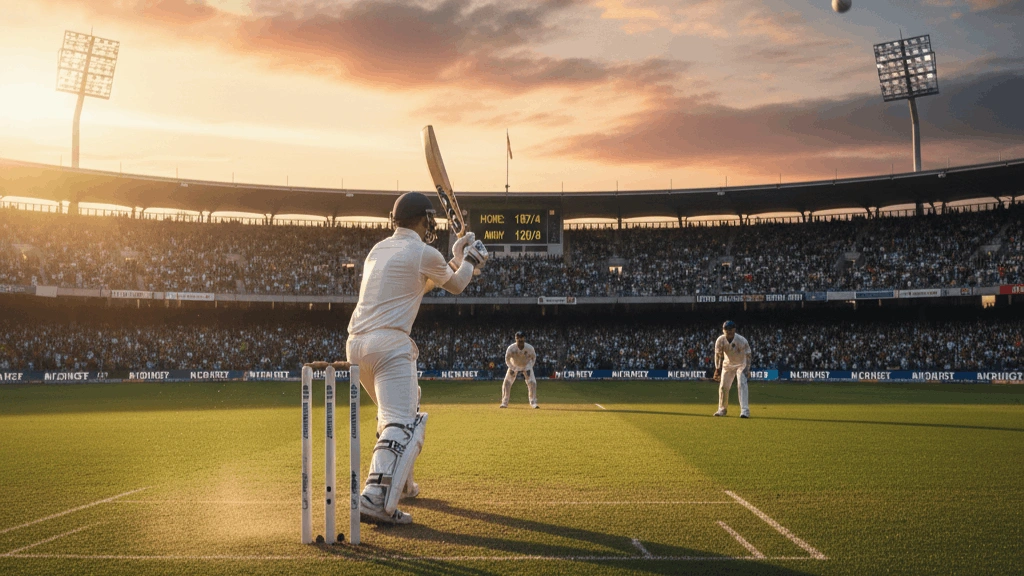
Cricket is a bat-and-ball sport played between two teams, normally with 11 players on each side. One team bats and tries to score runs, while the other bowls and fields in an attempt to dismiss the batters and limit scoring.
Cricket is unusual because it exists in several major formats. Test cricket can last up to five days, One Day Internationals (ODIs) normally give each team 50 overs, and Twenty20 Internationals (T20Is) normally give each team 20 overs.
The sport combines individual contests between batter and bowler with complex team strategy. Understanding runs, wickets, overs, dismissals, extras, field positions, and innings provides the foundation for following almost any cricket match.
Learning Objectives
After studying this guide, you should be able to:
· Explain the basic objective, field, pitch, wickets, and innings of cricket.
· Describe how runs are scored and how overs work.
· Identify important batting, bowling, and fielding skills.
· Explain common dismissals such as bowled, caught, run out, stumped, and LBW.
· Distinguish Test, ODI, and T20 cricket.
· Interpret common cricket statistics such as batting average, strike rate, economy rate, and bowling figures.
The Basic Objective
The batting team tries to score as many runs as possible.
The fielding team tries to:
· Dismiss batters.
· Prevent runs.
· Complete the innings as efficiently as possible.
After the teams have completed their allotted innings, their totals are compared.
In a limited-overs match, the team batting second usually wins by passing the first team's total before losing all available wickets or using all its overs.
The Cricket Ground
Cricket is usually played on a large oval or roughly circular grass field.
At the center is the pitch.
A regulation pitch is:
22 yards (20.12 m) long
and approximately:
10 feet (3.05 m) wide
A wicket stands at each end.
The Wicket
A wicket consists of:
· Three vertical stumps
· Two horizontal bails
The word wicket has several meanings in cricket.
It can refer to:
1. The physical stumps and bails.
2. A batter's dismissal.
3. Informally, the pitch or playing surface.
Context tells you which meaning is intended.
Batters and Bowlers
Two batters are on the field at the same time.
The striker faces the delivery.
The non-striker waits at the opposite end.
A bowler delivers the ball toward the striker's wicket.
After an over, bowling normally switches to the opposite end of the pitch.
What Is an Over?
An over consists of six valid deliveries bowled by the same bowler.
After six valid balls, another bowler delivers the next over from the opposite end.
MCC Law 17 specifies overs of six valid balls. No-balls and wides do not count as one of those six valid deliveries.
Example
A scoreboard showing:
15.3 overs
does not mean 15.3 decimal overs.
It means:
15 complete overs + 3 balls
Since an over contains six balls:
15.3 = 93 valid deliveries
How Runs Are Scored
The basic unit of scoring is the run.
Batters can score by running between the wickets after the ball is played.
If both batters safely reach the opposite ends:
1 run
If they return again:
2 runs
and so on.
Boundaries
Batters can score without running if the ball reaches the boundary.
Four
If the ball reaches or crosses the boundary after touching the ground:
4 runs
Six
If the ball crosses the boundary without touching the ground after being hit by the bat:
6 runs
A six is therefore the highest normal score from a single legal hit.
Extras
Not every run is credited to the batter.
Runs awarded to the team rather than directly to the batter are called extras.
Major types include:
· No-balls
· Wides
· Byes
· Leg byes
· Penalty runs
No-Ball
A no-ball is an illegal delivery.
Reasons can include an illegal bowling action, certain foot faults, or other infringements defined by the Laws.
A no-ball gives the batting team a one-run penalty, and the delivery normally does not count as one of the six valid balls in the over.
In international limited-overs cricket, particular no-balls can also lead to a free hit under ICC playing conditions.
Wide
A wide is called when a legal delivery passes too far from the striker for a normal cricket stroke under the applicable law and playing conditions.
The batting side receives an extra run.
A wide also does not count as a valid delivery in the over.
Byes and Leg Byes
Bye
A bye can be scored when a legal delivery passes the batter without touching the bat or person and the batters run.
Leg Bye
A leg bye can be scored when the ball touches the batter's body under the conditions allowed by the Laws and the batters complete runs.
These runs are added to the team total but not to the batter's individual score.
Batting
Batting combines technique, judgment, concentration, and shot selection.
Important batting skills include:
· Defensive strokes
· Drives
· Cuts
· Pulls
· Hooks
· Sweeps
· Running between wickets
Defensive Shot
A defensive shot is designed mainly to prevent the ball from hitting the wicket or creating a catching opportunity.
Drive
A drive is generally played with a full swing through the ball, often toward straight or cover regions.
Cut
A cut is usually played to a shorter ball outside the off stump, directing it toward the point region.
Pull
A pull shot attacks a short ball, commonly toward the leg side.
Sweep
A sweep is often used against spin bowling, with the batter swinging across the body toward the leg side.
Bowling
Bowling is not simply throwing the ball.
MCC laws regulate the bowling action, including restrictions on straightening the elbow during the delivery motion.
Two broad categories dominate cricket.
Fast and Seam Bowling
Fast bowlers use speed, bounce, seam movement, and sometimes swing through the air.
Common deliveries include:
· Yorker
· Bouncer
· Good-length ball
· Slower ball
A yorker pitches very close to the batter's feet or popping crease.
A bouncer is deliberately short and rises toward the batter.
Spin Bowling
Spin bowlers use finger or wrist action to make the ball rotate and change direction after pitching.
Important varieties include:
· Off spin
· Leg spin
· Left-arm orthodox spin
· Left-arm wrist spin
Spin bowling often depends more on flight, turn, deception, and changes of pace than raw speed.
Fielding
The fielding side positions players around the ground according to the bowler, batter, match situation, and strategy.
Important positions include:
· Wicketkeeper
· Slip
· Gully
· Point
· Cover
· Mid-off
· Mid-on
· Midwicket
· Square leg
· Fine leg
· Third
· Long-on
· Long-off
Field positions can move closer or deeper depending on tactics.
The Wicketkeeper
The wicketkeeper stands behind the striker's wicket.
The keeper:
· Collects balls missed by the batter.
· Takes catches.
· Attempts stumpings.
· Participates in run-outs.
· Helps organize fielding.
Special wicketkeeping gloves and protective equipment are normally used.
Off Side and Leg Side
The field is commonly divided relative to the striker.
For a right-handed batter:
Off side = generally the batter's right side.
Leg side/on side = generally the batter's left side.
The relationship reverses for a left-handed batter.
This distinction is essential for understanding fielding positions and tactics.
How a Batter Can Be Dismissed
A dismissal is commonly described as taking a wicket.
Several methods exist.
Bowled
The batter is bowled when a legal delivery hits the wicket and puts it down.
Caught
The batter is caught if the ball is hit by the bat and legally caught by a fielder before touching the ground.
Run Out
A batter can be run out when the wicket is fairly broken while that batter is outside the safe ground and the applicable conditions are met.
Stumped
A stumping occurs when the wicketkeeper puts down the striker's wicket while the striker is out of the ground and not attempting a run, under the conditions of the Law.
LBW
LBW means leg before wicket.
It prevents a batter from unfairly protecting the wicket with the body.
For LBW to apply, several conditions must be satisfied, including that the delivery is not a no-ball, the ball meets rules concerning where it pitched and struck the batter, and the ball would otherwise have hit the wicket.
LBW is therefore more complicated than:
"The ball hit the batter's leg."
The ball can also strike another part of the batter's body.
Other Dismissals
Less common dismissals include:
· Hit wicket
· Hit the ball twice
· Obstructing the field
· Timed out
Cricket historically contained additional dismissal terminology that has been revised or incorporated into other Laws over time.
Innings
An innings is a team's or batter's period of batting.
Notice the spelling:
One innings
Two innings
The word already ends in s.
A team innings ends when conditions such as these apply:
· Ten wickets have fallen.
· The permitted overs have been completed.
· The captain declares in formats where declarations are allowed.
· A target has been reached.
· Other match-specific conditions apply.
Why only ten wickets if there are eleven players?
Because batting requires two batters. Once ten are out, only one remains and cannot continue alone.
Test Cricket
Test cricket is the longest major international format.
Modern Tests are scheduled for up to five days, with each team normally able to bat twice.
Tests can end as:
· Win
· Loss
· Draw
· Tie
A draw means the allotted time ends before a result is completed.
A tie means both teams finish with exactly equal completed scores under the conditions required for a tie.
They are not the same thing.
One Day International Cricket
An ODI normally gives each team:
50 overs
and:
One innings
The team scoring more runs wins.
Because overs are limited, batters must balance wicket preservation with faster scoring.
ODIs became established internationally from the 1970s onward.
Twenty20 Cricket
A T20 match normally gives each team:
20 overs
T20 encourages aggressive batting, specialized bowling variations, athletic fielding, and rapid tactical decisions.
An international T20 is known as a T20I.
ICC international cricket currently recognizes Test, ODI, and T20I as the three main international formats.
Test vs. ODI vs. T20
Feature | Test | ODI | T20 |
Maximum scheduled length | 5 days | About 1 day | About 3 hours |
Innings per team | Usually 2 | 1 | 1 |
Overs per innings | No fixed ordinary limit | 50 | 20 |
Clothing tradition | Usually whites | Usually colored | Usually colored |
Main tactical challenge | Long-term endurance and wickets | Balance attack and preservation | Rapid scoring and pressure |
Exact international playing conditions can change, and the ICC maintains separate current regulations for men's and women's Tests, ODIs, and T20Is.
The Toss
Before a match, the captains normally conduct a coin toss.
The winning captain chooses whether to:
· Bat first, or
· Field/bowl first.
The decision may depend on:
· Pitch condition
· Weather
· Expected deterioration
· Dew
· Team strengths
· Match format
The Pitch and Conditions
Cricket is unusually affected by playing conditions.
A dry pitch may assist spin.
Grass may assist seam movement.
Cloud or atmospheric conditions can influence swing.
As a Test progresses, the surface may wear and change.
The ICC formally rates pitches and outfields used in international matches, with substandard surfaces potentially leading to sanctions.
Batting Statistics
Runs
The total number of runs scored by a batter.
Batting Average
A simplified formula is:
Batting average = total runs ÷ number of times dismissed
Not every innings necessarily ends in dismissal.
Strike Rate
In limited-overs cricket:
Strike rate = runs ÷ balls faced × 100
A strike rate of 150 means 150 runs per 100 balls at the same scoring pace.
Century
A batter scores a century by reaching 100 runs in one innings.
Half-Century
A score of 50–99 is commonly described as a half-century once the batter reaches 50.
Bowling Statistics
Bowling figures are often written like:
4/35
This means:
4 wickets for 35 runs
Bowling Average
Runs conceded ÷ wickets taken
Lower is generally better.
Economy Rate
Runs conceded ÷ overs bowled
Lower economy indicates fewer runs conceded per over.
Five-Wicket Haul
Taking five wickets in one innings is a major bowling achievement.
It is sometimes informally called a five-for.
Partnerships
Because two batters play together, scoring is often discussed in terms of partnerships.
A partnership lasts from one wicket to the next.
Strong partnerships can:
· Stabilize an innings.
· Wear down bowlers.
· Build a large total.
· Accelerate scoring.
Cricket is therefore both individual and cooperative.
Powerplays
Limited-overs cricket uses fielding restrictions that control how many fielders can stand in particular parts of the ground during certain periods.
These phases are commonly called powerplays.
Exact powerplay rules differ by format and can change through ICC playing conditions, so they should not be treated as one universal cricket law.
Duckworth-Lewis-Stern Method
Rain can interrupt limited-overs cricket.
When playing time is lost, simply reducing the target by the same number of runs would often be unfair because wickets and overs are resources.
The Duckworth-Lewis-Stern (DLS) method is used in many international limited-overs matches to calculate revised targets after interruptions.
It considers the batting resources remaining, especially:
· Overs available
· Wickets lost
Common Mistakes
Mistake 1: An Over Always Contains Six Deliveries Total
Not necessarily.
An over contains six valid balls. Wides and no-balls can make the bowler deliver additional balls.
Mistake 2: 18.4 Overs Means 18.4 × 6 Balls
False.
It means 18 complete overs plus four balls.
Mistake 3: Every Run Goes to the Batter
False.
Extras such as wides, no-balls, byes, and leg byes can increase the team score without all being credited to the batter.
Mistake 4: LBW Means the Ball Must Hit the Leg
False.
The Law concerns interception by the batter's person and several other conditions, not merely contact with a leg.
Mistake 5: A Draw and Tie Are the Same
False.
A tie involves equal scores under the required match conditions. A draw usually occurs in time-based cricket because no winning result has been completed before time expires.
Mistake 6: Test Cricket Has 50 Overs Per Team
False.
ODIs normally use 50 overs per innings. Test innings do not have an ordinary fixed over limit.
Memory Tips
For formats:
Test = five days
ODI = 50 overs
T20 = 20 overs
For boundaries:
Ground first = 4
Over boundary on full = 6
For an over:
6 valid balls
For the main jobs:
Batter = score
Bowler = dismiss
Fielder = stop runs/take wickets
Wicketkeeper = behind the stumps
For common dismissals:
Bowled → Caught → LBW → Run out → Stumped
Summary
Cricket is played between two teams, normally of eleven players each. The batting side scores runs while the fielding side attempts to dismiss batters and restrict scoring.
The central playing surface is a 22-yard pitch with wickets at both ends. Bowlers deliver balls in overs of six valid deliveries, while batters score by running or hitting boundaries worth four or six.
Wickets can fall through several forms of dismissal, including bowled, caught, LBW, run out, and stumped.
Cricket has three major international formats. Test cricket can last five days and usually permits two innings per side. ODIs use 50 overs per team, while T20Is use 20.
The sport rewards different skills across formats: patient batting, attacking stroke play, fast and spin bowling, field positioning, catching, wicketkeeping, tactical captaincy, and adaptation to changing pitch and weather conditions.
Understanding overs, wickets, innings, extras, and dismissals provides the foundation for reading scorecards and following cricket strategy.
FAQ
1. How many players are on a cricket team?
A standard cricket team has 11 players.
2. How many balls are in an over?
An over contains six valid balls. No-balls and wides do not count toward those six.
3. How many runs is a boundary worth?
A ball reaching the boundary after touching the ground normally scores four; a ball hit over the boundary on the full normally scores six.
4. What does LBW stand for?
Leg before wicket.
5. What does 3/25 mean for a bowler?
The bowler has taken three wickets while conceding 25 runs.
6. What is a century?
A batter reaching 100 runs in one innings has scored a century.
7. How long is Test cricket?
A modern international Test is scheduled for up to five days.
8. How many overs are played in an ODI?
Each team normally receives a maximum of 50 overs.
9. How many overs are played in T20?
Each team normally receives a maximum of 20 overs.
10. Why does an innings normally end after ten wickets?
A cricket team has eleven players, but two batters are required. After ten dismissals, only one undismissed batter remains.
Key Takeaways
· Cricket is normally played by two teams of eleven, with one side batting while the other bowls and fields.
· An over consists of six valid balls, while wides and no-balls normally require additional deliveries.
· Batters score through running and boundaries, while the fielding side seeks wickets through dismissals such as bowled, caught, LBW, run out, and stumped.
· Test, ODI, and T20 cricket use different match lengths and therefore require different tactical approaches.
· Scorecards use specialized statistics such as batting average, strike rate, bowling figures, economy rate, centuries, and wicket hauls.
References
4. MCC — Law 36: Leg Before Wicket
5. ICC — International Playing Conditions