


Introduction
Historical dates help us place people, events, inventions, wars, discoveries, and political changes in the correct order. Dates are not history by themselves, but they provide the chronological framework needed to understand how events are connected.
A student who knows that the French Revolution began in 1789 but does not understand what came before or after it has learned only an isolated fact. A stronger approach connects dates with periods, causes, consequences, and other events happening around the same time.
This guide covers the major dating systems used by historians, explains centuries and timelines, and introduces important anchor dates from ancient, medieval, early modern, and modern world history. These dates are especially useful for general-knowledge quizzes and introductory history study.
Learning Objectives
After studying this guide, you should be able to:
Explain BCE, CE, BC, and AD.
Calculate the century in which a year falls.
Arrange major historical events in chronological order.
Recognize important anchor dates in world history.
Distinguish exact dates from approximate historical dates.
Avoid common mistakes involving centuries, timelines, and historical periods.
Why Historical Dates Matter
A chronology is an arrangement of events in the order in which they happened.
Chronology helps answer questions such as:
Which civilization appeared first?
Which war happened earlier?
How long did an empire exist?
Did two famous people live at the same time?
What events preceded a revolution?
How much time passed between two discoveries?
Dates also help historians study cause and effect.
For example, World War I ended in 1918, while World War II began in 1939. Knowing these dates immediately shows that only about two decades separated the conflicts.
Exact and Approximate Dates
Not every historical event can be assigned an exact year.
For events supported by extensive written records, historians may know the exact day on which something happened.
For example, the United States Declaration of Independence was adopted by the Continental Congress on July 4, 1776.
For prehistoric events, however, researchers often work with approximate dates.
Modern Homo sapiens, for example, appeared approximately 300,000 years ago, according to fossil evidence summarized by the Smithsonian Institution.
Therefore, historical dates may be expressed using words such as:
About
Approximately
Circa
Around
The abbreviation c. means circa, meaning approximately.
For example:
c. 2500 BCE
means approximately 2500 BCE.
BC, AD, BCE, and CE
Two major naming systems are commonly used for historical years.
BC and AD
BC means Before Christ.
AD comes from the Latin Anno Domini, meaning "in the year of the Lord."
A common mistake is thinking AD means "After Death." It does not.
BCE and CE
Many historians and educational sources use:
BCE = Before Common Era
CE = Common Era
BCE and CE use the same year numbering as BC and AD.
Therefore:
500 BCE = 500 BC
and:
500 CE = AD 500
The terminology changes, but the chronological position does not.
There Is No Year Zero
In the traditional historical calendar system:
1 BCE is followed immediately by 1 CE.
There is no year zero between them.
This matters when calculating periods that cross the BCE–CE boundary.
For most beginner-level history questions, remembering that there is no year 0 is sufficient.
How BCE Dates Work
BCE dates count backward toward the beginning of the Common Era.
This sometimes causes confusion.
For example:
500 BCE occurred before 300 BCE.
Although 500 is the larger number, it represents an earlier year.
Think of BCE dates as a countdown:
500 BCE → 400 BCE → 300 BCE → 200 BCE → 100 BCE → 1 BCE → 1 CE
This rule is extremely useful in chronological-order questions.
Understanding Centuries
A frequent history quiz challenge is identifying the correct century.
Years 1–100
These belong to the:
1st century
Years 101–200
These belong to the:
2nd century
Years 1701–1800
These belong to the:
18th century
Years 1801–1900
These belong to the:
19th century
Years 1901–2000
These belong to the:
20th century
Years 2001–2100
These belong to the:
21st century
This explains why the year 1776 belongs to the 18th century, not the 17th.
Quick Century Calculation
For most years that do not end in 00:
Remove the final two digits and add 1.
Example:
1789
Remove 89:
17
Add 1:
18
Therefore, 1789 is in the 18th century.
But if the year ends in 00, do not add one.
For example:
1800 = 18th century
1900 = 19th century
2000 = 20th century
Prehistoric Timeline
Before recorded history, several developments transformed human life.
About 300,000 Years Ago — Homo sapiens
Current fossil evidence indicates that Homo sapiens evolved in Africa about 300,000 years ago.
About 12,000 Years Ago — Expansion of Agriculture
During roughly the last 12,000 years, human communities in several parts of the world increasingly domesticated plants and animals.
Agriculture encouraged permanent settlement, larger populations, and eventually the growth of towns and cities.
Because these developments occurred at different times in different regions, there is no single worldwide "date when agriculture began."
Ancient History: Important Anchor Dates
Ancient history covers thousands of years, so approximate dates and broad periods are especially useful.
c. 3500–3000 BCE — Early Writing Systems
Some of the earliest known writing systems developed in ancient Mesopotamia and Egypt.
Writing transformed administration because societies could record trade, taxation, property, laws, religious texts, and political information.
c. 3000 BCE — Early Egyptian Civilization
Ancient Egypt developed into a unified kingdom around the beginning of the third millennium BCE.
Egyptian civilization continued through numerous dynasties for thousands of years.
c. 2600–1900 BCE — Mature Indus Civilization
Large urban centers such as Harappa and Mohenjo-daro flourished in the Indus Valley.
c. 1750 BCE — Code of Hammurabi
Babylonian king Hammurabi is associated with one of the best-known surviving ancient collections of laws.
776 BCE — Traditional Date of the First Ancient Olympic Games
Greek tradition places the first recorded ancient Olympic Games in 776 BCE.
509 BCE — Traditional Beginning of the Roman Republic
According to Roman tradition, the Roman monarchy ended and the Republic began around 509 BCE.
336–323 BCE — Alexander the Great
Alexander III of Macedon, known as Alexander the Great, ruled from 336 to 323 BCE.
His conquests spread Greek political and cultural influence across large areas of the eastern Mediterranean and Southwest Asia.
221 BCE — Qin Unification of China
Qin Shi Huang became the first emperor of a unified imperial China in 221 BCE.
The Qin dynasty was short-lived, but it established institutions that influenced later Chinese imperial government.
27 BCE — Beginning of the Roman Empire
Octavian, later known as Augustus, became Rome's first emperor.
Historians commonly use 27 BCE as the beginning of the Roman Empire.
Late Antiquity and the Early Medieval Period
313 CE — Edict of Milan
Roman emperors Constantine and Licinius issued an agreement associated with religious toleration for Christianity and other religions within the Roman Empire.
395 CE — Permanent Division of the Roman Empire
After the death of Emperor Theodosius I, administration of the Roman Empire was divided between eastern and western rulers.
476 CE — Traditional Date for the Fall of the Western Roman Empire
The deposition of the western emperor Romulus Augustulus in 476 CE is conventionally used as a marker for the end of the Western Roman Empire.
The eastern part of the Roman Empire continued for centuries and is commonly called the Byzantine Empire by modern historians.
Medieval History: Important Dates
622 — Hijra
In 622 CE, Muhammad and his followers migrated from Mecca to Medina.
This event, known as the Hijra, became the starting point of the Islamic calendar.
800 — Charlemagne Crowned Emperor
Charlemagne was crowned emperor in Rome on Christmas Day in 800.
1066 — Norman Conquest of England
William, Duke of Normandy, defeated King Harold II at the Battle of Hastings in 1066.
The Norman conquest profoundly influenced English politics, landholding, language, and society.
1215 — Magna Carta
King John of England accepted Magna Carta in 1215 after conflict with his barons.
Although originally concerned with medieval political disputes, Magna Carta later became an important symbol in the history of constitutional government and limits on political authority.
1206–1227 — Genghis Khan
Temüjin was proclaimed Genghis Khan in 1206.
Under Genghis Khan and his successors, Mongol conquests eventually produced the largest contiguous land empire in recorded history.
1347–1351 — Black Death in Europe
The devastating plague pandemic commonly called the Black Death reached Europe in the late 1340s.
It killed a substantial portion of Europe's population and also affected parts of Asia and North Africa.
1453 — Fall of Constantinople
Ottoman forces led by Sultan Mehmed II captured Constantinople in 1453.
The conquest ended the Byzantine Empire.
Early Modern History
c. 1450 — Gutenberg Printing
Johannes Gutenberg's development of movable-type printing in Europe during the mid-15th century helped transform communication and the circulation of books.
1492 — Columbus Reaches the Caribbean
Christopher Columbus's first Atlantic voyage reached the Caribbean in 1492.
The voyage became a major turning point in sustained contact between Europe and the Americas, followed by conquest, colonization, migration, forced labor, disease transmission, and the Columbian Exchange.
1498 — Vasco da Gama Reaches India by Sea
Portuguese navigator Vasco da Gama reached India after sailing around Africa.
The voyage strengthened direct maritime connections between Europe and the Indian Ocean trading world.
1517 — Protestant Reformation
1517 is traditionally associated with Martin Luther's challenge to Church practices and the beginning of the Protestant Reformation.
1521 — Fall of the Aztec Capital
Spanish-led forces and Indigenous allies captured Tenochtitlan in 1521.
1600 — English East India Company Founded
The English East India Company received its royal charter in 1600.
It later became a major commercial and political force in South Asia.
Age of Revolutions
1776 — American Declaration of Independence
The Continental Congress adopted the Declaration of Independence on July 4, 1776.
A useful quiz distinction is that the Declaration was adopted on July 4, while most delegates signed the engrossed parchment later, beginning on August 2, 1776.
1789 — French Revolution Begins
The French Revolution began in 1789.
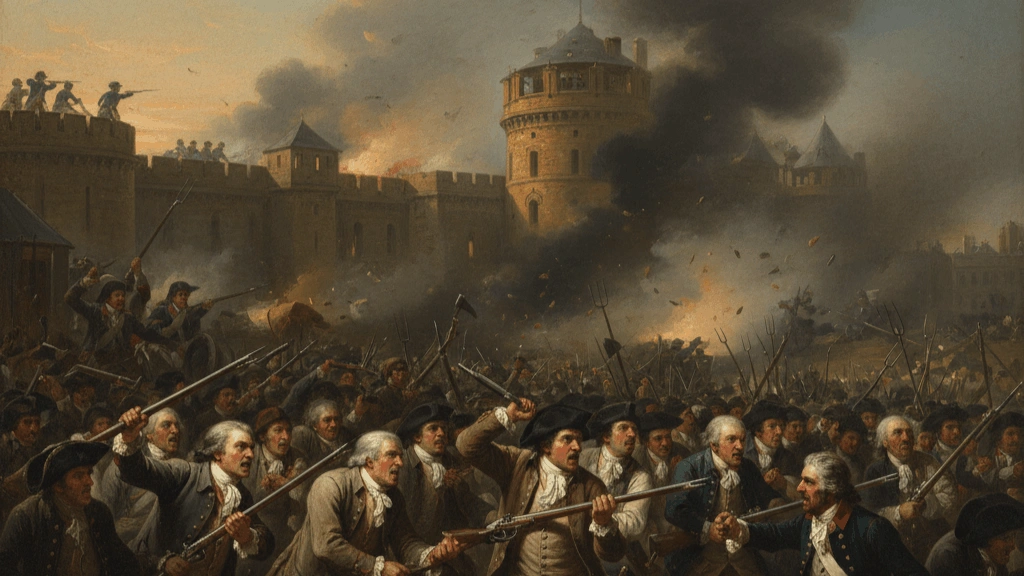
One of its most famous events was the storming of the Bastille on July 14, 1789.
The Revolution transformed France's political system and had major consequences for European politics.
1791 — Haitian Revolution Begins
The Haitian Revolution began in the French colony of Saint-Domingue in 1791.
1804 — Haitian Independence
Haiti declared independence in 1804 following a successful revolution against French colonial rule and slavery.
Industrialization and the 19th Century
Late 18th Century — Industrial Revolution
Industrialization began in Britain during the 18th century and later spread to other countries.
Key developments included mechanized production, factories, steam power, railways, and major changes in transportation.
1815 — Battle of Waterloo
Napoleon Bonaparte suffered his final military defeat at Waterloo in 1815.
1861–1865 — American Civil War
The United States Civil War lasted from 1861 to 1865.
1869 — Suez Canal Opens
The Suez Canal opened in 1869, creating a direct maritime connection between the Mediterranean Sea and Red Sea.
1871 — German Unification
The German Empire was proclaimed in 1871 following a series of political and military developments led by Prussia.
World War I
1914 — World War I Begins
World War I began in 1914 after growing international tensions and the crisis following the assassination of Archduke Franz Ferdinand.
1918 — World War I Ends
The fighting on the Western Front ended with the armistice of November 11, 1918.
A useful memory pattern is:
World War I = 1914–1918
Major Events Between the World Wars
1917 — Russian Revolution
Russia experienced two major revolutions in 1917.
The Bolsheviks eventually established a new revolutionary government, and the Soviet Union was formally created in 1922.
1929 — Wall Street Crash
The U.S. stock market crash of 1929 became associated with the beginning of the Great Depression.
1933 — Hitler Becomes German Chancellor
Adolf Hitler became chancellor of Germany in January 1933.
World War II
1939 — World War II Begins in Europe
Germany invaded Poland on September 1, 1939.
Britain and France declared war on Germany shortly afterward.
1941 — Pearl Harbor
Japan attacked the U.S. naval base at Pearl Harbor on December 7, 1941.
The United States subsequently entered World War II.
1945 — World War II Ends
Germany surrendered in May 1945.
Japan announced its surrender in August, and formal surrender documents were signed on September 2.
The standard quiz dates are therefore:
World War II = 1939–1945
1945 — United Nations Founded
Representatives of 50 countries signed the United Nations Charter on June 26, 1945.
The United Nations officially came into existence on October 24, 1945, after the Charter entered into force.
October 24 is now observed as United Nations Day.
Decolonization and the Cold War
1947 — Independence of India and Pakistan
British colonial rule over the Indian subcontinent ended in 1947 with the creation of the independent states of India and Pakistan.
1949 — People's Republic of China Established
The People's Republic of China was proclaimed on October 1, 1949.
1957 — Ghana Gains Independence
Ghana became independent from British colonial rule in 1957.
Its independence became an important milestone in postwar African decolonization.
1960 — "Year of Africa"
Seventeen African countries gained independence in 1960, leading the year to become widely known as the "Year of Africa."
1969 — First Humans Walk on the Moon
NASA's Apollo 11 mission launched on July 16, 1969.
Neil Armstrong and Buzz Aldrin landed on the Moon, and Armstrong became the first person to step onto the lunar surface on July 20, 1969. Michael Collins remained in lunar orbit aboard the command module.
This is one of the most commonly tested dates in the history of space exploration.
Late 20th-Century Turning Points
1989 — Berlin Wall Opens
In November 1989, restrictions on travel between East and West Berlin collapsed, and crossings through the Berlin Wall opened.
The event became one of the best-known symbols of the ending Cold War order in Europe.
1990 — German Reunification
East Germany and West Germany formally reunited on October 3, 1990.
1991 — Soviet Union Dissolves
The Soviet Union ceased to exist in December 1991.
The event is commonly used to mark the end of the Cold War period.
Major Dates at a Glance
Date | Event |
c. 300,000 years ago | Emergence of Homo sapiens |
c. 3500–3000 BCE | Early writing systems develop |
776 BCE | Traditional first ancient Olympic Games |
509 BCE | Traditional beginning of Roman Republic |
221 BCE | Qin unifies China |
27 BCE | Beginning of Roman Empire under Augustus |
476 CE | Traditional fall of Western Roman Empire |
622 | Hijra |
1066 | Norman Conquest of England |
1215 | Magna Carta |
1453 | Fall of Constantinople |
1492 | Columbus reaches Caribbean |
1517 | Traditional start of Protestant Reformation |
1776 | U.S. Declaration of Independence |
1789 | French Revolution begins |
1815 | Battle of Waterloo |
1914–1918 | World War I |
1917 | Russian Revolution |
1929 | Wall Street Crash |
1939–1945 | World War II |
1945 | United Nations founded |
1947 | India and Pakistan become independent |
1969 | Apollo 11 Moon landing |
1989 | Berlin Wall opens |
1991 | Soviet Union dissolves |
Which Came First?
Chronology questions frequently compare famous events.
Pyramids or Roman Empire?
The great pyramids of ancient Egypt were constructed thousands of years before the Roman Empire began.
Magna Carta or Columbus?
Magna Carta — 1215
Columbus reaches Caribbean — 1492
Therefore, Magna Carta came first.
American Revolution or French Revolution?
American Declaration of Independence — 1776
French Revolution begins — 1789
The American Revolution occurred earlier.
World War I or Russian Revolution?
World War I begins — 1914
Russian Revolution — 1917
World War I began first.
Moon Landing or Fall of Berlin Wall?
Moon landing — 1969
Berlin Wall opens — 1989
The Moon landing came 20 years earlier.
Common Mistakes
Confusing the Century With the First Two Digits
1776 belongs to the 18th century, not the 17th century.
Thinking Larger BCE Numbers Are Later
500 BCE occurred before 100 BCE.
Assuming There Is a Year Zero
The traditional historical sequence moves directly from:
1 BCE → 1 CE
Treating Approximate Dates as Exact
Many ancient and prehistoric dates are estimates based on archaeological and scientific evidence.
Confusing an Event's Different Dates
An event can have several historically meaningful dates.
For example, American independence was approved on July 2, 1776, the Declaration was adopted on July 4, and most delegates signed the engrossed copy beginning August 2.
Memorizing Dates Without Context
Instead of memorizing:
1789 = French Revolution
connect it with:
Enlightenment → financial and political crisis → 1789 Revolution → political transformation → Napoleonic era
Connections make dates easier to remember.
Memory Tips
Use anchor dates rather than trying to memorize every date independently.
A useful sequence is:
476 → 1066 → 1215 → 1453 → 1492 → 1517
Then:
1776 → 1789 → 1815
For the 20th century:
1914 → 1918 → 1929 → 1939 → 1945 → 1969 → 1989 → 1991
Remember the wars as pairs:
WWI: 1914–1918
WWII: 1939–1945
And remember:
1969 = Moon
1989 = Berlin Wall
1991 = Soviet Union ends
Summary
Historical dates provide the chronological structure that allows us to understand the past. They help establish which events happened first, how long historical periods lasted, and how developments in different regions relate to one another.
BCE dates count backward toward the Common Era, while CE dates move forward. There is no year zero in the traditional system. Century numbering also requires care: 1776 belongs to the 18th century, while 1914 belongs to the 20th.
The most effective way to study dates is to memorize a smaller number of anchor dates and connect other events around them. Dates such as 476, 1066, 1215, 1492, 1776, 1789, 1914, 1939, 1945, 1969, 1989, and 1991 provide a useful framework for general world-history chronology.
FAQ
What is chronology?
Chronology is the arrangement of events according to when they occurred.
What does BCE mean?
BCE means Before Common Era.
What does CE mean?
CE means Common Era.
Is BCE different from BC?
The terminology differs, but the numbering does not. For example, 500 BCE and 500 BC refer to the same year.
Is there a year zero?
No. In the conventional historical dating system, 1 BCE is followed by 1 CE.
What century is 1492?
1492 is in the 15th century.
What century is 1776?
1776 is in the 18th century.
When did World War I take place?
World War I lasted from 1914 to 1918.
When did World War II take place?
World War II lasted from 1939 to 1945.
When did humans first land on the Moon?
Apollo 11 landed on the Moon in 1969, and Neil Armstrong became the first person to walk on its surface on July 20.
Key Takeaways
Historical dates establish chronology and help explain relationships between events.
BCE counts backward toward the Common Era, and there is no year zero in the traditional system.
A year such as 1789 belongs to the 18th century because centuries are numbered one ahead of most year prefixes.
Important anchor dates make large historical timelines easier to learn than memorizing hundreds of isolated years.
Dates should always be connected with people, causes, events, and consequences to create meaningful historical understanding.
References
Smithsonian Institution, Human Origins Program — Homo sapiens Scientific reference for the emergence of modern humans approximately 300,000 years ago and the later transition toward food production.
Smithsonian — Homo sapiensSmithsonian Institution, Human Origins Program — Dating Educational reference explaining relative and absolute dating methods used to establish prehistoric timelines.
Smithsonian — DatingU.S. National Archives — Declaration of Independence (1776) Official archival record explaining the adoption and signing dates of the Declaration of Independence.
National Archives — Declaration of IndependenceU.S. National Archives — Creating the Declaration: A Timeline Official chronology covering the drafting, approval, printing, and signing of the Declaration of Independence.
National Archives — Declaration TimelineUnited Nations — History of the United Nations Official UN history covering the drafting of the Charter and the organization's establishment in 1945.
United Nations — History of the UNNASA — Apollo 11 Mission Overview Official NASA reference for the July 1969 Apollo 11 mission and the first crewed Moon landing.
NASA — Apollo 11Encyclopaedia Britannica — Magna Carta Reference covering Magna Carta, its issuance in 1215, and its historical significance.
Britannica — Magna CartaEncyclopaedia Britannica — French Revolution Reference covering the French Revolution beginning in 1789 and its major events and consequences.
Britannica — French RevolutionEncyclopaedia Britannica — World War I Historical reference covering World War I from 1914 to 1918.
Britannica — World War IEncyclopaedia Britannica — World War II Historical reference covering World War II from 1939 to 1945.
Britannica — World War II