


Introduction
International relations (IR) is the study of interactions among countries and other actors that operate across national borders. It examines subjects such as diplomacy, war and peace, alliances, international trade, development, human rights, migration, environmental cooperation, and international law.
Countries remain central to international relations, but they are not the only participants. International organizations, multinational companies, humanitarian groups, courts, financial institutions, and civil society organizations can also influence international affairs.
International organizations help states cooperate on problems that cross borders. The United Nations focuses on areas including peace, security, development, and international cooperation, while institutions such as the World Trade Organization, International Monetary Fund, World Bank, NATO, European Union, African Union, and ASEAN have more specialized or regional roles.
Understanding how these institutions differ is essential for geography, politics, economics, history, and general-knowledge quizzes.
Learning Objectives
After studying this guide, you should be able to:
Explain sovereignty, diplomacy, foreign policy, national interest, and international law.
Distinguish states, nations, governments, and international organizations.
Describe the principal organs of the United Nations.
Compare organizations such as the UN, WTO, IMF, World Bank, NATO, EU, AU, and ASEAN.
Explain treaties, alliances, sanctions, peacekeeping, collective security, and multilateralism.
Recognize major approaches used to study international relations.
What Are International Relations?
International relations concern interactions that cross political borders.
Important subjects include:
Diplomatic negotiations
Military security
International trade
Economic development
Climate cooperation
Migration
Human rights
International law
International organizations
A decision made by one government can affect many other countries.
For example, a trade restriction can alter international supply chains. An armed conflict may create refugee movements, while an environmental agreement may require governments on several continents to cooperate.
State, Nation, Country, and Government
These words are related but should not automatically be treated as synonyms.
State
A state is a political entity associated with a defined territory, population, government, and capacity to conduct international relations.
In international relations, the word state often means an independent sovereign country rather than a province or state inside a federation.
Nation
A nation usually refers to a community connected by a shared identity, which may involve language, history, culture, ethnicity, or political consciousness.
A nation does not necessarily have its own independent state.
Country
Country is a common geographic and political term for a territorial political entity.
Government
A government is the group of institutions and officials exercising public authority within a state.
Governments can change while the state itself continues to exist.
Sovereignty
Sovereignty is a fundamental concept in international relations.
It generally refers to a state's authority over its territory and political affairs and its legal independence from other states.
The UN Charter is based partly on the principle of the sovereign equality of its members. It also requires members to settle international disputes peacefully and to refrain from the threat or use of force in ways inconsistent with the Charter.
Sovereignty does not mean states operate in complete isolation. Governments regularly accept international obligations by joining organizations and treaties.
National Interest
The national interest refers to goals a government considers important for its country.
These may include:
National security
Economic prosperity
Access to resources
Territorial integrity
Trade
Political influence
Protection of citizens abroad
Different governments can define their interests differently, and political groups within the same state may disagree about priorities.
Foreign Policy
Foreign policy is the strategy a government uses in dealing with other states and international actors.
Foreign-policy tools can include:
Diplomacy
Trade agreements
Foreign aid
Sanctions
Alliances
International negotiations
Military cooperation
Domestic politics, geography, economic interests, history, ideology, and security concerns can all influence foreign policy.
Diplomacy
Diplomacy is the management of international relations through communication and negotiation.
Diplomats may:
Represent governments abroad
Negotiate agreements
Exchange information
Protect their country's interests
Manage disputes
Maintain communication during crises
An embassy is usually a country's main diplomatic mission in another state.
The senior diplomatic representative is generally called an ambassador.
Bilateral and Multilateral Relations
Bilateral
Bilateral relations involve two countries.
A trade agreement between two states is bilateral.
Multilateral
Multilateral relations involve three or more states, often through an international institution or treaty.
The United Nations is a major forum for multilateral diplomacy.
Memory tip:
Bi = two
Multi = many
International Organizations
An international organization is an institution through which states or other participants cooperate across borders.
Intergovernmental Organizations
An intergovernmental organization (IGO) is created primarily by states.
Examples include:
United Nations
World Trade Organization
African Union
ASEAN
NATO
Non-Governmental Organizations
A non-governmental organization (NGO) is not itself an organization of states.
NGOs may work in areas such as:
Humanitarian assistance
Health
Development
Human rights
Environmental protection
Education
Governments and NGOs therefore play different institutional roles.
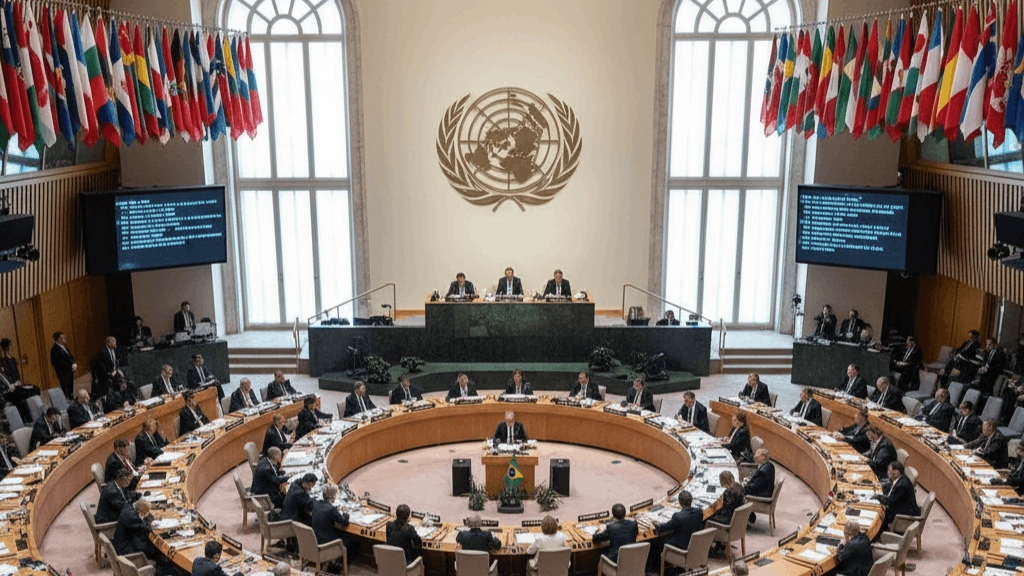
The United Nations
The United Nations (UN) was created in 1945 following World War II.
Its Charter identifies purposes including maintaining international peace and security, developing friendly relations among nations, promoting international cooperation, and supporting human rights.
The UN currently has 193 member states.
Six Principal UN Organs
The United Nations was established with six principal organs:
General Assembly
Security Council
Economic and Social Council
International Court of Justice
Secretariat
Trusteeship Council
The Trusteeship Council suspended regular operations in 1994 after the final UN trust territory achieved self-government or independence.
UN General Assembly
The General Assembly includes all 193 UN member states.
Each member has representation in the Assembly.
The General Assembly discusses international issues and makes decisions on areas including:
UN budgets
Elections to UN bodies
Admission of members
International cooperation
Development
Peace and security questions
On important questions, General Assembly decisions normally require a two-thirds majority of members present and voting; other questions generally require a simple majority.
Important Distinction
General Assembly resolutions are not automatically equivalent to national laws or Security Council decisions.
Their legal effects depend on the subject, applicable law, and circumstances.
UN Security Council
The Security Council has primary responsibility under the UN Charter for international peace and security.
It contains 15 members:
5 permanent members
10 members elected for two-year terms
The five permanent members are:
China
France
Russia
United Kingdom
United States
Security Council Veto
For substantive Security Council decisions, nine affirmative votes are required, and a negative vote by any permanent member prevents adoption.
This special power is commonly called the veto.
An abstention by a permanent member does not automatically prevent adoption if the proposal receives the required number of affirmative votes.
UN Secretariat
The Secretariat carries out much of the UN's administrative and organizational work.
It is headed by the Secretary-General.
The Secretariat prepares reports, supports UN meetings and operations, conducts research, and assists other UN bodies.
International Court of Justice
The International Court of Justice (ICJ) is the principal judicial organ of the United Nations.
It is based in The Hague, Netherlands.
The ICJ has two major roles:
Settling legal disputes submitted by states
Giving advisory opinions on legal questions referred by authorized UN bodies and agencies
Only states can be parties in contentious cases before the ICJ.
ICJ vs ICC
This is an important quiz distinction.
International Court of Justice
ICJ → disputes between states
International Criminal Court
ICC → criminal responsibility of individuals
The ICC has jurisdiction under its governing legal framework over crimes including genocide, crimes against humanity, war crimes, and the crime of aggression.
The ICJ and ICC are therefore completely different courts despite both being located in The Hague.
World Trade Organization
The World Trade Organization (WTO) provides a framework of international rules for trade.
Its work includes:
Trade agreements
Trade negotiations
Monitoring trade policies
Dispute settlement
Technical assistance
The WTO began operating in 1995, succeeding the earlier General Agreement on Tariffs and Trade framework.
As of 2026, the WTO has 166 members, representing about 98% of world trade.
Quiz Connection
WTO → international trade rules
International Monetary Fund
The International Monetary Fund (IMF) was created in 1944.
Its work centers on international monetary cooperation and financial stability.
Major IMF functions include:
Monitoring economic and financial developments
Providing policy advice
Lending to member countries facing balance-of-payments problems
Providing technical assistance and training
The IMF currently has 191 member countries.
Quiz Connection
IMF → monetary cooperation + financial stability
World Bank
The World Bank focuses heavily on economic development and poverty reduction through financing, technical expertise, and development projects.
Its activities can involve:
Infrastructure
Education
Health
Agriculture
Governance
Water
Energy
The International Bank for Reconstruction and Development, one of the core World Bank institutions, currently has 189 member countries.
IMF vs World Bank
A simplified distinction is:
IMF → macroeconomic and financial stability
World Bank → longer-term development financing
Their functions sometimes overlap, so this should be treated as a learning shortcut rather than an absolute division.
NATO
The North Atlantic Treaty Organization (NATO) is a political and military alliance founded in 1949.
NATO currently has 32 member countries in Europe and North America. Sweden became the 32nd member in 2024.
A central principle of the North Atlantic Treaty is collective defence.
Article 5 establishes that an armed attack against one or more members in Europe or North America is considered an attack against them all, subject to the treaty's provisions.
Quiz Connection
NATO → 1949 → collective defence
Alliance vs International Organization
An alliance is an agreement or institutional arrangement through which states cooperate, especially on security.
Not every international organization is a military alliance.
For example:
NATO → security alliance
WTO → trade organization
IMF → financial institution
European Union
The European Union (EU) is a political and economic union of European states.
It has 27 member countries.
European integration began after World War II with institutions involving six founding states and developed gradually into today's EU.
EU institutions include:
European Parliament
European Council
Council of the European Union
European Commission
Court of Justice of the European Union
European Central Bank
The EU is more deeply integrated than a typical international organization because member states have created institutions that can exercise significant authority in agreed policy areas.
EU vs Europe
Europe is a geographic region.
European Union is a political and economic union.
Not every European country belongs to the EU.
African Union
The African Union (AU) is a continental organization consisting of 55 member states.
It was officially launched in 2002 as the successor to the Organization of African Unity.
The AU works in areas including:
Continental cooperation
Peace and security
Economic integration
Development
Governance
Regional coordination
Quiz Connection
OAU → predecessor
AU → launched in 2002
ASEAN
ASEAN stands for the Association of Southeast Asian Nations.
It was founded in 1967.
ASEAN promotes cooperation in areas including:
Politics and security
Economics
Trade
Social and cultural affairs
Regional integration
An important recent change occurred in October 2025, when Timor-Leste was admitted as ASEAN's 11th member state.
This is a useful example of why membership numbers in international organizations should be checked rather than memorized permanently.
G20
The Group of Twenty (G20) is an international economic forum rather than a treaty-based organization with a permanent secretariat.
It consists of:
19 countries
European Union
African Union
The G20 brings together major economies to discuss international economic and financial issues.
Common Mistake
Despite its name, today's G20 has 21 member entities because the European Union and African Union participate alongside the 19 countries.
International Law
International law consists of rules and principles governing relations among states and other international actors.
Important sources include:
Treaties
International conventions
Customary international law
General principles of law
Judicial decisions and scholarly writings as subsidiary means
International law addresses subjects such as:
Armed conflict
Diplomacy
Oceans
Trade
Human rights
Treaties
Borders
International crimes
Treaties
A treaty is a formal international agreement governed by international law.
Treaties may involve:
Two states
Several states
Large groups of states
A bilateral treaty involves two parties.
A multilateral treaty involves several.
Treaties can address trade, security, borders, environmental protection, human rights, arms control, and many other issues.
International Cooperation
Countries cooperate because many problems cannot be managed effectively within one state's borders.
Examples include:
Climate change
Pandemics
International crime
Financial crises
Refugee movements
Maritime navigation
Telecommunications
International trade
Cooperation does not mean states always agree. International institutions often exist precisely because governments have different interests and need mechanisms for negotiation.
International Conflict
International disputes can arise from issues such as:
Territory
Resources
Security
Political influence
Trade
Historical claims
Treaty interpretation
Methods of peaceful dispute settlement can include:
Negotiation
Mediation
Arbitration
Judicial settlement
Diplomatic agreements
The UN Charter requires members to seek peaceful settlement of international disputes and restricts the threat or use of force except within the Charter's legal framework.
Sanctions
Sanctions are restrictions intended to influence the behavior of a state, organization, entity, or individual.
They may include:
Asset freezes
Travel restrictions
Trade restrictions
Arms embargoes
Financial measures
Sanctions may be imposed by individual states, groups of states, or international institutions.
The UN Security Council can impose sanctions under its Charter responsibilities relating to peace and security.
Peacekeeping
Peacekeeping generally involves international personnel deployed to help support peace and security.
Operations can include:
Monitoring ceasefires
Protecting civilians under authorized mandates
Supporting political processes
Assisting elections
Helping restore rule-of-law institutions
UN peacekeeping is different from the ordinary armed forces of a single country.
Collective Security vs Collective Defence
These terms sound similar but describe different concepts.
Collective Security
A broader system in which participating states seek to respond to threats against international peace.
The United Nations is associated with the idea of collective security.
Collective Defence
Members of an alliance agree to assist one another if a member is attacked.
NATO is the best-known contemporary example.
Memory tip:
UN → collective security
NATO → collective defence
Major International Relations Theories
International relations scholars use theories to interpret why states and institutions behave as they do. These are analytical frameworks, not universally accepted laws.
Realism
Realism emphasizes:
States
Power
Security
Competition
Survival
Realists generally argue that because no single world government stands above sovereign states, governments must pay close attention to power and security.
In IR terminology, this absence of a central world authority is often called international anarchy. It does not mean complete chaos.
Liberalism
Liberal approaches place greater emphasis on possibilities for cooperation.
They often examine:
International institutions
Trade
Rules
Domestic political systems
Interdependence
From this perspective, organizations and agreements can help governments coordinate behavior and reduce some forms of uncertainty.
Constructivism
Constructivism emphasizes the importance of:
Ideas
Identities
Norms
Beliefs
Social expectations
Constructivist analysis asks how concepts such as sovereignty, legitimacy, security, and national identity acquire meaning through social interaction.
Important Point
These theories can interpret the same international event differently.
Students should learn what each perspective emphasizes rather than treating one theory as automatically correct.
Soft Power and Hard Power
Hard Power
Hard power involves tools such as:
Military capability
Economic pressure
Sanctions
Soft Power
Soft power refers to the ability to influence through attraction and persuasion.
Possible sources include:
Culture
Education
Diplomacy
Political values
International reputation
States can use both forms at the same time.
Globalization
Globalization refers to increasing cross-border connections involving:
Trade
Finance
Information
Technology
Migration
Culture
Production
A product may be designed in one country, manufactured using components from several others, financed elsewhere, and sold worldwide.
Globalization therefore creates both opportunities for cooperation and new forms of dependence between economies.
Major Organizations at a Glance
Organization | Founded / Established | Main Association | Current Membership |
United Nations | 1945 | Peace and international cooperation | 193 states |
NATO | 1949 | Collective defence | 32 states |
European Union | Developed from institutions founded from 1951 | European political and economic integration | 27 states |
ASEAN | 1967 | Southeast Asian regional cooperation | 11 states |
African Union | 2002 | African continental cooperation | 55 states |
WTO | 1995 | International trade | 166 members |
IMF | 1944 | Monetary and financial stability | 191 countries |
Membership figures are current as of September 2026 and can change.
Common Mistakes
The UN Is Not a World Government
The United Nations is an international organization created by states. Member governments remain sovereign.
The UN General Assembly and Security Council Are Different
All 193 UN members participate in the General Assembly.
The Security Council has 15 members.
ICJ and ICC Are Not the Same Court
ICJ → states
ICC → individuals accused of specified international crimes
NATO Is Not the Same as the United Nations
NATO is a regional political-military alliance.
The United Nations is a global international organization with much broader purposes.
The IMF and World Bank Are Not the Same
The IMF concentrates heavily on monetary and macroeconomic stability.
World Bank institutions concentrate more on longer-term development and financing.
The EU Is Not the Same as Europe
Europe is a continent or geographic region.
The EU is an organization of 27 member states.
International Organizations Do Not All Have Countries as Their Only Members
The WTO includes the European Union as a member, while forums such as the G20 include both the EU and AU alongside individual countries.
Memory Tips
Connect each institution with one main idea:
UN → peace and cooperation
Security Council → peace and security decisions
ICJ → disputes between states
ICC → criminal cases against individuals
WTO → trade
IMF → monetary and financial stability
World Bank → development
NATO → collective defence
EU → European integration
AU → African cooperation
ASEAN → Southeast Asia
For diplomatic terminology:
Bilateral → two
Multilateral → many
Treaty → formal international agreement
Sovereignty → state authority
Summary
International relations studies how states and other international actors interact across borders. Major subjects include diplomacy, security, trade, development, international law, human rights, and environmental cooperation.
States remain central to the international system because they possess sovereignty and conduct foreign policy. However, international organizations provide important forums for negotiation and collective action.
The United Nations is the most broadly representative global intergovernmental organization, with 193 member states. Its major institutions include the General Assembly, Security Council, International Court of Justice, Secretariat, and Economic and Social Council.
Other organizations perform more specialized roles. The WTO deals with international trade, the IMF with monetary and financial cooperation, World Bank institutions with development, NATO with collective defence, and regional organizations such as the EU, AU, and ASEAN with forms of regional cooperation.
The easiest way to master international relations for quizzes is to connect each institution with its purpose, membership, region, and basic powers.
FAQ
What is international relations?
International relations is the study of interactions among states and other actors across national borders, including diplomacy, security, trade, law, development, and international organizations.
What is sovereignty?
Sovereignty refers broadly to a state's authority over its territory and political affairs and its independence within the international system.
How many members does the United Nations have?
The United Nations has 193 member states.
How many members are on the UN Security Council?
The Security Council has 15 members: five permanent and ten elected members.
What is the difference between the UN and NATO?
The UN is a global organization concerned with international peace, cooperation, development, law, and other issues. NATO is a political-military alliance built around collective defence.
What is the difference between the ICJ and ICC?
The ICJ hears legal disputes between states and gives advisory opinions. The ICC prosecutes individuals accused of certain international crimes within its jurisdiction.
What does the WTO do?
The WTO administers international trade rules, provides a forum for negotiations, monitors trade policies, and operates dispute-settlement processes.
What does the IMF do?
The IMF works on international monetary cooperation and financial stability and can provide financing to member countries experiencing balance-of-payments problems.
What is bilateral diplomacy?
Bilateral diplomacy involves relations or negotiations between two states.
What is multilateral diplomacy?
Multilateral diplomacy involves several states working together, often through an international organization or conference.
Key Takeaways
International relations examines diplomacy, security, trade, law, development, and cooperation across borders.
Sovereign states remain central actors, but international organizations also play major roles.
The United Nations has 193 member states, while its Security Council contains 15 members.
The WTO, IMF, World Bank, NATO, EU, AU, and ASEAN have different purposes and institutional structures.
Understanding distinctions such as ICJ vs ICC, collective security vs collective defence, and bilateral vs multilateral relations is essential for international-relations quizzes.
References
· United Nations — UN Charter: Purposes and Principles Official text covering international peace and security, sovereign equality, peaceful settlement of disputes, international cooperation, and the basic principles governing UN members.
United Nations — UN Charter
· United Nations — Main Bodies Official overview of the General Assembly, Security Council, ECOSOC, International Court of Justice, Secretariat, and Trusteeship Council.
United Nations — Main Bodies
· United Nations Security Council — Current Members Official information on the Council's five permanent members and ten elected members.
UN Security Council — Current Members
· International Court of Justice — How the Court Works Official explanation of the ICJ's role in disputes between states and advisory proceedings.
International Court of Justice — How the Court Works
· International Criminal Court — Elements of Crimes Official ICC material covering genocide, crimes against humanity, war crimes, and the crime of aggression.
International Criminal Court — Elements of Crimes
· World Trade Organization — Annual Report 2026 Official WTO information on its membership, international trade system, negotiations, and institutional work.
World Trade Organization — Annual Report 2026
· International Monetary Fund — About the IMF Official explanation of IMF membership, financial stability, monetary cooperation, economic monitoring, lending, and technical assistance.
International Monetary Fund — About the IMF
· World Bank — What We Do Official overview of World Bank development financing, technical assistance, projects, and development priorities.
World Bank — What We Do
· NATO — Member Countries Official NATO information on membership, enlargement, and its 32 member states.
NATO — Member Countries
· European Union — Key Facts and Figures Official EU information covering its 27 member countries, institutions, population, and history of European integration.
European Union — Facts and Figures
· African Union — About the African Union Official overview of the AU, its 55 member states, history, and development from the Organization of African Unity.
African Union — Overview
· ASEAN — Timor-Leste Admitted into ASEAN Official ASEAN source documenting Timor-Leste's admission as the organization's 11th member state in October 2025.
ASEAN — Timor-Leste Admission