
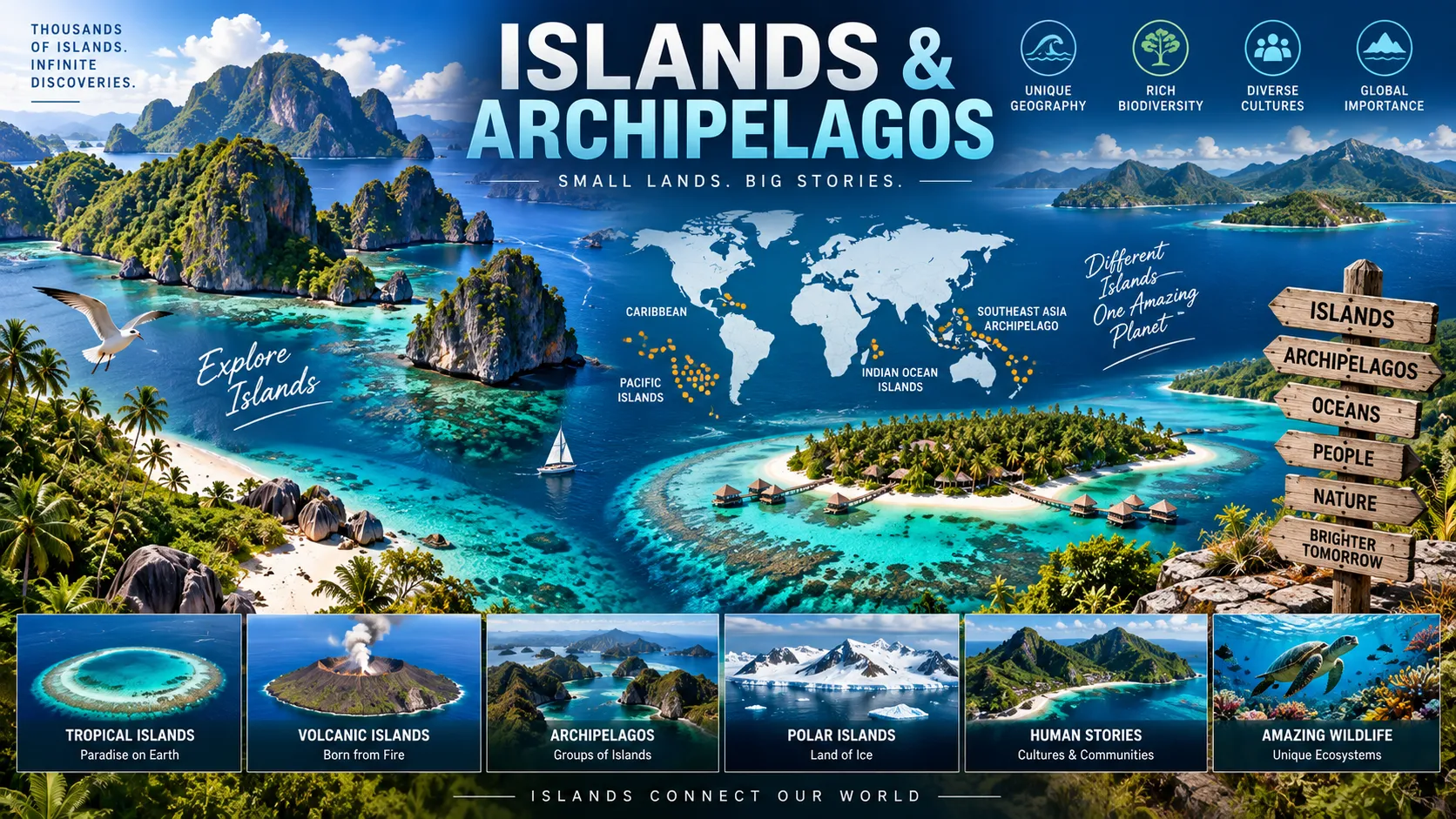
Islands & Archipelagos: Complete Study Guide
Introduction
Islands are among the most varied landforms on Earth. Some are tiny rocks rising above the sea, while others contain mountains, forests, cities, rivers, and millions of people. Islands can occur in oceans, seas, lakes, and rivers.
An island is a body of land surrounded by water. An archipelago is a group or chain of islands located relatively close to one another. Archipelagos may form through volcanic activity, tectonic movement, coral growth, erosion, sediment deposition, or changes in sea level. NOAA notes that archipelagos can occur in oceans, lakes, and rivers rather than only in the sea.
Studying islands and archipelagos helps explain plate tectonics, volcanoes, coral reefs, evolution, biodiversity, human migration, maritime trade, and environmental change. They are also common subjects in geography quizzes because many countries, territories, and famous natural landmarks are located on islands.
Learning Objectives
After studying this guide, you should be able to:
· Define an island, islet, archipelago, atoll, and island arc.
· Explain the major ways islands form.
· Distinguish between continental, volcanic, coral, and sedimentary islands.
· Explain how volcanic island chains and atolls develop.
· Describe why isolated islands often contain endemic species.
· Identify important examples of islands and archipelagos around the world.
What Is an Island?
An island is an area of land completely surrounded by water.
Islands vary enormously in size. Some are little more than exposed rocks, while others are large enough to contain several climate zones and extensive human settlements.
Very small islands are often called islets.
Islands can occur in:
· Oceans
· Seas
· Lakes
· Rivers
· Deltas
· Estuaries
Continents are also surrounded by water, but geographic convention places them in a different category because of their enormous size and geological importance. Greenland is generally classified as the world's largest island, while Australia is classified as a continent.
What Is an Archipelago?
An archipelago is a group, chain, or cluster of islands.
The islands may be located close together or spread across a large area. They commonly share some geological or geographic relationship.
Examples include:
· The Hawaiian Islands
· The Japanese archipelago
· The Philippine archipelago
· The Indonesian archipelago
· The Galápagos Islands
· The Aleutian Islands
· The Maldives
· The Caribbean island groups
An archipelago does not have to be volcanic. NOAA explains that archipelagos can result from volcanic eruptions, erosion, sediment deposition, rising sea level, coral processes, and the separation of land from continents.
Island, Islet, Archipelago, and Atoll
These terms are related but should not be confused.
Term | Meaning |
Island | Land completely surrounded by water |
Islet | A very small island |
Archipelago | A group or chain of islands |
Atoll | A ring-shaped coral reef or group of coral islands surrounding a lagoon |
Island arc | A curved chain of volcanic islands usually associated with a subduction zone |
Cay | A small, low island formed largely from sand or coral material |
A single island can belong to an archipelago. An archipelago, however, contains multiple islands or related island features.
How Islands Form
There is no single process that creates all islands. Their origins depend on geology, water movement, coral growth, sediment, and changes in Earth's crust.
1. Continental Islands
Continental islands are associated geologically with continents.
They may lie on a continental shelf or consist of pieces of continental crust separated from a larger landmass.
Separation can occur because of tectonic movement, erosion, or rising sea level. When sea level rises, lower land may become submerged while higher areas remain above water as islands.
Some islands near continental coasts were once connected to the mainland during periods when sea levels were lower.
Continental Fragments
In some cases, a piece of continental crust becomes separated through plate movement.
These fragments can remain isolated for millions of years. Long isolation can allow distinctive plants and animals to evolve.
Madagascar is a famous example of a large island with ancient continental origins.
2. Volcanic Islands
Many oceanic islands are volcanic.
A volcanic island begins when repeated eruptions build a submarine volcano on the ocean floor. Lava and other volcanic material accumulate until the volcano becomes tall enough to rise above sea level.
USGS explains that submarine volcanic material can build upward over millions of years until an island volcano emerges above the ocean.
Volcanic islands commonly form in two major settings:
Hot Spots
A hot spot is an area where hot material from deep within Earth supplies magma that rises through the crust.
A tectonic plate can move over a hot spot while the source of magma remains in roughly the same area. This process can produce a chain of volcanoes.
The Hawaiian Islands are a classic example.
The Pacific Plate has moved over the Hawaiian hot spot, creating a long sequence of volcanic islands and submerged seamounts. Islands farther from the currently active part of the hot spot are generally older.
Memory Tip
Think:
Plate moves + hot spot stays = volcanic island chain
3. Island Arcs
An island arc is a curved chain of volcanic islands usually created near a convergent plate boundary.
At some convergent boundaries, one oceanic tectonic plate moves beneath another in a process called subduction. Water and other materials associated with the descending plate help produce magma. That magma rises and can feed volcanoes on the overriding plate.
Over time, some of these volcanoes become islands.
USGS identifies the Mariana and Aleutian island chains as examples of island arcs associated with subduction. These arcs commonly run roughly parallel to deep ocean trenches.
Island arcs are often associated with:
· Volcanoes
· Earthquakes
· Deep-sea trenches
· Tectonic plate boundaries
This is why many volcanic archipelagos occur around the Pacific Ring of Fire.
Hot-Spot Chain vs. Island Arc
Students often confuse these two volcanic settings.
Feature | Hot-Spot Island Chain | Island Arc |
Main cause | Plate moving over a source of magma | Subduction at a convergent boundary |
Plate boundary required? | Not necessarily | Yes |
Typical shape | Chain of progressively aged volcanoes | Often curved |
Nearby trench | Usually absent | Common |
Example | Hawaiian Islands | Mariana Islands |
Both produce volcanic islands, but the tectonic processes are different.
4. Coral Islands
Some islands develop mainly from coral reef material.
Corals are animals that can build hard calcium carbonate skeletons. Over long periods, colonies of reef-building corals can create enormous reef structures.
Sand, shells, broken coral, and other material may accumulate on a reef until part of it remains above high tide, creating a low coral island or cay.
Coral islands are usually very different in shape and elevation from high volcanic islands. Many are low and relatively flat.
How an Atoll Forms
An atoll is one of the most distinctive island formations.
It usually consists of a roughly ring-shaped coral reef, sometimes with small islands on the reef, surrounding a central lagoon.
A simplified sequence is:
1. A volcanic island rises above the ocean.
2. Coral grows around its coast, creating a fringing reef.
3. The volcanic island slowly subsides or erodes while coral continues growing upward.
4. A lagoon develops between the shrinking island and the reef, creating a barrier reef.
5. The original volcanic island eventually disappears below sea level.
6. The coral reef remains around a central lagoon, forming an atoll.
NOAA notes that this process may take millions of years.
The Maldives and many Pacific island groups contain famous examples of atolls.
5. Sedimentary and Barrier Islands
Not every island forms from rock rising out of Earth's crust.
Waves, rivers, and ocean currents transport large quantities of sediment. When sand, mud, gravel, shells, or other material accumulates, it can create islands.
Barrier Islands
A barrier island is usually a long, narrow island running roughly parallel to a coastline.
Barrier islands are composed largely of sediment and can change shape as waves, currents, storms, and sea-level changes redistribute material.
River and Delta Islands
Rivers also create islands.
Sediment can accumulate between channels, producing land surrounded by flowing water. Large river deltas may contain numerous islands separated by branching channels.
Volcanic Islands Can Change Over Time
An island is not necessarily permanent.
Young volcanic islands can grow through eruptions. Once volcanism becomes less active, weathering and erosion gradually wear them down.
In tropical waters, coral reefs may grow around an aging volcanic island. Over extremely long periods, the landscape can change from a high volcanic island to a lower reef system and eventually an atoll.
The Hawaiian archipelago provides examples of multiple stages in this geological sequence, from younger high volcanic islands to older reefs, banks, and atolls farther along the chain.
Islands and Plate Tectonics
Islands provide some of the clearest evidence that Earth's surface is dynamic.
Volcanic island chains can reveal the direction in which tectonic plates have moved. Island arcs reveal where one plate is descending beneath another.
For example, the sequence of ages in the Hawaiian-Emperor chain records movement of the Pacific Plate over a hot spot.
Island geography therefore helps scientists reconstruct Earth's geological history.
Islands and Biodiversity
Islands are especially important in biology.
Because water separates island populations from mainland populations, organisms may remain isolated for long periods. Over many generations, isolated populations can evolve into new species.
A species found naturally in only one particular location is called endemic.
UNESCO notes that islands occupy only a small proportion of Earth's land area but contain a disproportionately large share of global biodiversity. Isolation has helped produce unusual evolutionary traits and many species found nowhere else.
Adaptive Radiation
Adaptive radiation occurs when one ancestral species gives rise to several different species adapted to different ecological roles.
Islands can provide ideal conditions for this process because new populations may encounter habitats and food sources that are different from those of their ancestors.
The Galápagos Islands are one of the world's best-known natural laboratories for studying evolution. Their geographic isolation has produced high levels of endemism among plants and animals.
Why Island Species Can Be Vulnerable
The isolation that creates unique species can also make island ecosystems fragile.
An island species may have:
· A very small population
· A limited geographic range
· Few defenses against newly introduced predators
· Specialized food or habitat requirements
Introduced rats, cats, insects, plants, diseases, and other organisms can therefore cause severe ecological damage.
UNESCO reports that invasive species, habitat loss, and other human pressures have contributed heavily to extinctions on islands.
Islands and Human Geography
Islands have played major roles in human history.
Ocean voyages connected island societies with distant trading networks. Islands became ports, migration stops, fishing centers, military bases, plantation economies, cultural crossroads, and independent states.
Island communities often develop strong maritime traditions because the sea provides transportation, food, and economic resources.
However, island life can also present challenges.
Remoteness may increase transportation costs and make access to large markets difficult. Small islands may have limited freshwater, farmland, minerals, or other resources.
The United Nations recognizes a group known as Small Island Developing States (SIDS). Their challenges can include geographic isolation, small domestic markets, dependence on ocean resources, exposure to natural hazards, and climate-related risks.
Islands and Maritime Territory
An island can influence much more than the amount of land controlled by a country.
Under international maritime law, qualifying islands may play a role in determining maritime zones such as territorial seas and exclusive economic zones.
As a result, even relatively small islands can have major strategic and economic importance because surrounding waters may contain fisheries, shipping routes, or seabed resources.
This helps explain why island geography sometimes becomes important in international relations.
Famous Archipelagos and Their Origins
Archipelago | Region | Important Geographic Feature |
Hawaiian Islands | Pacific Ocean | Hot-spot volcanism |
Galápagos Islands | Eastern Pacific | Volcanic hot-spot islands |
Mariana Islands | Western Pacific | Subduction-related island arc |
Aleutian Islands | North Pacific | Volcanic island arc |
Maldives | Indian Ocean | Coral islands and atolls |
Japan | Western Pacific | Complex tectonic island-arc setting |
Philippines | Western Pacific | Tectonically active archipelago |
Indonesia | Southeast Asia | Large, geologically complex archipelago |
Not every island in an archipelago necessarily formed in exactly the same way. Large island systems can have complicated geological histories.
The Hawaiian Archipelago as a Case Study
Hawaiʻi is especially useful for understanding island formation.
The islands formed as the Pacific Plate moved over a volcanic hot spot. A new volcano formed above the hot spot, while older volcanoes were gradually carried away as the plate moved.
NOAA describes the broader Hawaiian archipelago as including not only large islands but also atolls, reefs, banks, shoals, and seamounts extending across a vast portion of the North Pacific.
This means an archipelago can include both emerged and partly submerged geographic features associated with the same geological system.
The Galápagos as a Case Study
The Galápagos lie roughly 1,000 kilometers from continental Ecuador and are volcanic in origin.
Their isolation has allowed many organisms to evolve independently from mainland relatives. UNESCO identifies the archipelago as an area of exceptional biodiversity and endemism.
The islands demonstrate an important connection:
Geological isolation can lead to biological isolation.
That principle is central to the study of island biogeography.
Common Mistakes
Mistake 1: An Archipelago Is One Large Island
False. An archipelago is a group of islands.
Mistake 2: All Islands Are Volcanic
False. Islands can have continental, volcanic, coral, sedimentary, or other origins.
Mistake 3: Every Volcanic Island Chain Is an Island Arc
False. Hawaiʻi is a hot-spot chain, while the Marianas are associated with subduction and form an island arc.
Mistake 4: Atolls Are Volcanoes Above Sea Level
False. An atoll is mainly a coral reef formation surrounding a lagoon. A submerged volcanic foundation may lie far below it.
Mistake 5: Australia Is the World's Largest Island
In standard geographic classification, Australia is treated as a continent. Greenland is classified as the world's largest island.
Mistake 6: Islands Exist Only in Oceans
False. Islands can also occur in lakes and rivers.
Mistake 7: Islands Have Few Important Species
False. Geographic isolation can produce extremely high levels of endemism and biological diversity.
Memory Tips
Remember the main concepts with these associations:
Island = land surrounded by water
Archipelago = group of islands
Hot spot = moving plate over magma source
Island arc = subduction + volcanoes
Atoll = coral ring + lagoon
Endemic = naturally found only in a particular place
For coral development, remember:
Fringing reef → barrier reef → atoll
Summary
An island is a landmass surrounded by water, while an archipelago is a group or chain of islands. Islands occur in oceans, seas, lakes, and rivers and can form through several geological and environmental processes. Continental islands are connected geologically with continents. Volcanic islands can form above hot spots or at tectonic plate boundaries. Subduction can create curved volcanic island arcs, while coral growth around sinking volcanic islands can eventually produce atolls.
Islands are also important biological environments. Their isolation can allow species to evolve independently, producing high levels of endemism and adaptive radiation. The same isolation can make island ecosystems vulnerable to invasive species and environmental disruption.
For people, islands can provide homes, ports, fisheries, tourism, cultural centers, and control over important maritime areas. They can also present challenges related to transportation, limited resources, hazards, and environmental change.
Understanding islands therefore connects physical geography, geology, biology, environmental science, history, and human geography.
FAQ
1. What is an island?
An island is an area of land completely surrounded by water.
2. What is an archipelago?
An archipelago is a group or chain of islands located in the same general geographic area.
3. What is the difference between an island and an islet?
An islet is simply a very small island. There is no single worldwide size boundary separating the two terms.
4. How do volcanic islands form?
Repeated volcanic eruptions build lava and other material on the ocean floor until the volcano rises above sea level.
5. What is an island arc?
An island arc is a curved chain of volcanic islands typically created where one oceanic tectonic plate is subducted beneath another.
6. What is an atoll?
An atoll is a ring-shaped coral reef or series of low coral islands surrounding a lagoon.
7. Why are the Hawaiian Islands in a chain?
They formed as the Pacific Plate moved over a volcanic hot spot, creating volcanoes at different times.
8. Why do islands have many endemic species?
Water creates geographic isolation, limiting contact with mainland populations and allowing island populations to evolve independently.
9. What is the largest island?
Greenland is generally classified as the world's largest island. Australia is larger but is classified as a continent.
10. Can an island disappear?
Yes. Erosion, subsidence, volcanic collapse, storms, changing sediment patterns, and sea-level changes can reduce or submerge islands.
Key Takeaways
· An island is land surrounded by water, while an archipelago is a group or chain of islands.
· Islands can form through continental separation, volcanism, coral growth, and sediment deposition.
· Hot-spot island chains and subduction-related island arcs form through different tectonic processes.
· Atolls develop through a long interaction between coral growth and the subsidence or erosion of an underlying island.
· Island isolation encourages endemism and evolution but can also make ecosystems especially vulnerable to disturbance.
Related Topics
· Coastlines and Borders
· Volcanoes and Volcanic Landforms
· Plate Tectonics
· Oceans and Seas
· Coral Reefs and Atolls
· Continents and Oceans
· Island Biogeography
· Earthquakes and Subduction Zones
· Biodiversity and Endemic Species
· Maritime Boundaries and Exclusive Economic Zones
References
1. National Oceanic and Atmospheric Administration. What Is an Archipelago?
2. National Oceanic and Atmospheric Administration. How Did the Hawaiian Islands Form?
3. National Oceanic and Atmospheric Administration. How Do Coral Reefs Form?
4. National Oceanic and Atmospheric Administration. How a Coral Atoll Forms.
5. U.S. Geological Survey. Understanding Plate Motions — This Dynamic Earth.
6. U.S. Geological Survey. Volcanoes: Volcano Environments.
7. UNESCO. Galápagos Islands — World Heritage Centre.
8. UNESCO. Islands: Fragile Showcases of Biodiversity.
9. United Nations Department of Economic and Social Affairs. Small Island Developing States.
10. National Geographic Society. Island.