


Introduction
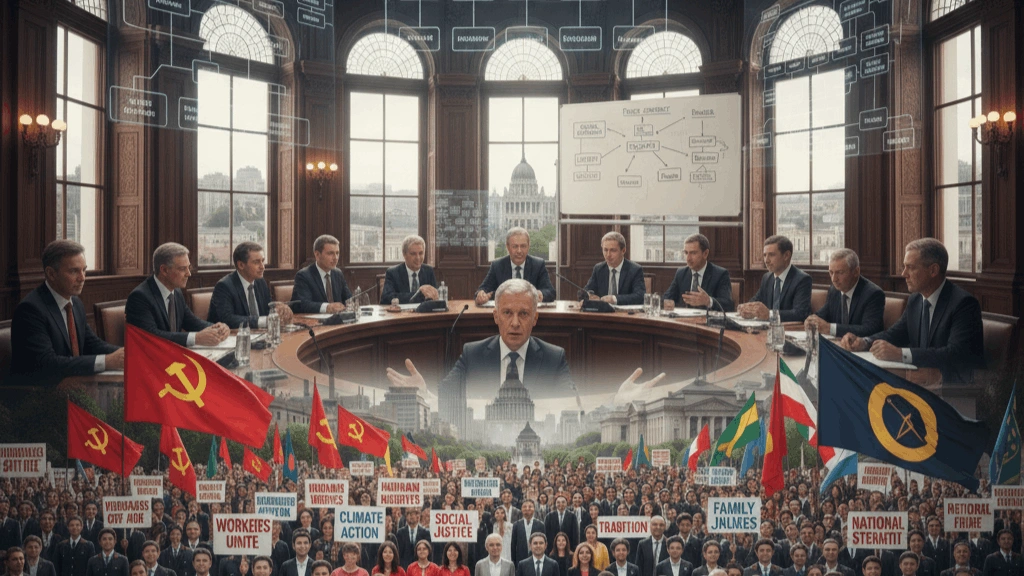
Politics is the process through which societies make collective decisions, distribute authority and resources, resolve disagreements, create laws, and determine who exercises public power.
Politics occurs at many levels. It can involve national governments, local councils, political parties, elections, courts, social movements, international organizations, and ordinary citizens. Studying politics therefore involves much more than studying politicians.
Political science examines concepts such as power, authority, government, the state, sovereignty, democracy, representation, political parties, elections, public policy, political participation, and governance. International IDEA's democracy framework, for example, examines representation, rights, rule of law, and citizen participation as distinct but connected dimensions of democratic politics.
Learning Objectives
After studying this guide, you should be able to:
Explain basic concepts such as politics, power, authority, state, government, and sovereignty.
Distinguish major forms and systems of government.
Understand democracy, elections, representation, and political parties.
Explain the roles of legislatures, executives, courts, and constitutions.
Understand public policy, civil society, political participation, and governance.
Recognize common political terms without assuming that similar labels mean exactly the same thing everywhere.
What is Politics?
Politics concerns decisions that affect groups of people.
Political questions commonly involve:
Who makes decisions?
Who has power?
How are leaders selected?
What laws should exist?
How are public resources distributed?
How should disagreements be resolved?
What rights and responsibilities do citizens have?
Politics exists because people often have different interests, values, needs, and priorities.
Political institutions create procedures through which these disagreements can be managed.
Power
Power is the ability to influence behavior, decisions, or outcomes.
Political power can come from many sources, including:
Government office
Law
Economic resources
Organization
Information
Public support
Having power is not automatically the same as possessing legitimate authority.
Authority and Legitimacy
Authority involves a recognized or claimed right to issue rules or commands.
Political legitimacy concerns whether the exercise of political authority can be justified. Political philosophers distinguish legitimacy from simply possessing enough force or power to obtain obedience.
Memory Tip
Power → ability to influence
Authority → claimed or recognized right to rule
Legitimacy → justification of that rule
State, Nation, and Government
These terms are frequently confused.
State
A state is a political organization exercising governing authority over a territory and population.
Typical features include:
Territory
Population
Government institutions
Sovereignty
Nation
A nation is a community whose members identify with one another through factors such as:
Shared history
Culture
Language
Political identity
A nation does not always possess its own independent state.
Government
A government consists of institutions and officeholders responsible for exercising public authority.
Governments can change through elections, resignations, constitutional procedures, or other political events while the state continues to exist.
Quiz Tip
State → enduring political structure
Government → current governing authority
Nation → community and identity
Sovereignty
Sovereignty refers broadly to supreme political authority within a political community.
It has both domestic and international dimensions.
Internal Sovereignty
Concerns authority within the state's territory.
External Sovereignty
Concerns the state's political independence in relation to other states.
Modern states operate within international law and international institutions, so sovereignty does not mean that every government can act without legal or political constraints.
Constitutions
A constitution establishes fundamental rules about political authority.
It may define:
Government institutions
Executive powers
Legislative powers
Courts
Elections
Rights
Relations between national and regional governments
Amendment procedures
Constitutions may be concentrated in a written document or distributed among several legal and customary sources.
Branches of Government
A common constitutional model divides government functions among three branches.
Legislature
The legislature makes laws and represents citizens or territorial units.
Parliaments also commonly perform oversight functions, examining government actions and holding executives accountable.
Executive
The executive implements laws and directs government administration.
It may include:
President
Prime minister
Cabinet
Ministries
Government agencies
Judiciary
The judiciary interprets and applies law through courts.
Courts may also resolve disputes and, in some systems, review whether laws or government actions comply with a constitution.
Separation of Powers
Separation of powers divides political authority among institutions.
This can reduce the risk that all public power becomes concentrated in one body.
Closely related are checks and balances, through which institutions can oversee or restrict one another.
The United Nations includes separation of powers, accountability, legal certainty, equality before the law, and independent adjudication among important principles of rule-of-law governance.
Parliamentary Government
In a parliamentary system, the government normally depends on support from the legislature.
A typical relationship is:
Voters → Parliament → Prime Minister and Government
If a government loses sufficient parliamentary support, procedures such as a vote of no confidence may result in its removal or replacement.
Presidential Government
In a presidential system, the president normally has a mandate independent from the legislature and serves a constitutionally defined term.
This creates separate political legitimacy for:
President
Legislature
Presidential constitutions usually establish exceptional rather than routine procedures for removing a president before the end of a term.
Semi-Presidential Government
A semi-presidential system combines:
A politically significant president
A prime minister and government responsible to the legislature
The division of power between president and prime minister varies considerably among countries.
Republic and Monarchy
These labels describe the position of the head of state rather than the entire political system.
Republic
A republic has a non-hereditary head of state, usually a president.
A republic can be:
Parliamentary
Presidential
Semi-presidential
Monarchy
A monarchy has a monarch as head of state.
In a constitutional monarchy, the monarch may perform mainly ceremonial duties while elected institutions exercise ordinary political authority.
Common Mistake
Republic does not mean presidential government.
A country can be both a republic and parliamentary democracy.
Democracy
Democracy broadly involves meaningful popular control over political decision-making and political equality among citizens.
International IDEA's current framework analyzes democracy through four broad attributes:
Representation
Rights
Rule of Law
Participation
Elections are a central democratic institution, but elections alone do not describe every dimension of democracy.
Other important elements may include:
Civil liberties
Political competition
Accountability
Effective legislatures
Independent courts
Citizen participation
Representative Democracy
In a representative democracy, citizens select representatives to make many public decisions.
Institutions can include:
Parliaments
Local councils
Elected executives
Representation connects citizens with political institutions.
Direct Democracy
Direct democracy allows citizens to vote directly on particular political questions rather than only selecting representatives.
Mechanisms may include:
Referendums
Citizens' initiatives
Many political systems combine representative institutions with limited forms of direct democracy.
Authoritarian Government
An authoritarian political system concentrates power while substantially limiting meaningful political competition, opposition, accountability, or participation.
Formal institutions may still exist, including:
Elections
Legislatures
Courts
Political parties
The important analytical question is whether these institutions exercise genuine independence, competition, and political influence.
Key Principle
Formal institutions and political practice are not always identical.
Elections
An election allows voters to choose public officials or representatives.
Modern democratic elections usually involve questions such as:
· Who can vote?
· Who can become a candidate?
· How are votes counted?
· How are seats distributed?
· Can competing parties campaign freely?
International IDEA describes credible elections as those free from serious irregularities involving registration, campaigns, intimidation, vote counting, and related processes.
Electoral Systems
An electoral system converts votes into political offices or legislative seats.
International IDEA groups electoral systems into three major families, while recognizing several systems outside those categories.
Plurality/Majority
Candidates or parties win according to plurality or majority rules.
Plurality means receiving more votes than any competitor.
Majority generally means receiving more than half.
Proportional Representation
Proportional representation (PR) aims to translate parties' vote shares into corresponding shares of legislative seats.
For example, a party receiving roughly 30% of votes may receive approximately 30% of seats under an idealized proportional result.
Mixed Systems
Mixed electoral systems combine proportional and plurality/majority mechanisms.
Different mixed systems connect the two components in different ways.
Political Parties
A political party is an organized group seeking political office in order to advance shared political principles, policies, or programmes.
International IDEA identifies several major democratic functions of political parties, including:
· Combining or aggregating interests
· Structuring electoral choices
· Recruiting candidates
· Organizing government and opposition
· Connecting voters with policymaking
Government and Opposition
In competitive political systems, parties that control government exercise executive authority, while opposition parties challenge, scrutinize, and offer alternatives.
A political opposition can:
· Question government ministers
· Criticize policy
· Propose alternative laws
· Compete for office at future elections
Opposition therefore has an institutional role beyond simply disagreeing with the governing party.
Political Ideologies
A political ideology is an organized set of ideas about society and political organization.
Major ideological traditions include:
· Liberalism
· Conservatism
· Socialism
· Social democracy
· Communism
· Libertarianism
· Nationalism
· Green politics
· Feminism
· Fascism
Each tradition contains internal disagreement.
Political labels should therefore be understood in historical and national context rather than treated as fixed definitions.
Left and Right
The political terms left and right developed historically from the French Revolution.
Today they are often used as broad shortcuts for political positions.
However, politics involves several dimensions, including:
· Economic policy
· Social values
· National identity
· Individual liberty
· Environmental policy
· Political authority
A single left-right line cannot capture every political belief.
Political Participation
Politics extends beyond voting.
Citizens may participate by:
· Voting
· Joining political parties
· Contacting representatives
· Attending public meetings
· Joining civil society organizations
· Petitioning
· Peacefully protesting
· Participating in campaigns
International IDEA treats electoral participation, civil society, and wider civic engagement as important forms of democratic participation.
Civil Society
Civil society consists broadly of organizations and associations outside the formal state apparatus through which people organize around shared interests or concerns.
Examples may include:
· Community groups
· Professional organizations
· Charities
· Advocacy organizations
Civil society can contribute to:
· Political participation
· Public debate
· Accountability
· Community organization
It does not mean that every non-governmental group is politically neutral or has identical goals.
Interest Groups
An interest group seeks to influence public policy without necessarily trying to form a government itself.
Examples can represent:
· Businesses
· Workers
· Professions
· Environmental causes
· Social issues
Party vs Interest Group
Political party → seeks public office
Interest group → mainly seeks to influence officeholders or policy
Public Opinion
Public opinion refers to the attitudes and preferences held by members of the public regarding political questions.
Researchers may study it through:
· Surveys
· Polls
· Interviews
· Election results
Polls estimate opinion from samples. They are not exact measurements of every person's views and depend on sampling, question wording, timing, methodology, and response patterns.
Media and Politics
Political information reaches citizens through:
· Newspapers
· Television
· Radio
· Websites
· Social platforms
Media can:
· Report government actions
· Investigate wrongdoing
· Provide political debate
· Communicate campaign messages
Freedom of expression and access to information are closely connected with political accountability because citizens need information to scrutinize decision-makers.
Public Policy
Public policy refers to government decisions and actions directed toward public issues.
Policy areas include:
· Education
· Health
· Taxation
· Transportation
· Environment
· Defense
· Social welfare
A simplified policy process may involve:
Problem → Proposal → Decision → Implementation → Evaluation
Real policymaking is usually less orderly because institutions, interest groups, public opinion, budgets, and political bargaining interact throughout the process.
The World Bank emphasizes that policymaking occurs within political arenas where groups with unequal power bargain over rules, resources, and policy outcomes.
Governance
Governance describes the institutions and processes through which authority is exercised.
The World Bank's governance framework considers:
· Selection and monitoring of governments
· Government capacity
· Public institutions
· Relationships between citizens and the state
Governance is therefore broader than simply asking who currently holds office.
Rule of Law
The rule of law means that government itself is subject to publicly established law.
The United Nations definition emphasizes:
· Equality before the law
· Accountability
· Independent adjudication
· Legal certainty
· Fairness
· Avoidance of arbitrary government action
Common Mistake
Rule of law does not simply mean that a country possesses many laws.
The question is also whether law limits public officials and is applied through fair and predictable procedures.
Accountability and Transparency
Accountability means officials can be required to explain and justify their actions and may face consequences for failures or misconduct.
Possible accountability mechanisms include:
· Elections
· Parliamentary oversight
· Courts
· Audits
· Independent watchdog institutions
Transparency means relevant government information and decision-making processes are sufficiently open to public scrutiny.
Without information, meaningful accountability becomes more difficult. International IDEA similarly treats transparency as a necessary condition for effective public accountability.
Federal and Unitary Government
Politics also involves how authority is divided geographically.
Federal System
A federal system constitutionally divides authority between national and regional governments.
Unitary System
A unitary system ultimately places constitutional authority at the national level, although substantial powers may still be delegated to regional or local governments.
Decentralization
Decentralization transfers responsibilities toward lower levels of government.
A unitary state can therefore still be highly decentralized.
Domestic and International Politics
Domestic politics concerns politics within a state.
International politics concerns relationships among:
· States
· International organizations
· Other transnational actors
Topics include:
· Diplomacy
· Conflict
· International trade
· Treaties
· International law
Domestic and international politics often influence each other.
Common Mistakes
Politics Is Not Only About Elections
Politics also includes lawmaking, public administration, courts, public policy, civic participation, and international relations.
State and Government Are Different
Governments change while states can continue.
Democracy Is More Than Voting
Representation, rights, rule of law, and political participation also matter in major contemporary democracy frameworks.
Republic and Democracy Are Not Opposites
A political system can be both a republic and a democracy.
Parliamentary and Presidential Systems Are Not Ideologies
They are institutional arrangements.
Political Party and Interest Group Are Different
Parties seek government office; interest groups primarily seek influence.
Left and Right Do Not Explain Every Political Position
Political beliefs can combine economic, social, institutional, environmental, and national views in complex ways.
Memory Tips
For basic concepts:
Power → influence
Authority → right to rule
Legitimacy → justified rule
State → political structure
Government → current rulers and institutions
For institutions:
Legislature → laws
Executive → implementation
Judiciary → courts
For electoral systems:
Plurality → most votes
Majority → over half
PR → proportional seats
Mixed → combines systems
For democratic politics:
Elections → choose
Parties → organize choices
Parliament → represent and scrutinize
Civil society → participate
Summary
Politics concerns how societies organize public power and make collective decisions. Basic political concepts include power, authority, legitimacy, sovereignty, the state, nation, government, and constitution. Political institutions such as legislatures, executives, and courts divide the work of governing. Political systems can be parliamentary, presidential, or semi-presidential. They may also be organized as republics or monarchies and as federal or unitary states. These classifications answer different questions and can therefore overlap. Democratic politics involves elections, representation, political parties, rights, participation, rule of law, and accountability. Electoral systems determine how votes become offices or legislative seats, while parties organize political competition and connect citizens to public institutions.
Politics also occurs outside formal government through civil society, interest groups, public opinion, media, campaigns, and social movements. For quiz preparation, focus on what each political term describes. Many mistakes occur when terms from different categories—such as democracy, republic, presidential system, and federalism—are incorrectly treated as opposites.
FAQ
What is politics?
Politics is the process through which groups make collective decisions, organize authority, resolve disputes, and distribute public power and resources.
What is the difference between a state and a government?
The state is the broader political structure associated with a territory and population. A government consists of the institutions and officeholders currently exercising authority.
What is political legitimacy?
Political legitimacy concerns whether the exercise of political authority is justified.
What is democracy?
Democracy broadly involves popular control and political equality. Modern frameworks also examine representation, rights, rule of law, and participation.
What does a political party do?
Political parties organize political choices, combine interests, recruit candidates, contest office, and seek to implement policies.
What is proportional representation?
It is a family of electoral systems designed to translate parties' shares of votes into broadly corresponding shares of seats.
What is the rule of law?
Rule of law means that people, institutions, and the state itself are accountable to publicly established and independently adjudicated law.
What is governance?
Governance concerns the institutions and traditions through which public authority is exercised, governments are monitored, and policies are formulated and implemented.
Is voting the only form of political participation?
No. Participation can also include civic engagement, party activity, civil society, public consultation, contacting representatives, and peaceful political advocacy.
What is the difference between a political party and an interest group?
A political party seeks to win public office and govern. An interest group primarily seeks to influence policy and decision-makers.
Key Takeaways
· Politics concerns power, collective decisions, authority, conflict, cooperation, institutions, and public policy.
· States, governments, nations, and political parties are different concepts and should not be used interchangeably.
· Parliamentary, presidential, federal, unitary, republican, and democratic describe different aspects of political organization.
· Elections, representation, political parties, rights, participation, rule of law, and accountability are central concepts in democratic politics.
· Political outcomes depend not only on formal constitutions but also on institutions, citizens, parties, public administration, civil society, and the actual exercise of power.
References
· International IDEA — Global State of Democracy Indices Methodology 2026 Current framework defining democracy through representation, rights, rule of law, and participation.
International IDEA — Democracy Methodology
· International IDEA — Political Participation and Representation Resource covering citizen participation, representation, parliaments, political parties, and inclusive democratic institutions.
International IDEA — Political Participation and Representation
· International IDEA — Political Parties: Constitutional Roles, Recognition, Rights and Regulations Comparative guide to the functions, organization, rights, regulation, funding, and democratic role of political parties.
International IDEA — Political Parties
· International IDEA — Electoral System Design Database Comparative definitions of plurality/majority, proportional representation, mixed, and other electoral systems.
International IDEA — Electoral System Design Database
· United Nations — What Is the Rule of Law? UN definition covering accountability, equality before law, independent adjudication, separation of powers, participation, and legal certainty.
United Nations — Rule of Law
· United Nations — Guidance Note on Democracy Reference on democratic institutions, pluralism, political participation, transparency, accountability, legislatures, executives, and judiciaries.
United Nations — Democracy Guidance
· World Bank — Worldwide Governance Indicators Governance framework covering voice and accountability, political stability, government effectiveness, regulatory quality, rule of law, and control of corruption.
World Bank — Worldwide Governance Indicators
· World Bank — World Development Report 2017: Governance and the Law Research on political power, institutions, policy bargaining, policy implementation, and governance outcomes.
World Bank — Governance and the Law
· Stanford Encyclopedia of Philosophy — Political Legitimacy Scholarly discussion of authority, political legitimacy, the right to rule, and political obligation.
Stanford Encyclopedia of Philosophy — Political Legitimacy