


Introduction
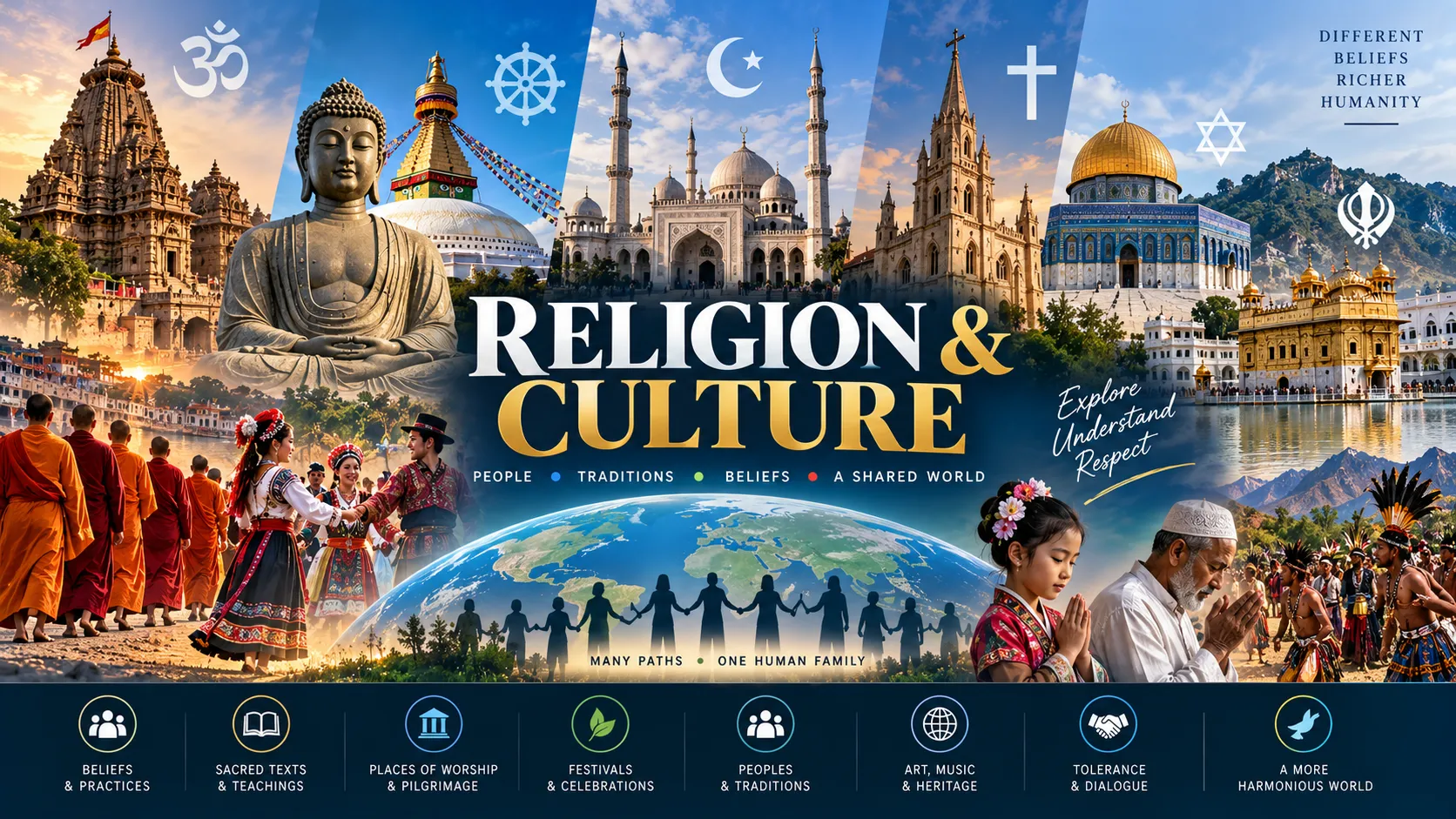
Religion and culture are two powerful forces that shape how people understand themselves, their communities, and the world around them. They influence beliefs, celebrations, clothing, food, art, music, architecture, family traditions, moral values, and many other parts of everyday life.
Although religion and culture often overlap, they are not the same thing. Religion usually involves beliefs and practices connected with spiritual questions, sacred ideas, worship, morality, or the meaning of life. Culture is broader. It includes the shared values, customs, language, traditions, arts, lifestyles, and social practices of a group.
Understanding the relationship between religion and culture helps students study history, geography, sociology, anthropology, politics, and world civilizations. It also helps people understand why communities may share a religion but practice it differently in different parts of the world.
Learning Objectives
After studying this topic, you should be able to:
· Define religion and culture in simple terms.
· Explain the main differences between religion and culture.
· Identify ways religion can influence cultural life.
· Describe how local cultures can influence religious practices.
· Understand concepts such as rituals, symbols, traditions, cultural diffusion, and religious diversity.
· Recognize why respect for religious and cultural differences is important in diverse societies.
What Is Religion?
Religion is a system of beliefs, practices, values, and traditions that helps people address questions about existence, morality, the sacred, life, death, and humanity's place in the universe.
Religions may include belief in one God, many gods, spiritual beings, sacred forces, or principles that do not center on a god at all. Because religions vary greatly, scholars avoid defining religion only in terms of belief in a deity.
Religious life may include:
· Worship and prayer
· Meditation
· Sacred writings
· Moral teachings
· Religious festivals
· Pilgrimages
· Ceremonies
· Dietary rules
· Religious clothing
· Community gatherings
· Rites connected with birth, marriage, adulthood, or death
International human rights standards treat religion and belief broadly. The United Nations recognizes freedom of thought, conscience, religion, and belief, including the freedom to practice a belief individually or with others.
What Is Culture?
Culture is the shared way of life of a group of people. It includes both visible practices and less visible ideas.
UNESCO describes culture broadly as the spiritual, material, intellectual, and emotional features of a society or social group. These include lifestyles, ways of living together, values, traditions, and beliefs as well as art and literature.
Culture may include:
· Language
· Food
· Clothing
· Music
· Art
· Literature
· Social customs
· Family traditions
· Festivals
· Values
· Manners
· Architecture
· Beliefs
· Forms of entertainment
Culture is learned rather than biologically inherited. Children learn much of their culture from families, schools, communities, media, and daily interaction with other people.
Culture also changes. Migration, trade, technology, education, political change, and contact with other societies can introduce new cultural practices.
Religion and Culture: What Is the Difference?
Religion is usually one part of culture, while culture includes many areas that may have little or nothing to do with religion.
For example, a society's language, popular music, sports, architecture, food, clothing, and family traditions are cultural features. Some may have religious origins, while others may be secular.
A useful distinction is:
Religion | Culture |
Often deals with sacred beliefs and spiritual questions | Covers a society's broader way of life |
May include worship and religious rituals | Includes customs, language, arts, food, values, and traditions |
May be organized around religious communities | Exists in every human society |
Can spread across many cultures | Often develops within particular communities |
May influence morality and behavior | Influences everyday social behavior |
The two categories still overlap. A religious festival, for example, can be both a religious observance and an important cultural celebration.
How Religion Influences Culture
Religion has influenced civilizations for thousands of years. Its effects can appear in both everyday habits and major institutions.
Festivals and Calendars
Many cultural celebrations began as religious observances.
Examples include Christmas and Easter in Christian communities, Eid al-Fitr and Eid al-Adha in Muslim communities, Diwali among several South Asian religious traditions, Vesak in Buddhist communities, and Passover in Judaism.
Even people who are not highly religious may participate in some festivals because they have become important family or national traditions.
Food
Religious teachings may influence what people eat and how food is prepared.
Judaism has kosher dietary traditions. Islam includes halal dietary rules and prohibits pork. Many Hindus avoid beef, while some follow vegetarian diets. Certain Christian traditions have historically included fasting or restrictions on particular foods during specific religious seasons.
Over time, such rules can affect regional cuisines and family traditions.
Clothing
Religious beliefs sometimes influence clothing.
Examples include the Sikh turban, Muslim hijab, Jewish kippah, Buddhist monastic robes, Christian clerical clothing, and garments used during Hindu ceremonies.
Clothing practices often vary between regions because religious teachings interact with local history and customs.
Art and Architecture
Religion has inspired some of the world's best-known artistic and architectural traditions.
Temples, churches, mosques, stupas, monasteries, shrines, sculptures, manuscripts, paintings, calligraphy, and sacred music can all express religious ideas.
Architecture can also teach religious concepts. A building's orientation, symbols, decorative patterns, statues, or layout may have spiritual meaning.
Moral Values
Religions often teach principles about honesty, compassion, justice, charity, family responsibilities, violence, forgiveness, and treatment of other people.
These teachings sometimes influence wider cultural expectations even among people who do not personally follow the religion.
Rites of Passage
A rite of passage is a ceremony marking an important stage of life.
Birth ceremonies, naming ceremonies, coming-of-age rituals, marriages, funerals, and memorial practices frequently combine religious belief with cultural tradition.

How Culture Influences Religion
The relationship also works in the opposite direction. Religion shapes culture, but culture can shape how religion is practiced.
A religion followed in several countries may look different in each location. Communities may use different languages, musical styles, foods, clothing, architecture, and customs while sharing many of the same religious beliefs.
For example, Christian worship traditions vary greatly between Ethiopia, Italy, South Korea, Brazil, and the United States. Buddhist communities in Thailand, Tibet, Japan, and Sri Lanka also developed distinctive cultural traditions.
This does not necessarily mean that the religions are completely different. It shows how religious traditions adapt to different historical and cultural settings.
Religious Symbols and Their Cultural Meaning
A symbol is an object, image, gesture, sound, or sign that represents a deeper idea.
Religious symbols may identify a community, communicate teachings, or remind believers of important events.
Examples include:
· The cross in Christianity
· The crescent often associated with Islam
· The Dharma wheel in Buddhism
· The Om symbol in Hindu traditions
· The Star of David in Judaism
· The Khanda in Sikhism
Symbols must be understood in context. Their meaning can differ according to time, place, community, and interpretation.
Rituals, Customs, and Traditions
A ritual is a repeated action performed according to an established pattern and often given symbolic meaning.
Prayer ceremonies, pilgrimages, fasting, lighting lamps or candles, offering food, chanting, and communal worship are examples of religious rituals.
A custom is a common way of behaving within a community, while a tradition is a belief or practice passed from one generation to another.
Not every cultural tradition is religious. A community may have traditional dances, foods, clothing, games, or greetings with no sacred meaning.
Sacred and Secular Life
The word sacred refers to something regarded as holy, spiritually significant, or set apart for religious purposes.
The word secular usually refers to activities or institutions that are not specifically religious.
A society can contain both sacred and secular elements. A historic church, mosque, temple, or monastery may function as a religious site while also being valued as cultural heritage.
Similarly, a religious festival can have sacred meaning for believers while also becoming a public cultural celebration involving food, music, decorations, or tourism.
Cultural Diffusion and Religion
Cultural diffusion is the spread of ideas, customs, technologies, beliefs, or practices from one society to another.
Religion has often spread through cultural diffusion.
Trade routes connected merchants, travelers, teachers, missionaries, scholars, and pilgrims. Migration moved religious communities into new regions. Empires and political expansion also played important historical roles.
As religions entered new societies, they sometimes adopted local languages, artistic styles, foods, architecture, or customs.
This process helps explain why a single religious tradition may develop many regional forms.
Syncretism
Syncretism occurs when elements from different religious or cultural traditions combine.
It often develops when communities remain in close contact for long periods. Local customs may become connected with newly introduced religious beliefs, producing traditions that contain features from several sources.
Historians and anthropologists study syncretism because it shows that cultures are rarely isolated. Human communities constantly exchange ideas.
Religion, Culture, and Identity
Both religion and culture can contribute to personal and group identity.
People may identify themselves through nationality, language, ethnicity, family background, religion, occupation, region, or several identities at once.
A person may also belong culturally to a religious community without being personally religious. For example, someone might participate in traditional festivals or family customs because those practices are part of their heritage.
For this reason, researchers should avoid assuming that every member of a cultural or religious group believes or behaves in exactly the same way.
UNESCO emphasizes that cultures are internally diverse rather than completely uniform. People within the same cultural group may have different experiences and interpretations.
Religious and Cultural Diversity
Religious diversity means the presence of different religions and beliefs within a society.
Cultural diversity refers to the variety of cultures, identities, customs, languages, beliefs, and forms of cultural expression found among human communities.
Modern cities may contain people from many cultural and religious backgrounds. Schools, workplaces, and neighborhoods can therefore include different holidays, dietary practices, languages, forms of dress, and traditions.
UNESCO recognizes cultural diversity as part of humanity's shared heritage and emphasizes dialogue and mutual understanding among cultures.
Freedom of Religion and Cultural Rights
Freedom of religion or belief is recognized as a human right.
Article 18 of the Universal Declaration of Human Rights protects freedom of thought, conscience, and religion. International human rights guidance also protects theistic, non-theistic, and atheistic beliefs and the right not to profess a religion.
Cultural rights are also connected with human rights. However, cultural or religious traditions do not automatically justify practices that violate the fundamental rights of other people. United Nations guidance states that cultural diversity cannot be used to reduce human rights protected under international law.
Common Misconceptions
Everyone from the Same Culture Has the Same Religion
False. Most societies contain religious diversity, and some people follow no religion.
Everyone Who Follows the Same Religion Has the Same Culture
False. Religions often exist across dozens of cultures, languages, and nationalities.
Culture Never Changes
False. Culture changes through migration, technology, trade, education, political change, and interaction between groups.
Every Tradition Is Religious
False. Many traditions are social, historical, regional, or family customs without religious meaning.
Religion and Culture Can Always Be Separated Easily
Not always. A custom may have religious origins but later become mainly cultural, making the boundary difficult to define.
Memory Tips
Remember the distinction with this simple formula:
Religion = sacred beliefs and practices
Culture = shared way of life
Then remember:
Religion can shape culture, and culture can shape religion.
A useful quiz clue is that language, food, music, clothing, customs, values, and traditions usually point toward culture, while worship, sacred beliefs, prayer, religious ceremonies, and spiritual teachings usually point toward religion.
FAQ
1. Are religion and culture the same thing?
No. Religion can be part of culture, but culture also includes language, food, art, customs, music, social behavior, and many non-religious traditions.
2. Can a person have culture without religion?
Yes. Every person participates in cultural environments, but people may be religious, non-religious, atheist, agnostic, or follow other belief systems.
3. How does religion affect culture?
Religion may influence festivals, food, clothing, art, architecture, moral values, family traditions, and ceremonies.
4. How does culture affect religion?
Local languages, music, architecture, clothing, food, and traditions can influence how a religion is practiced in different regions.
5. What is religious diversity?
Religious diversity is the presence of different religions and beliefs within a community or society.
6. What is cultural diffusion?
Cultural diffusion is the spread of ideas, beliefs, customs, technologies, or practices between societies.
7. What is syncretism?
Syncretism is the combination of elements from different cultural or religious traditions.
8. Are all cultural traditions religious?
No. Many traditions involve food, family customs, music, clothing, sports, or celebrations without having religious meaning.
9. Why do people following the same religion have different customs?
Religious communities develop within different languages, histories, climates, political systems, and local cultures. These factors can produce different customs.
10. Why is studying religion and culture useful?
It helps explain historical events, social identities, traditions, conflicts, cultural exchange, art, geography, and relationships between communities.
Key Takeaways
· Religion generally concerns sacred beliefs, spiritual ideas, moral teachings, and religious practices, while culture describes a broader shared way of life.
· Religion can influence food, clothing, festivals, architecture, ethics, art, and family traditions.
· Culture also influences how the same religion is practiced in different regions.
· Religious and cultural groups are internally diverse, so individuals should not be judged only by group labels.
· Cultural and religious diversity are important parts of human society and should be studied with attention to human rights and historical context.
References
1. UNESCO. Concepts Glossary – Culture and Cultural Diversity. UNESCO Intercultural Dialogue Programme.
2. UNESCO. Universal Declaration on Cultural Diversity. Adopted by the UNESCO General Conference, 2001.
3. UNESCO. About the Culture Sector. United Nations Educational, Scientific and Cultural Organization.
4. United Nations Office of the High Commissioner for Human Rights. Universal Declaration of Human Rights, Article 18.
5. United Nations Human Rights Committee. General Comment No. 22: Article 18 — Freedom of Thought, Conscience or Religion.
6. United Nations Committee on Economic, Social and Cultural Rights. General Comment No. 21: Right of Everyone to Take Part in Cultural Life.