
Introduction
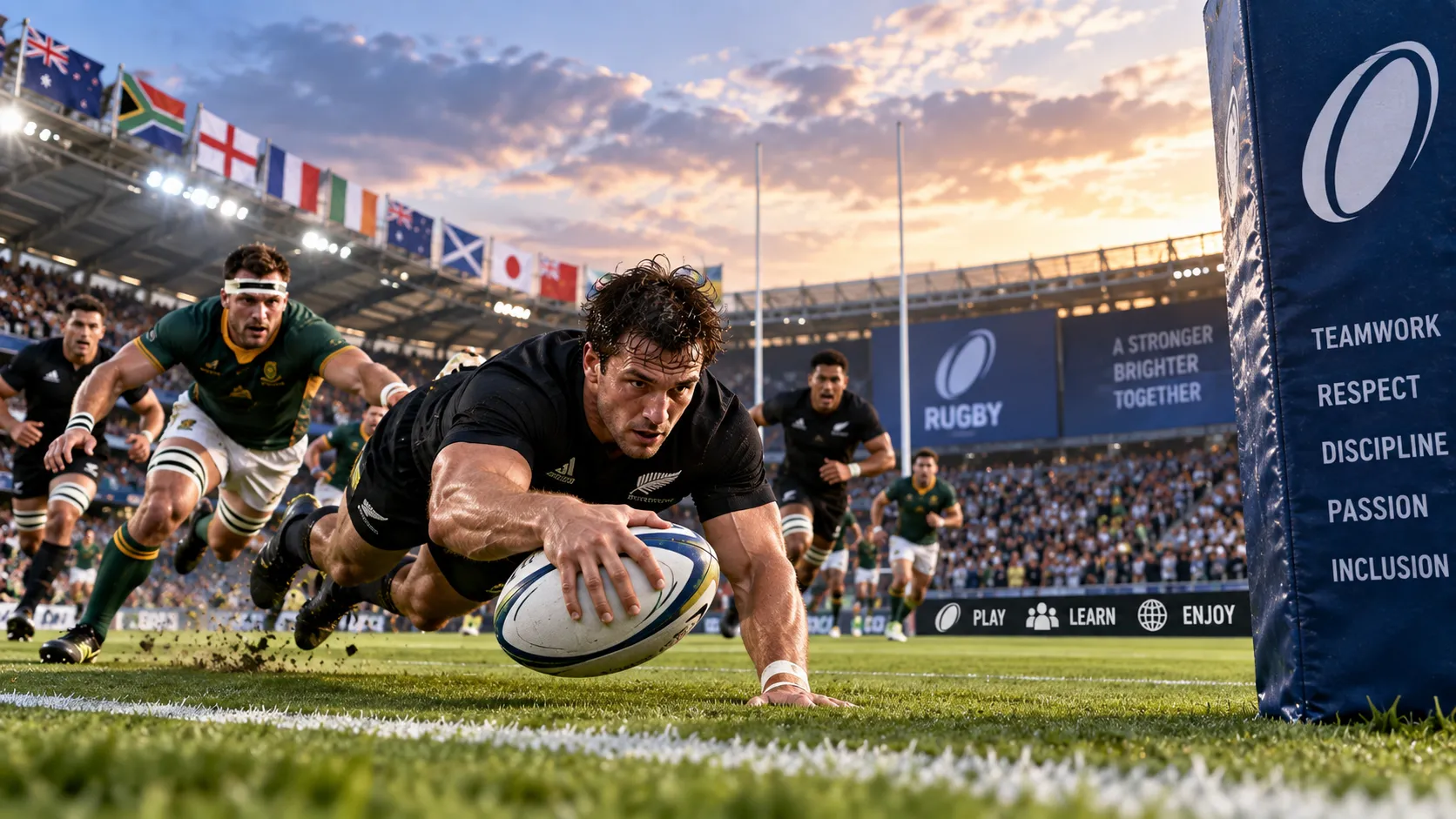
Rugby is a team sport in which players run, pass, kick, tackle, and compete for possession of an oval-shaped ball. The main objective is to score more points than the opposing team, especially by carrying or moving the ball into the opponent's in-goal area and grounding it for a try.
The word rugby can describe several related sports. The two major codes are rugby union and rugby league. Rugby union is commonly played with 15 players per side, while rugby league normally uses 13. Rugby sevens, an Olympic form of rugby union, uses seven players per team.
This guide focuses mainly on rugby union while explaining the most important differences between union, league, and sevens. Understanding rugby requires learning how players can move the ball, how scoring works, what happens after a tackle, and why scrums, rucks, mauls, and lineouts are important.
Learning Objectives
After studying this guide, you should be able to:
· Explain the basic objective and structure of rugby.
· Identify the major rugby union positions.
· Describe tries, conversions, penalty goals, and drop goals.
· Explain tackles, rucks, mauls, scrums, lineouts, and offside.
· Distinguish rugby union from rugby league and rugby sevens.
· Recognize important rugby terminology, tactics, and competitions.
Origins of Rugby
Rugby's traditional origin story is connected with Rugby School in England.
According to the famous legend, student William Webb Ellis picked up the ball during a school football match in 1823 and ran with it. The historical accuracy of this particular event has been questioned, and World Rugby describes it as a legend rather than an established fact.
What is certain is that Rugby School played an important role in developing the sport. Written rules associated with the school appeared in 1845. The first international rugby match between Scotland and England took place in 1871.
Rugby eventually developed into different codes, especially rugby union and rugby league.
Rugby Union, Rugby League, and Rugby Sevens
The three forms share many basic ideas but have important differences.
Feature | Rugby Union | Rugby League | Rugby Sevens |
Players on field | 15 per team | 13 per team | 7 per team |
Main scoring play | Try | Try | Try |
Try value | 5 points | 4 points | 5 points |
Normal match | Up to 80 minutes | Usually 80 minutes | 14 minutes |
Major possession feature | Rucks and mauls | Six-tackle sets | Rugby union rules with sevens variations |
Lineouts | Yes | No traditional union-style lineout | Yes |
Scrum | 8 forwards per team in 15s | Different league scrum structure | 3 players per team |
Olympic form | No | No | Yes |
World Rugby's current laws state that a standard union match lasts no longer than 80 minutes, normally divided into two halves of up to 40 minutes.
The Basic Objective
The objective is simple:
Score more points than the opposing team.
Teams try to advance toward the opponent's try line while maintaining possession.
Players may advance the ball by:
· Running while carrying it.
· Passing sideways or backward.
· Kicking it forward.
· Regaining possession after a kick.
· Winning possession at contests such as scrums, lineouts, and breakdowns.
One of rugby's most important rules is that players generally cannot deliberately pass the ball forward with their hands.
A player can, however, kick the ball forward.
The Rugby Field
A rugby field contains several important markings.
The halfway line divides the playing area into two halves.
The touchlines run along the sides of the field. When the ball goes beyond them, it is generally said to have gone into touch.
At each end is a try line or goal line. Beyond it is the in-goal area, where tries can be scored.
H-shaped goal posts stand on the goal line. Successful conversion, penalty, and drop-goal kicks must travel over the crossbar and between the posts.
Scoring in Rugby Union
Rugby union provides several ways to score.
Try — 5 Points
A try is worth five points.
It is normally scored when an attacking player legally grounds the ball in the opponent's in-goal area.
Despite the name, a player does not simply "try" to score. A completed grounding is required.
Conversion — 2 Points
After scoring a try, the team receives an opportunity to attempt a conversion.
A successful conversion is worth two additional points.
The ball must be kicked over the crossbar and between the uprights. The location of the kick is related to where the try was scored, which is why players often try to score closer to the posts when possible.
Penalty Goal — 3 Points
Certain infringements give the non-offending team a penalty.
The team may sometimes choose to kick at goal.
A successful penalty goal is worth three points.
Drop Goal — 3 Points
A player may score a drop goal during open play.
The player drops the ball so that it touches the ground and then kicks it as it rebounds. If the ball travels over the crossbar and between the posts, three points are scored.
Penalty Try — 7 Points
A referee may award a penalty try when foul play prevents a probable try from being scored, or from being scored in a more advantageous position.
It is worth seven points, and no conversion is attempted.
Rugby Union Positions
A rugby union team has 15 players: eight forwards and seven backs.
Number | Position | General Role |
1 | Loosehead prop | Scrum strength and close-contact play |
2 | Hooker | Scrum and lineout duties |
3 | Tighthead prop | Scrum strength |
4 | Lock / second row | Lineouts, scrums, physical contests |
5 | Lock / second row | Lineouts, scrums, physical contests |
6 | Blindside flanker | Tackling and breakdown work |
7 | Openside flanker | Competing for possession |
8 | Number eight | Controls ball at scrum base and carries |
9 | Scrum-half | Links forwards and backs |
10 | Fly-half | Directs attack and kicking |
11 | Wing | Speed and try-scoring |
12 | Inside centre | Running, passing, and defence |
13 | Outside centre | Attacking space and defence |
14 | Wing | Speed and try-scoring |
15 | Full-back | Deep defence, catching kicks, counterattack |
Forwards
Forwards generally perform much of the close physical work.
They compete in scrums and lineouts, carry the ball into contact, tackle, protect possession, and contest breakdowns.
Backs
Backs generally operate in more open space.
They rely heavily on passing, kicking, acceleration, positioning, and attacking movement.
These descriptions are not absolute. Modern rugby requires forwards who can pass and run skilfully and backs who can tackle effectively.
Passing the Ball
Players may pass the ball backward or sideways.
A deliberate forward throw is illegal.
This creates one of rugby's distinctive tactical problems: a team wants to move toward the opponent's goal line even though ordinary hand passes cannot be thrown forward.
Teams solve this by running forward, supporting the ball carrier from behind, and using backward passes to move the ball into space.
The Knock-On
A knock-on generally occurs when a player loses control of the ball forward and it contacts the ground or another player before the original player can recover it according to the laws.
A knock-on commonly results in a scrum for the non-offending team.
It is different from intentionally kicking the ball forward.
Tackling
A defender can stop a ball carrier by making a legal tackle.
After a tackle, the game does not simply stop.
In rugby union, the tackled player must release the ball, while the tackler must release the tackled player and comply with the laws governing the tackle area. Other players can then compete for possession.
This continuous contest after contact is one of rugby union's defining characteristics.
The Ruck
A ruck forms when the ball is on the ground and players from both teams, who remain on their feet, come into contact over or around it.
Players in a formed ruck generally cannot simply pick up the ball with their hands. They compete by maintaining body position and driving over the ball until it becomes available behind the ruck.
Rucks create new offside lines and are central to possession in rugby union.
The Maul
A maul occurs when the ball carrier remains on their feet while being held by an opponent and at least one teammate also binds to the contest.
Unlike a ruck:
Ruck → ball is on the ground.
Maul → ball carrier and ball remain off the ground.
Teams can drive a maul forward while protecting the ball.
The Scrum
A scrum is a structured contest used to restart play after certain minor infringements or stoppages.
In 15-player rugby union, eight forwards from each team bind together. The scrum-half introduces the ball, and the teams compete for possession.
Common situations leading to a scrum include certain knock-ons and forward passes.
Scrums require strength, balance, timing, coordination, and specialized technique.
The Lineout
When the ball goes into touch, rugby union often restarts with a lineout.
Players from the two teams form lines perpendicular to the touchline. The ball is thrown between them, and players compete to catch or tap it.
Players may lift teammates to help them reach the ball, subject to safety rules.
Lineouts require carefully planned movements and communication.
Offside
Rugby's offside rules help create space between attackers and defenders.
In open play, a player is generally offside when positioned ahead of the teammate who is carrying or last played the ball. Simply being ahead does not automatically produce a penalty, but an offside player may not improperly interfere with play until becoming onside.
Rucks, mauls, scrums, and lineouts also create specific offside lines.
A useful beginner's principle is:
Stay behind the appropriate teammate or offside line before joining play.
Advantage
The referee does not always immediately stop play after an infringement.
Under the advantage principle, the referee can allow play to continue when the non-offending team may gain a meaningful advantage.
If the advantage does not develop sufficiently, the referee may return play to the original infringement.
Advantage helps keep rugby flowing rather than stopping the match unnecessarily.
Penalties and Free Kicks
Different infringements result in different sanctions.
A team receiving a penalty may have several options depending on the situation, including:
· Kicking for goal.
· Kicking for touch.
· Taking a quick tap and continuing play.
· Choosing certain set-piece options where permitted.
Penalty decisions are strategically important. A team trailing by two points late in a match might attempt a penalty goal, while a team seeking a try might kick toward touch and attack from the resulting field position.
Foul Play and Player Safety
Rugby permits physical contact, but that contact is governed by safety rules.
Dangerous play can include illegal high contact, dangerous tackles, striking, or other forms of foul play.
Referees can award penalties and issue disciplinary cards.
Player welfare is a central part of modern rugby law, and World Rugby provides specific training and safety programs for players, coaches, referees, and unions.
Rugby League
Rugby league developed separately from rugby union and has important rule differences.
A rugby league team normally has 13 players.
After a legal tackle, play generally restarts through a play-the-ball rather than a rugby union-style ruck. The attacking team normally receives a set of up to six tackles before possession is handed over unless another event resets the count. Current International Rugby League laws continue to use the six-tackle structure.
League scoring also differs from union.
Under the 2026 international laws:
· Try = 4 points
· Conversion goal = 2 points
· Penalty goal = 2 points
· Drop goal = 1 point
This is one of the easiest ways to distinguish the two codes in quiz questions.
Rugby Sevens
Rugby sevens is an abbreviated version of rugby union.
Each team has seven players: three forwards and four backs. It is played on a full-size rugby field, creating considerably more open space than traditional 15-a-side rugby.
A standard sevens match normally consists of two seven-minute halves, for 14 minutes of playing time, subject to current competition and law provisions.
Because there are fewer players covering the same field, sevens emphasizes:
· Speed
· Fitness
· Open-field tackling
· Passing
· Support running
· Creating space
Rugby sevens returned to the Olympic programme at the Rio 2016 Games.
Basic Rugby Tactics
Although rugby has many laws, much of its strategy revolves around a few ideas.
Maintain Possession
Teams try to protect the ball through tackles and breakdowns while creating another attacking phase.
Gain Territory
Kicking can move play away from a team's own try line and place pressure on the opposition.
Create Space
Defenders cannot cover every part of the field equally.
Attacking teams use passes, runners, kicks, and changes of direction to concentrate defenders in one area before attacking another. World Rugby describes creating space as a fundamental tactical goal.
Support the Ball Carrier
A player who runs away from teammates may become isolated after being tackled.
Effective support allows teammates to protect possession or receive passes.
Major Rugby Competitions
Important rugby union competitions include the Rugby World Cup, the Women's Rugby World Cup, the Six Nations Championship, and The Rugby Championship.
Professional club and regional competitions also operate in many countries.
Rugby league has its own international and domestic competitions, including the Rugby League World Cup.
Rugby sevens is played internationally and is also part of the Olympic Games.
Common Rugby Terms
Try: grounding the ball in the opponent's in-goal to score.
Conversion: kick attempted after a try.
Touch: area beyond the side boundary.
Scrum: structured contest that restarts play.
Lineout: restart following the ball entering touch.
Ruck: contest over a ball on the ground.
Maul: contest involving a standing ball carrier.
Knock-on: losing the ball forward in circumstances defined by the laws.
Offside: being improperly positioned ahead of the relevant offside line and becoming involved in play.
Breakdown: general term commonly used for the contest immediately following a tackle.
Phase: a period of play between successive breakdowns or similar resets during continuous possession.
Common Mistakes
Mistake 1: Players Can Never Move the Ball Forward
False. Players cannot normally pass the ball forward with their hands, but they can run forward with it or kick it forward.
Mistake 2: Rugby Union and Rugby League Are the Same Sport
False. They share common origins but have different numbers of players, scoring systems, tackle rules, and possession structures.
Mistake 3: A Try Is Worth Three Points
False in rugby union. A try is worth five points. In rugby league, it is normally worth four.
Mistake 4: Every Tackle Stops the Match
False. Rugby union normally continues through the tackle and breakdown process.
Mistake 5: A Ruck and Maul Are the Same Thing
False.
In a ruck, the ball is on the ground.
In a maul, the ball carrier remains off the ground.
Mistake 6: Rugby Sevens Uses a Smaller Field
False. Sevens is normally played on a full-size rugby union field despite having only seven players per team.
Memory Tips
Remember:
Union = 15
League = 13
Sevens = 7
For rugby union scoring:
Try 5 → Conversion 2 → Penalty 3 → Drop goal 3
For league scoring:
Try 4 → Conversion 2 → Penalty 2 → Drop goal 1
For possession contests:
Ball down = ruck
Ball up = maul
And remember the fundamental movement rule:
Run forward, pass backward.
Summary
Rugby is a physical team sport built around running, passing, kicking, tackling, territorial control, and competition for possession.
In rugby union, teams normally field 15 players. A try scores five points, with additional points available through conversions, penalty goals, and drop goals. After tackles, players can compete for possession through breakdowns and rucks, while scrums and lineouts provide structured ways of restarting play.
Rugby league uses 13 players and a six-tackle possession system, while rugby sevens reduces union teams to seven players and produces a faster, more open style of play.
Understanding rugby becomes much easier when a beginner remembers a few core principles: the ball is normally passed backward, players may run or kick forward, tackled players must release the ball according to the laws, and teams continually compete to create space while protecting possession.
FAQ
1. How many players are on a rugby team?
Rugby union normally uses 15 players per team, rugby league uses 13, and rugby sevens uses seven.
2. How many points is a try worth in rugby union?
A try is worth five points.
3. Can players pass forward in rugby?
A normal hand pass cannot be thrown forward. Players can run forward with the ball or kick it forward.
4. What is a scrum?
A scrum is a structured contest used to restart play after certain infringements or stoppages.
5. What is a ruck?
A ruck is a contest for possession formed over the ball on the ground when players from opposing teams meet while remaining on their feet.
6. What is the difference between a ruck and a maul?
The ball is on the ground in a ruck. In a maul, the ball carrier remains standing and is held by players from both teams.
7. What is a lineout?
A lineout is a rugby union method of restarting play after the ball has gone into touch.
8. How long is a rugby union match?
Under the standard World Rugby laws, a match lasts no longer than 80 minutes, divided into two halves of up to 40 minutes, excluding permitted time adjustments.
9. What is the biggest difference between rugby union and rugby league?
Major differences include 15 versus 13 players, different scoring values, and the way possession continues after tackles. League uses a six-tackle set, while union uses breakdown contests such as rucks.
10. Is rugby sevens an Olympic sport?
Yes. Rugby sevens is the form of rugby played at the Olympic Games.
Key Takeaways
· Rugby union uses 15 players, rugby league 13, and rugby sevens seven.
· Rugby union awards five points for a try, two for a conversion, and three for a penalty goal or drop goal.
· Players can run or kick forward, but ordinary hand passes must travel sideways or backward.
· Rucks, mauls, scrums, lineouts, tackles, and offside rules are fundamental to rugby union.
· Rugby league and rugby sevens share rugby's basic principles but use different structures and rules.
References
1. World Rugby. Laws of the Game — Law 5: Time. Current law governing match duration.
2. World Rugby. Laws of the Game — Law 8: Scoring. Official rules for tries, conversions, penalty tries, penalty goals, and drop goals.
3. World Rugby. Beginner's Guide — Players and Positions. Explains the 15 rugby union positions and the division between forwards and backs.
4. World Rugby. Beginner's Guide — Tackle, Ruck and Maul. Explains continuity after a tackle and the formation of rucks and mauls.
5. World Rugby. Beginner's Guide — The Scrum. Explains the purpose and organization of the rugby union scrum.
6. World Rugby. Beginner's Guide — The Lineout. Explains the restart used after the ball enters touch.
7. World Rugby. Beginner's Guide — Offside. Introduces rugby's offside principle.
8. World Rugby. Rugby's History and Ethos. Covers Rugby School and the traditional William Webb Ellis story.
9. World Rugby. Rugby Sevens FAQs. Covers sevens teams, match length, rules, and origins.
10. International Rugby League. International Laws of the Game 2026. Official rugby league rules covering scoring and the tackle system.