


Introduction
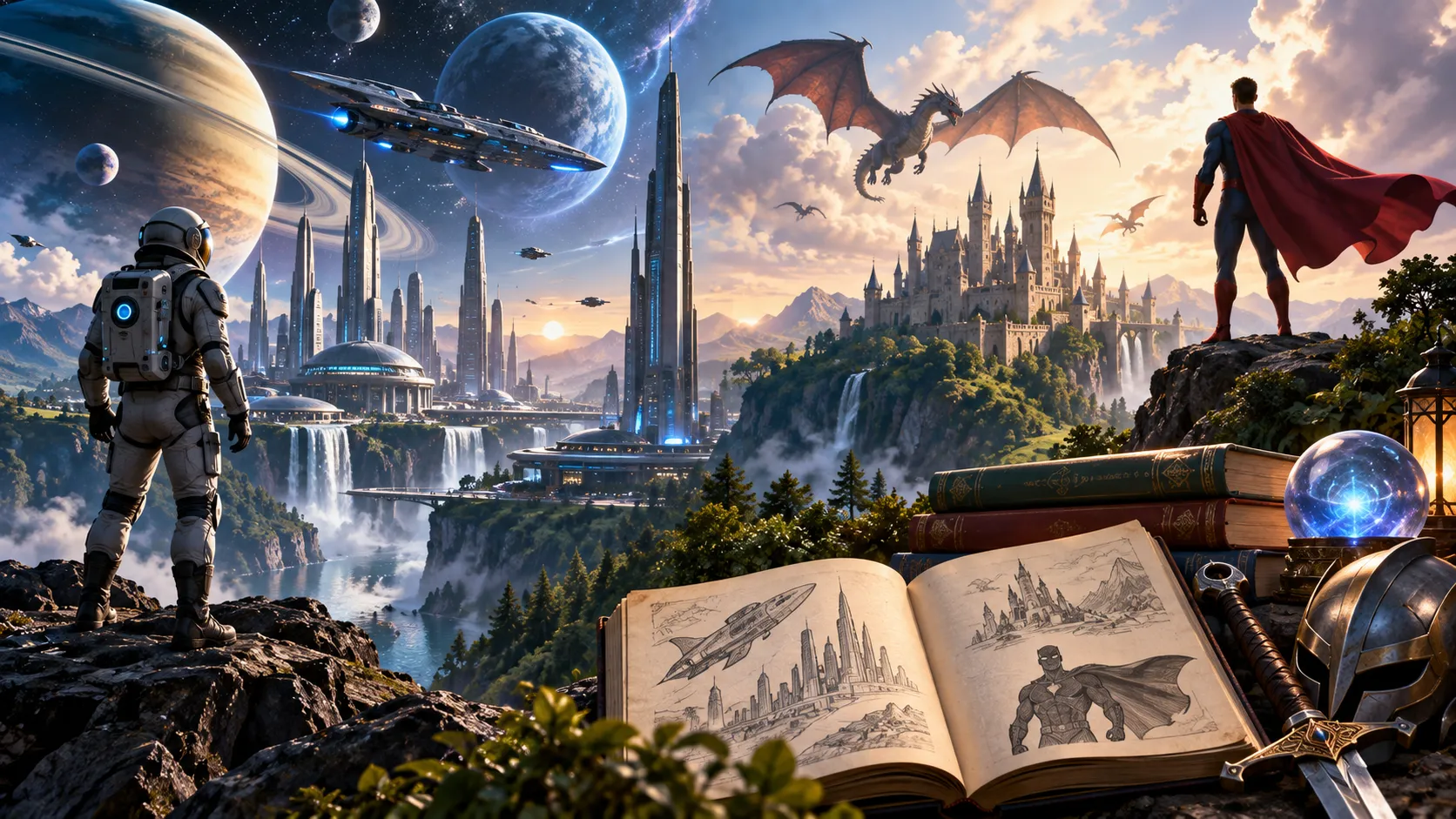
Science fiction, fantasy, and superhero fiction are three closely related forms of imaginative storytelling. They appear in novels, short stories, comics, films, television series, animation, video games, and other media.
The genres often overlap, but they usually ask different kinds of questions. Science fiction commonly imagines how science, technology, space exploration, artificial intelligence, or future societies might affect people. Fantasy allows magic, supernatural forces, mythical creatures, or invented worlds to operate as normal parts of the story. Superhero fiction focuses on extraordinary heroes and villains whose abilities, technology, training, or supernatural qualities place them beyond ordinary people.
The boundaries are not rigid. A superhero story can be science fiction if powers originate from advanced technology or genetic engineering, fantasy if gods and magic dominate the story, or a combination of both. Learning the main conventions of each genre makes it easier to classify stories, recognize subgenres, understand worldbuilding, and answer literature and popular-culture quiz questions.
Learning Objectives
After studying this guide, you should be able to:
Explain the differences among science fiction, fantasy, and superhero fiction.
Identify major subgenres such as space opera, dystopian fiction, cyberpunk, high fantasy, and urban fantasy.
Understand worldbuilding, magic systems, speculative technology, and superpowers.
Recognize common themes and character types.
Explain how superhero comics developed into a major popular-culture genre.
Identify where science fiction, fantasy, and superheroes overlap.
What Is Science Fiction?
Science fiction, often shortened to sci-fi or SF, is speculative fiction that explores imagined scientific discoveries, technological developments, future societies, space travel, extraterrestrial life, artificial intelligence, time travel, and similar possibilities.
The Library of Congress notes that technological developments not yet achieved, along with subjects such as long-distance spaceflight and time travel, are recurring elements of science fiction.
Science fiction often begins with a question such as:
What if humans colonized another planet?
What if computers became conscious?
What if time travel were possible?
What if genetic engineering could redesign humans?
What would society look like after a global catastrophe?
These questions allow writers to explore both technology and human behavior.
Science Fiction Is Not Always a Prediction
Science fiction may describe future technologies, but its main purpose is not necessarily to predict the future accurately.
A story about robots may really be examining labor, identity, prejudice, or consciousness. A story about another planet may explore colonialism or environmental destruction.
The imagined technology often creates conditions that allow the writer to examine a larger social question.
Major Science Fiction Subgenres
Hard Science Fiction
Hard science fiction places strong emphasis on scientific accuracy or plausibility.
Stories may focus on:
Astronomy
Physics
Engineering
Spaceflight
Biology
Planetary science
Writers may carefully explain how technologies or environments could work according to known scientific principles.
Soft Science Fiction
Soft science fiction focuses more heavily on people and societies.
It may explore:
Psychology
Sociology
Politics
Economics
Culture
Philosophy
The technology may matter less than its effects on human life.
Space Opera
Space opera features large-scale adventures set in space.
Common elements include:
Interstellar civilizations
Starships
Galactic conflict
Alien societies
Heroes and villains
Epic journeys
Space opera usually emphasizes adventure and dramatic scale rather than strict scientific realism.
Cyberpunk
Cyberpunk combines advanced technology with social disorder.
Typical cyberpunk settings include:
Artificial intelligence
Cybernetic implants
Virtual reality
Powerful corporations
Dense futuristic cities
Hackers
Social inequality
Cyberpunk often explores the question:
What happens when technology becomes highly advanced but society remains deeply unequal?
Dystopian Science Fiction
A dystopia is an imagined society characterized by serious oppression, control, inequality, or other harmful conditions.
Dystopian stories may explore:
Authoritarian governments
Mass surveillance
Environmental collapse
Propaganda
Social engineering
Loss of individual freedom
Dystopian fiction often functions as a warning about present-day social trends.
Post-Apocalyptic Fiction
Post-apocalyptic fiction takes place after a civilization-changing disaster.
Possible causes include:
Nuclear war
Pandemic
Asteroid impact
Climate disaster
Technological collapse
Alien invasion
The story often focuses on survival and the rebuilding of society.
Time-Travel Fiction
Time-travel stories involve characters or information moving between different periods.
These stories frequently create paradoxes.
For example, changing an event in the past could alter the future in ways that prevent the original journey from happening.
What Is Fantasy?
Fantasy is fiction in which impossible or supernatural elements are accepted as part of the story world.
Common fantasy elements include:
Magic
Dragons
Wizards
Gods
Curses
Mythical creatures
Enchanted objects
Imaginary kingdoms
The Library of Congress describes fantasy as storytelling that moves beyond ordinary physical laws and may involve supernatural forces, magical objects, imaginary lands, and mythological creatures.
Fantasy does not usually need to explain supernatural events scientifically.
A wizard may cast a spell because magic simply exists in that fictional world.
Major Fantasy Subgenres
High Fantasy
High fantasy normally takes place in a fully invented or extensively imagined world.
Such worlds may contain:
Original geography
Kingdoms and empires
Unique cultures
Constructed languages
Magical creatures
Extensive histories
J.R.R. Tolkien's Middle-earth is one of the most influential examples of large-scale fantasy worldbuilding. The Library of Congress notes the lasting influence and popularity of The Hobbit and The Lord of the Rings.
Epic Fantasy
Epic fantasy emphasizes a conflict with enormous consequences.
The story may concern the fate of:
A kingdom
A civilization
An entire world
Epic fantasy commonly includes long journeys, powerful enemies, ancient histories, and large groups of characters.
High fantasy and epic fantasy often overlap.
Low Fantasy
Low fantasy generally introduces magical or supernatural elements into a world closer to ordinary reality.
The term can be used differently by different readers and scholars, so it should not be treated as the perfect opposite of high fantasy in every context.
Urban Fantasy
Urban fantasy places supernatural elements in a modern or recognizable urban environment.
A contemporary city might secretly contain:
Witches
Vampires
Ghosts
Magical organizations
Mythological beings
The contrast between everyday life and hidden supernatural activity is often central to the story.
Dark Fantasy
Dark fantasy combines fantasy with disturbing, frightening, or tragic elements.
It may overlap with horror.
Common features include dangerous supernatural beings, curses, morally complex worlds, and threatening magical forces.
Sword and Sorcery
Sword and sorcery emphasizes individual heroes, physical adventure, combat, monsters, and magic.
The scale is often more personal than epic fantasy. Instead of saving an entire world, a hero might seek treasure, escape an enemy, or defeat a sorcerer.
Worldbuilding
Worldbuilding is the creation of the setting in which a fictional story operates.
Strong worldbuilding may include:
Geography
History
Politics
Religion
Technology
Magic
Languages
Economies
Social customs
Species or civilizations
Worldbuilding is especially important in science fiction and fantasy because the author may need to explain environments that do not exist in reality.
A fictional world should generally have consistent internal rules.
If teleportation exists, readers may naturally ask why people still use ordinary transportation. If magic can heal any injury instantly, the writer must consider how that affects warfare and medicine.
Consistency makes an imaginary world feel believable.
Magic Systems
A magic system describes how supernatural powers work in a fictional setting.
A tightly defined system may have clear rules concerning:
Who can use magic
What magic can accomplish
What it costs
What its limits are
How people learn it
Other stories deliberately keep magic mysterious.
Neither method is automatically better. The important point is that magic serves the story's themes and atmosphere.
Science Fiction vs. Fantasy
The easiest distinction is:
Science fiction → extraordinary events explained mainly through science or technology
Fantasy → extraordinary events explained mainly through magic or supernatural forces
Compare these examples:
Story Element | Science-Fiction Version | Fantasy Version |
Flight | Jetpack | Enchanted broom |
Immortality | Genetic engineering | Magical curse |
Communication at distance | Advanced transmitter | Telepathy or spell |
Powerful weapon | Energy weapon | Magical sword |
Strange creature | Alien species | Dragon |
The difference depends mostly on the fictional explanation.
Science Fantasy
Some stories deliberately combine both genres.
Science fantasy mixes scientific or technological ideas with magical, mythological, or supernatural concepts.
A fictional universe might contain starships and robots alongside mystical powers and ancient prophecies.
This overlap demonstrates why genre labels are useful categories rather than strict scientific classifications.
What Is Superhero Fiction?
Superhero fiction centers on characters who perform extraordinary heroic actions and usually possess abilities, equipment, training, or other qualities beyond those of ordinary people.
A superhero may gain extraordinary capabilities through:
Alien biology
Scientific experimentation
Genetic mutation
Advanced technology
Magic
Divine powers
Extreme training
The Library of Congress describes "superpower" as a popular-culture term for superhuman abilities such as super strength, flight, and telekinesis. Such abilities frequently appear in comics, science fiction, television, and film.
Not every superhero actually has a supernatural power. Some rely on intelligence, technology, physical training, wealth, or specialized equipment.
The Rise of Modern Superheroes
Heroic figures existed in mythology and literature long before comic books.
However, the modern comic-book superhero genre took recognizable form in the late 1930s.
Superman debuted in Action Comics No. 1 in 1938. Batman followed in Detective Comics No. 27 in 1939, while Wonder Woman appeared in All Star Comics No. 8 in 1941. The Library of Congress identifies these characters as central figures in the development of superhero comics.
The Smithsonian similarly identifies Superman's 1938 debut, created by Jerry Siegel and Joe Shuster, as a major starting point for the Golden Age of comic-book superheroes.
Comic Book Ages
Comic-book history is frequently divided into broad periods called "Ages."
The best-known labels include:
Golden Age
Silver Age
Bronze Age
Later period names are less standardized and frequently debated among scholars, collectors, and fans. The Library of Congress notes that these labels are useful but not universally agreed upon.
Common Superhero Characteristics
Although individual stories differ, superhero fiction frequently includes:
Extraordinary Ability
The hero possesses powers, technology, skills, or resources allowing unusual achievements.
Heroic Identity
The character adopts a role associated with protecting others or fighting threats.
Costume or Symbol
Many superheroes use recognizable clothing, colors, masks, or symbols.
Secret Identity
Some maintain separate heroic and everyday identities.
Origin Story
An origin story explains how the hero acquired powers, equipment, motivations, or identity.
Supervillain
A supervillain is an extraordinary antagonist whose abilities, intelligence, influence, or technology make them a major threat.
Superheroes and Moral Responsibility
Superhero stories frequently ask what someone should do with extraordinary power.
Common themes include:
Responsibility
Justice
Revenge
Sacrifice
Identity
Prejudice
Corruption
Freedom
Loyalty
A hero may be physically capable of defeating an enemy but still face a difficult moral decision.
This helps explain why superheroes can function as modern versions of mythic heroes. The Smithsonian explicitly compares their cultural appeal with larger-than-life figures from older mythology.
Heroes, Antiheroes, and Villains
Hero
A traditional hero generally tries to protect others or achieve a morally positive goal.
Antihero
An antihero is a central character who lacks some qualities traditionally associated with heroic behavior.
An antihero may be:
Cynical
Selfish
Violent
Morally uncertain
The character can still perform heroic actions.
Villain
A villain opposes the hero or pursues harmful goals.
Strong villains often believe they have reasons for their actions rather than simply behaving badly without motivation.
Supervillain
A supervillain is a villain operating within superhero conventions, often possessing extraordinary capabilities or resources.
Shared Themes Across All Three Genres
Science fiction, fantasy, and superhero fiction frequently explore similar questions.
Good and Evil
Fantasy and superhero stories often examine direct conflicts between heroic and destructive forces.
Modern stories may complicate this by introducing morally uncertain characters.
Power
All three genres frequently ask:
Who should possess power, and what happens when it is abused?
That power may be technological, magical, political, or superhuman.
Identity
Characters may struggle with:
Hidden identities
Transformation
Belonging
Alienation
Humanity
Robots wondering whether they are human and superheroes balancing two identities are different versions of the same question.
Society
Imagined worlds allow writers to examine real societies indirectly.
Fictional conflicts can explore:
Prejudice
War
Inequality
Environmental destruction
Government power
Scientific ethics
Common Mistakes
Mistake 1: All Stories Set in Space Are Science Fiction
Not necessarily.
A story can use spaceships while functioning more like fantasy if its central rules depend on mystical or supernatural forces.
Mistake 2: Fantasy Means Children's Stories
False.
Fantasy can be written for children, teenagers, or adults and can explore complex political, philosophical, or social themes.
Mistake 3: Every Superhero Has Superpowers
False.
Some superheroes rely primarily on technology, intelligence, physical training, or equipment.
Mistake 4: Science Fiction Must Be Scientifically Accurate
False.
Scientific plausibility varies greatly. Some science fiction carefully follows known science, while other works deliberately prioritize adventure or metaphor.
Mistake 5: Fantasy Has No Rules
False.
Effective fantasy often depends on consistent rules concerning magic, politics, geography, and character abilities.
Mistake 6: Genre Categories Never Overlap
False.
Science fantasy and many superhero stories deliberately combine multiple genres.
Memory Tips
Remember:
Sci-fi = science and technology
Fantasy = magic and supernatural
Superhero = extraordinary hero
For subgenres:
Space opera = galactic adventure
Cyberpunk = high technology + troubled society
Dystopia = oppressive society
High fantasy = invented world
Urban fantasy = magic in modern settings
For characters:
Hero = protects
Antihero = imperfect hero
Villain = opposes
Supervillain = extraordinary antagonist
Summary
Science fiction, fantasy, and superhero fiction are major forms of imaginative storytelling.
Science fiction typically uses imagined science, technology, future societies, space exploration, artificial intelligence, or similar concepts. Major subgenres include hard science fiction, space opera, cyberpunk, dystopian fiction, and post-apocalyptic fiction.
Fantasy relies more heavily on magic, supernatural forces, mythical creatures, and imaginary worlds. High fantasy, urban fantasy, dark fantasy, and sword and sorcery represent several important forms.
Superhero fiction centers on extraordinary heroes and villains. Modern superhero comics developed rapidly after Superman's debut in 1938 and grew into a major international form of popular culture.
The genres frequently overlap. A superhero may receive powers from science, magic, alien biology, or technology. A story can combine spaceships with supernatural forces. Genre labels therefore help us understand stories, but they do not create absolute boundaries.
Across all three genres, imaginative settings allow storytellers to examine real questions about power, identity, morality, technology, society, and what it means to be human.
FAQ
1. What is science fiction?
Science fiction is speculative fiction that commonly explores imagined science, technology, future societies, space travel, artificial intelligence, aliens, or other scientifically framed possibilities.
2. What is fantasy?
Fantasy is imaginative fiction that permits magic, supernatural forces, mythical creatures, or other events that go beyond ordinary physical laws.
3. What is the main difference between science fiction and fantasy?
Science fiction usually explains extraordinary events through science or technology, while fantasy generally uses magic or supernatural forces.
4. What is science fantasy?
Science fantasy combines elements of science fiction and fantasy within the same story.
5. What is a superhero?
A superhero is an extraordinary heroic character who uses unusual powers, technology, skills, or other abilities to confront threats.
6. Do all superheroes have superpowers?
No. Some rely on training, intelligence, technology, equipment, or other resources instead.
7. What is cyberpunk?
Cyberpunk is a science-fiction subgenre combining advanced technology with social disorder, corporate power, inequality, hacking, or cybernetic technology.
8. What is high fantasy?
High fantasy generally takes place in a substantially invented world with its own geography, societies, histories, creatures, or magical systems.
9. What is an antihero?
An antihero is a central character who may perform heroic actions while lacking conventional heroic qualities.
10. When did the modern superhero genre emerge?
The modern comic-book superhero genre developed strongly in the late 1930s, with Superman's 1938 debut representing a major milestone.
Key Takeaways
Science fiction focuses mainly on speculative science and technology, while fantasy centers more strongly on magic and supernatural possibilities.
Important sci-fi subgenres include space opera, cyberpunk, dystopian fiction, and hard science fiction.
Fantasy includes forms such as high fantasy, urban fantasy, dark fantasy, and sword and sorcery.
Modern superhero comics developed rapidly after Superman's 1938 debut and frequently combine science-fiction and fantasy elements.
All three genres use imagined worlds to explore real questions about power, society, morality, identity, and humanity.
References
1. Library of Congress. Science Fiction — Science Through Pop Culture: A Research Guide. Library of Congress — Science Fiction
2. Library of Congress. Fantasy — Science Through Pop Culture: A Research Guide. Library of Congress — Fantasy
3. Library of Congress. Superpowers — Science Through Pop Culture: A Research Guide. Library of Congress — Superpowers
4. Library of Congress. Super Heroes — Comic Art: 120 Years of Panels and Pages. Library of Congress — Super Heroes
5. Library of Congress. Superheroes — Geppi Gems. Library of Congress — Superheroes Exhibition
6. Smithsonian Institution. Excelsior! American Superheroes. Smithsonian — American Superheroes
7. Library of Congress. Comic Book Eras & History. Library of Congress — Comic Book History
8. Library of Congress. Lord of the Rings and Other Works by J.R.R. Tolkien. Library of Congress — J.R.R. Tolkien and Middle-earth