


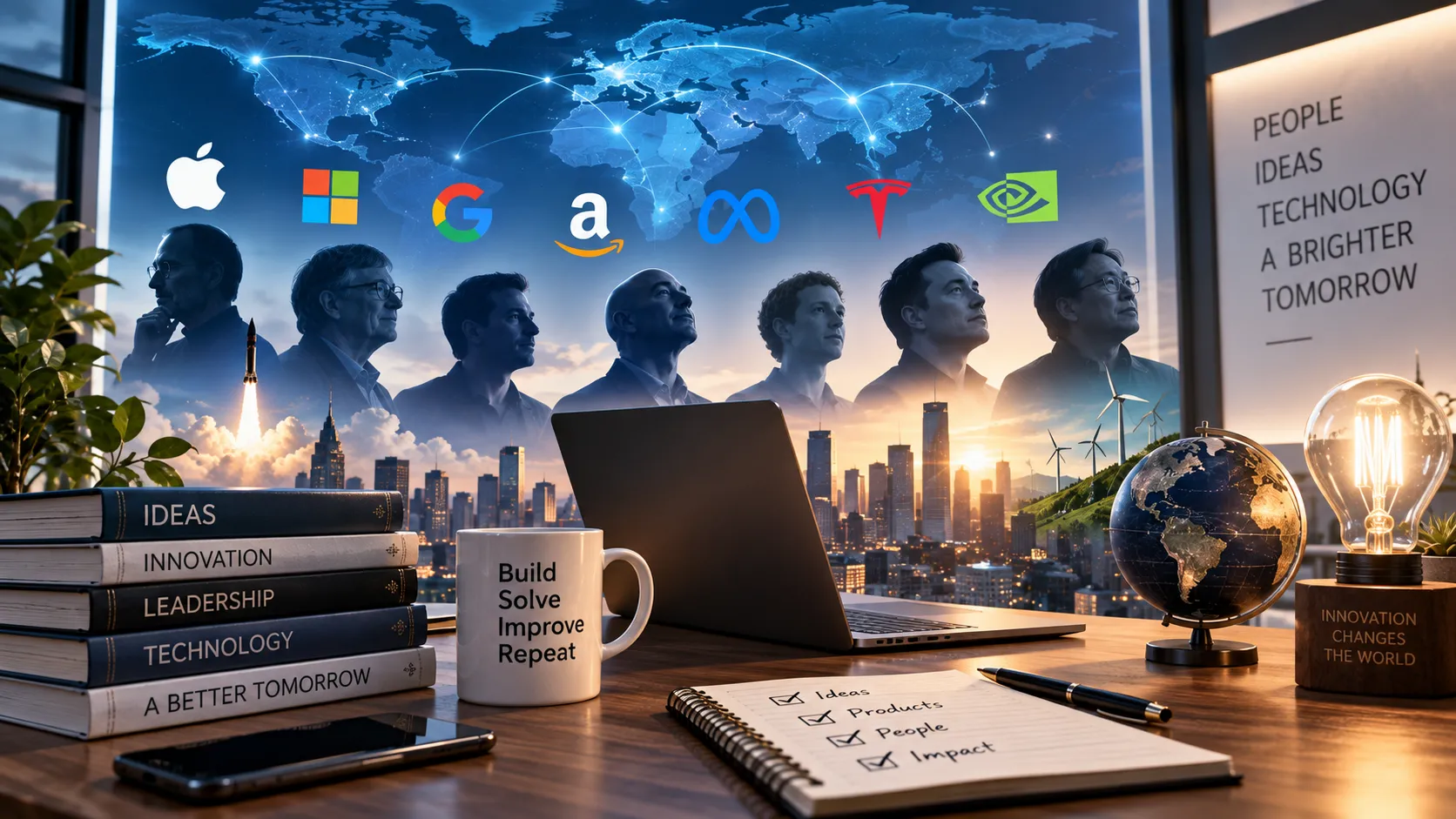
Introduction
Technology companies have transformed communication, computing, entertainment, transportation, commerce, artificial intelligence, and everyday life. Many of today's largest technology businesses began as small projects created by one person or a small founding team.
A founder is someone who helps establish a company. Founders may contribute an idea, technical expertise, business planning, early funding, or some combination of these. However, the person most publicly associated with a company is not always its only founder.
Understanding technology companies means looking beyond famous names. Successful companies usually depend on engineers, designers, investors, managers, employees, and customers in addition to their founders. Companies also change substantially after their early years, sometimes entering completely different industries from the ones in which they began.
This guide covers major companies including Apple, Microsoft, Google, Amazon, Meta, NVIDIA, Netflix, Tesla, and OpenAI while explaining the broader ideas behind startups, entrepreneurship, leadership, innovation, and company growth.
Learning Objectives
After studying this guide, you should be able to:
Explain the difference between a founder, co-founder, CEO, and investor.
Identify the founders of several major technology companies.
Describe how well-known technology companies began.
Explain startup concepts such as venture capital, IPOs, business models, and scaling.
Recognize that company histories often involve multiple contributors.
Understand how successful technology companies can change industries over time.
What Is a Technology Company?
A technology company develops or provides products and services based heavily on technological innovation.
Technology companies may specialize in:
Computer hardware
Software
Semiconductors
Internet services
Artificial intelligence
E-commerce
Cloud computing
Social media
Electric vehicles
Streaming
Robotics
The label is broad. Amazon began primarily as an online bookstore but later became a major cloud-computing provider. NVIDIA began by focusing on computer graphics and later became central to accelerated computing and artificial intelligence.
Founder vs. Co-Founder
A founder establishes a company.
When several people establish it together, they may be called co-founders.
Founders do not all perform the same role. One may design technology while another handles business development, sales, investment, or management.
Apple illustrates this clearly. Steve Wozniak provided much of the early computer engineering, while Steve Jobs focused heavily on turning that technology into a commercial product. Ronald Wayne was also part of Apple's original partnership, although he left very early. The Computer History Museum records Jobs, Wozniak, and Wayne as partners when Apple Computer Company was founded on April 1, 1976.
Founder vs. CEO
A CEO, or chief executive officer, is the senior executive responsible for leading a company.
Founder and CEO are therefore different concepts.
A founder may:
Become CEO.
Hire someone else as CEO.
Leave the company.
Remain on the board.
Have no management role later.
Likewise, a CEO does not need to have founded the company.
Memory Tip
Founder = helped create the company
CEO = leads the company as an executive
The same person can hold both roles, but the terms do not mean the same thing.
Investors and Venture Capital
Many startups require outside money before they become profitable.
An investor provides capital in return for an ownership interest or another financial arrangement.
Venture capital, or VC, is financing supplied to young companies that investors believe could grow rapidly.
Investors can become extremely influential, but providing money does not automatically make someone a founder.
This distinction is especially useful when studying complicated company histories.
Apple
Founding
Apple Computer Company was established on April 1, 1976 by:
Steve Jobs
Steve Wozniak
Ronald Wayne
The Smithsonian and Computer History Museum both document the three-person founding partnership.
Wozniak designed the Apple I computer. Jobs recognized its commercial potential and helped turn the project into a business.
Ronald Wayne participated in the original partnership but withdrew only days later.
Why Apple Became Important
The Apple II became one of the machines that helped expand the early personal-computer market. Apple later introduced products such as the Macintosh, iPod, iPhone, iPad, and Apple Watch.
Apple's history illustrates an important startup pattern:
Technical invention + product design + marketing + business execution
A strong invention alone does not guarantee a successful company.
Microsoft
Founders
Microsoft was started by Bill Gates and Paul Allen in 1975.
Their early opportunity came from the Altair 8800, one of the first commercially important personal computers. Gates and Allen developed a version of the BASIC programming language for the machine.
Microsoft records the earliest known written use of the name "Micro-soft" in a 1975 letter from Gates to Allen.
Microsoft describes Gates and Allen as friends who founded the company to develop software for early personal computers.
Why Microsoft Became Important
Microsoft became a dominant software company through products including:
MS-DOS
Windows
Microsoft Office
Server software
Xbox
Cloud services
Its history demonstrates the importance of software platforms.
A platform can become especially powerful when many other developers and businesses build products that depend on it.
Founders
Google was created by Larry Page and Sergey Brin while they were graduate students at Stanford University.
Their early search engine was called BackRub because it examined links between web pages.
Google's official history explains that Page and Brin developed a search engine that used links to estimate the importance of individual web pages. Google Inc. formally emerged in 1998 after Sun Microsystems co-founder Andy Bechtolsheim provided an early $100,000 investment.
Why Google Was Different
Early search engines often depended heavily on matching words.
Page and Brin's work emphasized the relationships among pages, helping rank results according to signals of importance.
Google later expanded into:
Advertising
Gmail
Maps
YouTube
Android
Cloud computing
Artificial intelligence
Google illustrates how a company can begin by solving one narrow technical problem and later build an entire ecosystem around it.
Amazon
Founder
Jeff Bezos founded Amazon in 1994.
Amazon opened its online store in 1995, initially focusing on books. Amazon's investor materials state that Bezos founded Amazon.com in 1994.
Books were especially suitable for early online retail because a website could offer a catalog far larger than a typical physical bookstore.
From Bookstore to Technology Platform
Amazon eventually expanded into:
General e-commerce
Marketplace services
Logistics
Kindle devices
Streaming
Smart devices
Cloud computing
Amazon Web Services, or AWS, became a major provider of cloud infrastructure.
Amazon demonstrates how a successful company can move far beyond its original business model.
Meta and Facebook
Founding
Facebook launched in 2004 while Mark Zuckerberg was a student at Harvard University.
Other early collaborators played important roles in Facebook's development, including Eduardo Saverin, Dustin Moskovitz, Andrew McCollum, and Chris Hughes.
Meta's current corporate materials identify Zuckerberg as its founder and state that he founded the company originally as Facebook in 2004.
The corporate name changed from Facebook to Meta in 2021.
Why Facebook Became Important
Facebook helped make online social networking a mass global phenomenon.
Meta later built or acquired major platforms and technologies associated with:
Instagram
WhatsApp
Messenger
Virtual and augmented reality
Artificial intelligence
The company shows how network effects can accelerate technology businesses.
A network effect occurs when a service becomes more useful as more people use it.
NVIDIA
Founders
NVIDIA was founded on April 5, 1993 by:
Jensen Huang
Chris Malachowsky
Curtis Priem
NVIDIA's official history states that the founders originally focused on bringing advanced 3D graphics to gaming and multimedia.
From Graphics to AI
NVIDIA became famous for graphics processors.
In 1999, the company popularized the term GPU, or graphics processing unit, for its graphics-processing technology. NVIDIA later introduced CUDA, which allowed GPUs to perform large amounts of general-purpose parallel computation.
GPUs proved particularly useful for machine learning because many AI calculations can be performed in parallel.
NVIDIA's history demonstrates how a technology created for one industry can become important in another.
Gaming graphics → parallel computing → artificial intelligence
Netflix
Founders
Netflix was founded in 1997 by Reed Hastings and Marc Randolph.
It began during the early DVD era rather than as a streaming company.
Netflix's first online DVD store opened in April 1998. An original company announcement described Marc Randolph as its president and CEO and explained that Netflix rented and sold DVDs over the Internet.
Business Model Evolution
Netflix's development can be simplified into three major stages:
DVD rental → subscription service → streaming platform
The company later moved heavily into producing original television and film content.
Netflix demonstrates the importance of adapting before older technology becomes obsolete.
A company that defines itself too narrowly—for example, as only a "DVD rental company"—may struggle when technology changes.
Tesla
Tesla provides an important lesson because the word founder can sometimes become historically complicated.
Tesla Motors was incorporated in 2003 by Martin Eberhard and Marc Tarpenning. Other key early participants included Ian Wright, Elon Musk, and JB Straubel.
Following a legal dispute, Tesla publicly supported a broader group of people being recognized as founders. Tesla's investor materials describe Musk as one of its founders and Straubel as a co-founder.
For study purposes, it is therefore safer to understand Tesla as having an early founding team rather than reducing its origin to one person.
Why Tesla Became Important
Tesla helped push battery-electric vehicles toward the mainstream automobile market.
Its strategy combined several technology areas:
Batteries
Electric motors
Software
Vehicle electronics
Charging infrastructure
Energy storage
Tesla demonstrates how technology companies can disrupt industries that were traditionally considered manufacturing businesses.
OpenAI
Founding
OpenAI was founded in 2015 as a nonprofit artificial-intelligence research organization.
Its original announcement named Sam Altman and Elon Musk as co-chairs, Ilya Sutskever as research director, Greg Brockman as CTO, and several other researchers and engineers as founding members.
Those founding members included figures such as:
Greg Brockman
Ilya Sutskever
John Schulman
Wojciech Zaremba
Trevor Blackwell
Vicki Cheung
Andrej Karpathy
Durk Kingma
Pamela Vagata
OpenAI's founding illustrates why identifying a single "founder" can oversimplify the creation of a research organization.
The organization later changed its corporate structure as the computing and capital requirements of advanced AI research increased. OpenAI's current structural history still identifies its origin as a nonprofit founded in 2015.
Major Tech Companies at a Glance
Company | Founded | Key Founder(s) | Early Focus |
Apple | 1976 | Steve Jobs, Steve Wozniak, Ronald Wayne | Personal computers |
Microsoft | 1975 | Bill Gates, Paul Allen | Computer software |
1998 | Larry Page, Sergey Brin | Web search | |
Amazon | 1994 | Jeff Bezos | Online bookselling |
Facebook / Meta | 2004 | Mark Zuckerberg and early collaborators | Social networking |
NVIDIA | 1993 | Jensen Huang, Chris Malachowsky, Curtis Priem | Computer graphics |
Netflix | 1997 | Reed Hastings, Marc Randolph | DVD rental |
Tesla | 2003 | Early founding team including Eberhard and Tarpenning | Electric vehicles |
OpenAI | 2015 | Multi-person founding team | Artificial intelligence research |
Startups and Scaling
A startup is a young business typically designed around a new product, technology, service, or business model.
A startup usually begins with:
A problem or opportunity.
An idea for solving it.
A prototype or early product.
Initial customers.
Funding or revenue.
Expansion.
Scaling means increasing the size of a business while building systems capable of handling much larger numbers of users or customers.
A website that works for 100 people may need completely different infrastructure when used by 100 million people.
What Is an IPO?
An IPO, or initial public offering, occurs when a private company first sells shares to the public through a stock market.
Companies may use an IPO to:
Raise capital.
Allow earlier investors to sell shares.
Increase public visibility.
Finance expansion.
An IPO is not the same thing as founding a company. A business may remain privately owned for years before becoming public.
Amazon, for example, was founded in 1994 and completed its IPO in 1997.
Acquisition
An acquisition occurs when one company buys another.
Technology companies often use acquisitions to obtain:
Technology
Employees
Customers
Intellectual property
Market share
The company being purchased may remain as a recognizable brand or be absorbed into the buyer.
Founders of acquired companies may stay, leave, or take new roles.
Business Models
A business model explains how a company creates value and earns revenue.
Technology companies use many models.
Advertising
Platforms provide services to users while advertisers pay for access to audiences.
Subscription
Customers pay regularly for access.
Hardware Sales
The company sells physical devices.
Software Licensing
Customers pay for permission to use software.
Cloud Computing
Customers rent computing resources or services.
Marketplace Fees
A company operates a platform connecting buyers and sellers and earns fees from transactions.
Large technology companies may use several models simultaneously.
Innovation Does Not Come From Founders Alone
Founder stories are memorable, but they can create a misleading impression that a single genius builds an entire corporation.
In reality, major innovations usually require:
Engineers
Researchers
Designers
Managers
Investors
Sales teams
Manufacturing partners
Early customers
For example, Apple's early success involved Wozniak's engineering and Jobs's product vision, but later growth also depended on investors such as Mike Markkula and large teams of employees. The Computer History Museum highlights Markkula's role in providing capital and business experience as Apple expanded.
Common Mistakes
Mistake 1: Founder and CEO Mean the Same Thing
False.
A founder creates a company. A CEO is an executive position.
Mistake 2: Steve Jobs Founded Apple Alone
False.
Apple's original 1976 partnership included Steve Jobs, Steve Wozniak, and Ronald Wayne.
Mistake 3: Bill Gates Created Microsoft Alone
False.
Microsoft was founded by Bill Gates and Paul Allen.
Mistake 4: Amazon Began as a General Online Marketplace
False.
Its first major business was selling books online.
Mistake 5: NVIDIA Was Originally an AI Company
False.
NVIDIA began primarily around computer graphics. Its GPU technology later became highly important for AI computing.
Mistake 6: Netflix Started as a Streaming Service
False.
Netflix began by renting and selling DVDs online.
Mistake 7: The Most Famous Person at a Company Must Be Its Only Founder
False.
Many companies have founding teams, and public recognition is not always distributed equally among them.
Memory Tips
Remember:
Apple → Jobs + Wozniak + Wayne
Microsoft → Gates + Allen
Google → Page + Brin
Amazon → Bezos
Meta/Facebook → Zuckerberg
NVIDIA → Huang + Malachowsky + Priem
Netflix → Hastings + Randolph
For company beginnings:
Apple → personal computers
Microsoft → software
Google → search
Amazon → books
Meta → social networking
NVIDIA → graphics
Netflix → DVDs
Tesla → electric vehicles
OpenAI → AI research
Summary
Major technology companies often begin with a small group trying to solve a specific problem.
Apple grew from early personal computers, Microsoft from programming software, Google from a university search project, Amazon from online bookselling, Facebook from social networking, NVIDIA from computer graphics, and Netflix from DVD rentals.
The company associated most strongly with one famous individual may actually have several founders. Founder, CEO, investor, engineer, and early employee are separate roles, although one person may hold more than one.
Technology companies also evolve. Amazon became a cloud-computing leader, NVIDIA's graphics processors became important to AI, Netflix moved from physical DVDs to streaming, and Apple expanded from computers into mobile devices and services.
The central lesson is that technology history is not only about famous personalities. Successful companies emerge through combinations of invention, entrepreneurship, capital, teamwork, timing, business models, and the ability to adapt when technology changes.
FAQ
1. What is a company founder?
A founder is a person who participates in creating and establishing a company.
2. Is a founder always the CEO?
No. A founder may become CEO, hire another CEO, leave the company, or take another role.
3. Who founded Apple?
Apple Computer Company was established in 1976 by Steve Jobs, Steve Wozniak, and Ronald Wayne.
4. Who founded Microsoft?
Bill Gates and Paul Allen founded Microsoft in 1975.
5. Who founded Google?
Larry Page and Sergey Brin developed Google while studying at Stanford and established Google Inc. in 1998.
6. Who founded Amazon?
Jeff Bezos founded Amazon in 1994.
7. Who founded NVIDIA?
Jensen Huang, Chris Malachowsky, and Curtis Priem founded NVIDIA in 1993.
8. Did Netflix always stream movies?
No. Netflix began as an online DVD rental and sales business.
9. What is venture capital?
Venture capital is investment provided to young companies that investors believe have strong growth potential.
10. Why can lists of company founders sometimes differ?
Company origins can be complicated. Different people may contribute ideas, money, engineering, incorporation, or early management, and legal agreements can also affect who is officially recognized as a founder.
Key Takeaways
· A founder establishes a company, while a CEO is the executive responsible for leading it.
· Apple, Microsoft, Google, NVIDIA, Netflix, Tesla, and OpenAI all involved multiple important people during their creation.
· Many technology companies begin by solving one narrow problem and later expand into much larger markets.
· Venture capital, business models, acquisitions, and IPOs help explain how startups become large corporations.
· Technology companies succeed through teams and institutions, not through founders alone.
References
1. Computer History Museum. Apple@50 Timeline. Computer History Museum — Apple History
2. Smithsonian Institution. 1976: A Year in the Collections. Smithsonian — Founding of Apple Computer Company
3. Library of Congress. The Founding of Apple Computer, Inc. Library of Congress — Apple Founding History
4. Microsoft. About Microsoft — Company History. Microsoft — Company History
5. Microsoft Learn. The History of Microsoft — 1975. Microsoft Learn — Microsoft in 1975
6. Google. Our Story: From the Garage to the Googleplex. Google — Company History
7. Amazon Investor Relations. Jeffrey P. Bezos. Amazon — Jeff Bezos Biography
8. Amazon Investor Relations. Frequently Asked Questions. Amazon — Company History and IPO Information
9. Meta Investor Relations. Leadership and Governance. Meta — Mark Zuckerberg and Company History
10. NVIDIA. NVIDIA History: Timeline of Innovation. NVIDIA — Company History
11. Netflix. First Online DVD Rental Store Opens. Netflix — Original 1998 Launch Announcement
12. Tesla Investor Relations. Corporate Governance and Leadership. Tesla — Corporate Information
13. Tesla Investor Relations. JB Straubel. Tesla — JB Straubel Biography
14. OpenAI. Introducing OpenAI. OpenAI — 2015 Founding Announcement
15. OpenAI. Our Structure. OpenAI — Organizational History and Structure