


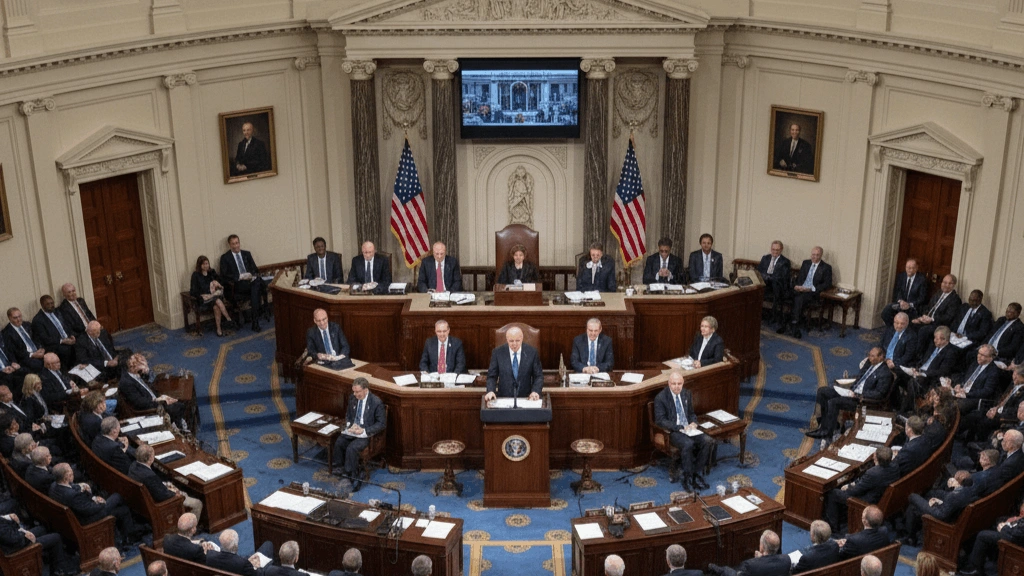
Introduction
The United States government is a federal constitutional republic. Political authority is divided between the federal government and the states, while the federal government itself is divided into legislative, executive, and judicial branches.
The U.S. Constitution establishes this framework and distributes governmental powers among institutions. The system also uses checks and balances, allowing each branch to limit or respond to certain actions of the others.
Understanding U.S. government requires more than memorizing presidents or elections. Important quiz topics include Congress, the presidency, federal courts, amendments, federalism, political parties, the Electoral College, civil liberties, and the process by which legislation becomes law.
Learning Objectives
After studying this guide, you should be able to:
· Explain federalism, separation of powers, and checks and balances.
· Identify the powers and structure of Congress, the presidency, and the federal judiciary.
· Compare the House of Representatives and Senate.
· Explain the basic federal legislative process.
· Describe the Electoral College and the role of political parties.
· Recognize important constitutional amendments and civil-liberty protections.
The Constitution
The U.S. Constitution was drafted in 1787 and established the framework of the federal government. It replaced the earlier Articles of Confederation, which had created a much weaker central government.
The Constitution contains a preamble, seven original articles, and amendments added through the constitutional amendment process. The first ten amendments are collectively known as the Bill of Rights.
Important Articles
Article | Main Subject |
Article I | Legislative branch |
Article II | Executive branch |
Article III | Judicial branch |
Article IV | Relations among states |
Article V | Constitutional amendments |
Article VI | Federal supremacy and related provisions |
Article VII | Ratification |
Memory Tip
I → Congress
II → President
III → Courts
Separation of Powers
Separation of powers divides federal authority among three branches:
1. Legislative
2. Executive
3. Judicial
Congress makes federal laws, the executive branch administers and enforces federal law, and federal courts interpret and apply law in cases properly before them.
The branches are separate, but they are not completely independent of one another.
Checks and Balances
Checks and balances allow each branch to restrain certain powers of the others.
Examples include:
· The president may veto legislation.
· Congress can override a presidential veto under constitutional procedures.
· The Senate considers many presidential nominations.
· Federal courts can determine that laws or executive actions conflict with the Constitution.
· The House has the sole power of impeachment, while the Senate conducts impeachment trials.
This structure prevents all federal power from being concentrated in one institution.
Federalism
Federalism divides governing authority between a national government and state governments.
The Constitution gives the federal government particular powers, while the Tenth Amendment states that powers not delegated to the United States, nor prohibited to the states, are reserved to the states or the people.
Federalism means that Americans live under several overlapping levels of government, including:
· Federal
· State
· Local
These levels have different responsibilities and legal authority.
Supremacy Clause
Article VI contains the Supremacy Clause.
It establishes that the Constitution, valid federal laws, and treaties made under U.S. authority are the supreme law of the land. When valid federal and state laws directly conflict, federal law can take precedence under constitutional principles of supremacy and preemption.
Legislative Branch: Congress
The U.S. Congress is the federal legislative branch.
It is bicameral, meaning it contains two chambers:
House of Representatives + Senate
Congress writes legislation, appropriates federal funds, conducts oversight, and exercises other constitutional powers.
House of Representatives
The House represents people through congressional districts.
The number of voting representatives is currently fixed by law at 435, distributed among the states according to population. Representatives serve two-year terms.
Constitutional qualifications include:
· At least 25 years old
· U.S. citizen for at least 7 years
· An inhabitant of the represented state when elected
The House also has the sole power of impeachment.
Senate
The Senate gives each state equal representation.
Each state has:
2 senators
With 50 states, that produces:
100 Senate seats
Senators serve six-year terms, with approximately one-third of the Senate facing election every two years.
Senators must be:
· At least 30 years old
· U.S. citizens for at least 9 years
· Inhabitants of their state when elected
The Seventeenth Amendment, ratified in 1913, established direct popular election of senators rather than selection by state legislatures.
House vs Senate
Feature | House | Senate |
Voting membership | 435 | 100 |
Representation | Based on state population | 2 per state |
Term | 2 years | 6 years |
Minimum age | 25 | 30 |
Impeachment role | Impeaches | Conducts trial |
Revenue bills | Originate here | Considers them afterward |
Memory Tip
House → population
Senate → states equally
Congressional Committees
Much congressional work occurs in committees.
Committees may:
· Review legislation
· Hold hearings
· Gather expert testimony
· Amend bills
· Conduct investigations
· Oversee executive agencies
Senate committees also consider nominations and, in relevant committees, treaties and international agreements.
How a Bill Becomes Federal Law
Legislation can begin in either chamber in most cases, although the Constitution requires revenue bills to originate in the House.
A simplified process is:
Bill introduced → committee consideration → chamber debate and vote → other chamber → identical text approved → president
For a bill to be sent to the president, both chambers must approve the same text. If the president signs it, it becomes law. Congress can also enact a bill over a presidential veto if the constitutionally required supermajorities vote to override it.
Important Distinction
Bill → proposed law
Act or statute → enacted law
Executive Branch
The executive branch includes the president, vice president, executive departments, agencies, and other federal bodies.
The president serves as:
· Head of the executive branch
· Head of state
· Commander in chief of the armed forces
The president also appoints many federal officials, subject to Senate confirmation where constitutionally or legally required, and can veto legislation passed by Congress.
President
Article II establishes the presidency.
A president serves a four-year term.
Constitutional eligibility requires a president to be:
· A natural-born U.S. citizen
· At least 35 years old
· A U.S. resident for at least 14 years
The Twenty-Second Amendment limits election to the presidency to two times, subject to its provisions concerning succession to an unfinished term.
Vice President
The vice president has both executive and legislative roles.
Under the Constitution, the vice president is also President of the Senate and may cast a vote there when senators are equally divided.
The vice president is also first in the presidential line of succession.
Cabinet
The Cabinet consists principally of the heads of executive departments and other officials designated to cabinet-level roles.
Cabinet officials advise the president and lead major areas of federal administration.
Many department heads are presidential nominees who require Senate confirmation.
Judicial Branch
The federal judicial branch includes the Supreme Court and lower federal courts established under federal law.
Article III establishes the Supreme Court and the federal judicial power.
Federal courts decide cases involving federal statutes, constitutional questions, and other matters within their jurisdiction.
Supreme Court
The Supreme Court of the United States is the nation's highest federal court.
An important judicial power is judicial review: courts may determine that legislation or executive action conflicts with the Constitution. The Supreme Court notes that judicial review is not explicitly stated as such in the constitutional text, although it became a central part of the constitutional system.
Judicial review is strongly associated with the 1803 case:
Marbury v. Madison
Bill of Rights
The Bill of Rights consists of the first 10 amendments to the Constitution.
Congress originally proposed 12 amendments in 1789; 10 were ratified in 1791.
Important protections include:
Amendment | Major Subject |
1st | Religion, speech, press, assembly, petition |
2nd | Keeping and bearing arms |
4th | Searches and seizures |
5th | Due process and other protections |
6th | Criminal-procedure protections |
8th | Bail, fines, and punishment |
9th | Unenumerated rights |
10th | Reserved powers |
The First Amendment protects freedoms involving religion, expression, press, assembly, and petition.
Later Constitutional Amendments
The Constitution currently has 27 amendments.
Several frequently tested amendments include:
13th Amendment → abolished slavery, except as punishment for crime under its text
14th Amendment → citizenship, due process, and equal protection
15th Amendment → voting rights cannot be denied on account of race, color, or previous condition of servitude
17th Amendment → direct election of senators
19th Amendment → voting rights cannot be denied on account of sex
22nd Amendment → presidential term-election limit
26th Amendment → voting age cannot be denied to citizens aged 18 or older on account of age
The National Archives maintains the official text and ratification dates of Amendments 11–27.
Civil Liberties and Civil Rights
The terms are related but not identical.
Civil liberties generally concern protections against improper government interference.
Examples include:
· Speech
· Religion
· Due process
Civil rights generally concern equal legal treatment and protection against unlawful discrimination.
Constitutional amendments, federal statutes, judicial decisions, and state laws all contribute to these areas.
Presidential Elections and the Electoral College
The president is selected through the constitutional Electoral College system rather than by a single direct nationwide popular vote.
The Electoral College currently contains 538 electors, and 270 electoral votes constitute a majority. Each state's number of electors equals its total representation in the House and Senate, while the District of Columbia receives three electors under the Twenty-Third Amendment.
The process ultimately includes the casting of electoral votes in the states and their formal counting by Congress.
Important Quiz Point
Electoral College = process, not a physical college or building.
Political Parties
Political parties are organizations that coordinate political activity, nominate or support candidates, organize lawmakers, and develop policy agendas.
Parties began developing soon after the federal government was established. The modern congressional system has long been dominated by the Democratic and Republican parties, although independents and other parties have also participated in American politics.
Party organizations in Congress help arrange:
· Leadership
· Committee assignments
· Legislative agendas
· Floor strategy
The Constitution itself does not establish political parties.
Majority and Minority Parties
Within each chamber of Congress, the majority party is the party or coalition controlling more seats for organizational purposes.
The minority party has fewer seats.
Party control affects:
· Leadership positions
· Committee organization
· Legislative scheduling
Exact party strength changes with elections, vacancies, party changes, and other developments, so current partisan numbers should always be checked against up-to-date congressional sources.
Speaker of the House
The House chooses a Speaker.
The Speaker presides over the House and has important institutional and political responsibilities.
The Constitution specifically provides that the House chooses its Speaker and other officers.
Senate Leadership
The vice president is constitutionally President of the Senate, but the Senate also chooses a president pro tempore.
Political parties additionally elect floor leaders and other leadership officials who organize legislative work.
Impeachment
Impeachment is a constitutional process involving allegations of serious misconduct by certain federal officials.
The House has the sole authority to impeach.
The Senate conducts the trial.
Common Mistake
Impeachment does not itself mean removal from office.
It is comparable to the formal bringing of charges within the constitutional process. Removal requires conviction in the Senate under the Constitution's required voting threshold.
Common Mistakes
The Three Branches Are Not Congress, Senate, and President
Congress includes both the House and Senate.
The three branches are:
Legislative → Executive → Judicial
House and Senate Representation Work Differently
House seats are distributed mainly according to state population.
Every state receives two senators.
The Supreme Court Does Not Write Federal Statutes
Congress legislates.
Courts interpret and apply law in cases and controversies.
The Electoral College Is Not a Physical Institution
It is the constitutional process for electing the president and vice president.
The Bill of Rights Is Not the Entire Constitution
It consists of the first ten amendments.
Impeachment and Removal Are Different
The House impeaches; the Senate conducts the trial.
Political Parties Are Not Created by the Constitution
They developed historically after the constitutional government began operating.
Memory Tips
For the branches:
Legislative → makes laws
Executive → executes laws
Judicial → interprets laws
For Congress:
House → 435 → 2 years
Senate → 100 → 6 years
For impeachment:
House → charges
Senate → trial
For presidential elections:
538 electors → 270 majority
For constitutional structure:
Article I → Congress
Article II → President
Article III → Courts
Summary
The United States is governed under a federal Constitution that divides authority both vertically and horizontally.
Federalism divides powers between federal and state governments. Separation of powers distributes federal authority among Congress, the president, and the federal courts. Checks and balances allow those branches to limit one another in defined ways.
Congress contains the House of Representatives and Senate. The House currently has 435 voting representatives serving two-year terms, while the Senate has 100 senators serving staggered six-year terms.
The president leads the executive branch, while the Supreme Court sits at the top of the federal judiciary. Judicial review allows courts to address whether government actions are consistent with the Constitution.
The Bill of Rights protects important liberties, while later amendments changed the constitutional system in areas including citizenship, voting rights, Senate elections, and presidential tenure.
For quizzes, focus on branch powers, House-vs-Senate differences, constitutional amendments, federalism, the Electoral College, checks and balances, and the legislative process.
FAQ
What are the three branches of the U.S. federal government?
Legislative, executive, and judicial.
What is federalism?
Federalism is the constitutional division of governing authority between the federal government and the states.
How many voting representatives are in the House?
The number is currently fixed by law at 435.
How many U.S. senators are there?
100, because each of the 50 states has two senators.
How long is a senator's term?
Six years.
What are the first ten constitutional amendments called?
The Bill of Rights.
What is judicial review?
It is the authority of courts to determine whether laws or government actions conflict with the Constitution.
What is the Electoral College?
It is the constitutional process used to elect the president and vice president. It currently consists of 538 electors.
Which chamber impeaches federal officials?
The House of Representatives.
Which chamber conducts impeachment trials?
The Senate.
Key Takeaways
· The U.S. constitutional system combines federalism, separation of powers, and checks and balances.
· Congress consists of the House of Representatives and Senate, which differ in size, representation, terms, and constitutional roles.
· The president heads the executive branch, while the federal judiciary interprets and applies federal law and the Constitution.
· The Bill of Rights contains the first ten amendments, while later amendments changed important features of citizenship, elections, rights, and government.
· Political parties play a major role in American politics, but they are historical institutions rather than bodies created by the Constitution.
References
· Congress.gov — Constitution Annotated
Official congressional resource containing the Constitution, constitutional interpretation, federalism, amendments, separation of powers, and Supreme Court doctrine.
Congress.gov — Constitution Annotated
· USAGov — Branches of the U.S. Government
Official overview of the legislative, executive, and judicial branches and their checks and balances.
USAGov — Branches of Government
· U.S. House of Representatives — The House Explained
Official information about the House, representatives, terms, congressional districts, and legislative responsibilities.
House.gov — The House Explained
· U.S. Senate — Constitution and Senate
Official information on Senate structure, constitutional powers, terms, qualifications, and history.
U.S. Senate — Constitution
· U.S. Senate — Laws and Acts
Official explanation of bills, laws, statutes, and how legislation approved by both chambers reaches the president.
U.S. Senate — Laws and Acts
· Supreme Court of the United States — Constitutional Interpretation
Official explanation of the Supreme Court's constitutional role and judicial review.
Supreme Court — Constitutional Interpretation
· National Archives — Bill of Rights
Official text and historical background for the first ten amendments.
National Archives — Bill of Rights
· National Archives — Amendments 11–27
Official text and ratification information for later constitutional amendments.
National Archives — Amendments 11–27
· National Archives — Electoral College
Official explanation of electors, electoral-vote allocation, and the constitutional presidential-election process.
National Archives — Electoral College
· U.S. Senate — Parties and Leadership
Official historical resource explaining the development and role of political parties and party leadership in Congress.
U.S. Senate — Parties and Leadership