
How to Memorize All 195 Countries Without Cramming
Learning all 195 countries does not have to mean memorizing one enormous list. This guide shows how to use continents, blank maps, active recall, spaced review, and short daily practice sessions to learn countries faster and remember them longer.
Pramesh Koirala · Oct 2, 2026 · 7 views
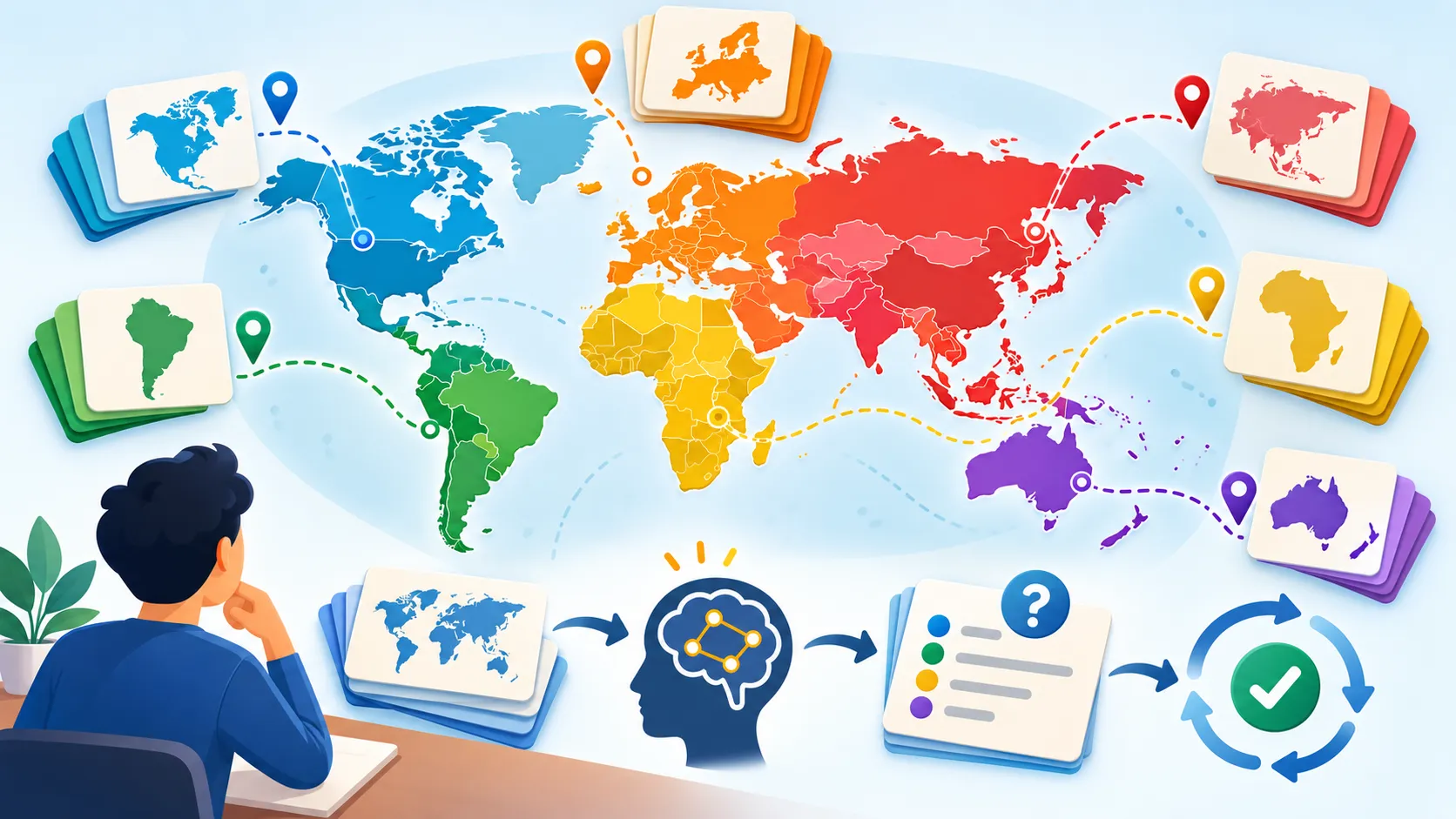
How to Memorize All 195 Countries Without Cramming
Trying to memorize 195 countries sounds like the kind of task that requires hours of repetition.
You open a list of countries, read through it several times, remember a few unfamiliar names, and then discover the next day that half of them have disappeared from your memory.
The problem is not that 195 countries are impossible to learn.
The problem is trying to learn them as one giant list.
Country names become much easier to remember when they are connected to something: a continent, a neighboring country, a coastline, a shape on a map, a flag, or a capital you already recognize.
Instead of asking your brain to remember 195 unrelated words, you can gradually build a mental map of the world.
The most effective approach is simple:
Learn countries in meaningful geographic groups, actively recall them, and revisit the ones you forget.
You do not need three-hour study sessions or complicated memory tricks. Fifteen focused minutes a day can take you surprisingly far.
Why Memorizing 195 Countries Feels Harder Than It Is
Imagine someone gives you this list:
Belize, Rwanda, Moldova, Laos, Suriname, Eritrea, Bhutan, Guyana, Benin, Brunei.
You might remember a few of them, but there is very little structure to help your memory.
Now imagine learning:
Argentina, Bolivia, Brazil, Chile, Colombia, Ecuador, Guyana, Paraguay, Peru, Suriname, Uruguay and Venezuela.
They are still country names, but now they belong to one clear group: the sovereign countries of South America.
You can picture the continent.
You can notice that Chile runs along its western edge, Brazil occupies much of the east, Argentina stretches toward the south, and countries such as Bolivia and Paraguay are landlocked.
Suddenly the information has context.
Human memory generally handles connected information better than isolated facts. Geography gives you those connections naturally.
So your first goal should not be:
“I need to memorize 195 names.”
It should be:
“Today I am going to learn one small part of the world.”
That change alone makes the project much less intimidating.
1. Learn One Continent at a Time
Do not begin with an alphabetical list of every country.
Start geographically.
You might divide your learning into:
South America
North America
Europe
Africa
Asia
Oceania
You can divide large continents into even smaller regions.
For example, instead of trying to learn all African countries together, study smaller clusters such as North Africa, West Africa, East Africa, Central Africa and Southern Africa.
Europe can also be broken into northern, western, central, southern and eastern groups.
The exact regional definitions matter less than having a manageable structure.
A useful rule is to work with roughly 5–15 new countries at a time.
If you can already identify most countries in Europe, there is little reason to spend equal time there. Concentrate on regions where your knowledge is weaker.
That makes your study sessions more efficient from the beginning.
2. Use a Blank Map Instead of Rereading Country Lists
Reading country names feels productive because everything looks familiar while you are looking at it.
Recognition, however, is not the same as recall.
You may look at a list and think:
“Of course I know Slovenia.”
But if someone points to Slovenia on an unlabeled map, can you identify it?
That is a much stronger test.
Blank maps force your brain to retrieve information rather than simply recognize it.
Try this process:
Study a labeled map of one region for several minutes.
Then close it.
Take a blank map and identify as many countries as you can.
Afterward, compare your answers with the original map.
Do not worry about getting everything correct.
The mistakes are actually useful because they show you exactly where your memory is weak.
If you repeatedly confuse Slovakia and Slovenia, for example, you now have a specific problem to solve rather than vaguely “studying Europe” again.
Interactive geography quizzes can serve the same purpose. A Countries & Borders quiz or Countries by Continent quiz gives you repeated retrieval practice while immediately showing where your gaps are.
That is much more useful than reading the same country list five times.
3. Build Geographic Connections
Once you start learning countries, connect them to their surroundings.
Ask simple questions.
What countries border this one?
Is it landlocked?
Is it an island?
What sea or ocean is nearby?
Which country lies directly north or south of it?
What shape does it have on the map?
Suppose you are learning South America.
Instead of memorizing Ecuador as an isolated name, you might remember that it sits on the Pacific coast between Colombia and Peru.
Uruguay becomes easier to place when you associate it with Argentina and Brazil near the southeastern Atlantic coast.
Paraguay becomes easier to remember when you recognize it as one of the continent's landlocked countries.
These geographic relationships create multiple paths back to the same memory.
If one clue fails, another may help.
Over time, you stop remembering countries as separate trivia facts and begin seeing them as parts of a connected world.
4. Test Yourself Before You Feel Ready
One of the most common study mistakes is waiting until information feels familiar before testing yourself.
Do the opposite.
Test yourself early.
If you study ten countries for five minutes, try recalling them immediately.
You will probably miss several.
That is fine.
Look at the answers, correct yourself, and try again later.
The effort involved in retrieving an answer strengthens the memory.
This is why quizzes, flashcards and blank-map exercises are so useful. They make your brain produce the answer rather than passively observe it.
You can use questions such as:
Which country is this?
Where is it located?
Which countries border it?
Which continent does it belong to?
Can I find it on a blank map?
When you can answer those questions without looking anything up, the country is beginning to move from short-term familiarity into usable knowledge.
5. Keep a “Countries I Forget” List
Do not give every country equal attention forever.
Some will become automatic quickly.
Others will refuse to stick.
Create a small list called something like:
Countries I Keep Forgetting
Perhaps yours contains:
Eswatini
Lesotho
Timor-Leste
Kyrgyzstan
Tajikistan
Suriname
Your list will be different from someone else's.
Review that short list regularly instead of repeatedly reviewing countries you already know.
This makes studying much faster.
It also turns mistakes into useful information.
Every forgotten answer tells you where your next few minutes of practice should go.
As a country becomes easy, remove it from the list.
When another one gives you trouble, add it.
Eventually your difficult-country list should become shorter and shorter.
6. Add Flags and Capitals Only After the Countries Stick
It can be tempting to learn everything together:
Country.
Capital.
Flag.
Currency.
Continent.
Population.
Borders.
Language.
That creates unnecessary cognitive overload.
Start with one objective:
Can I recognize and locate the country?
Once the countries themselves feel familiar, add another layer.
Capitals are a natural next step.
For example:
Japan → Tokyo
Kenya → Nairobi
Argentina → Buenos Aires
Canada → Ottawa
Then introduce flags.
Because you already understand where each country belongs geographically, the new information has somewhere to attach.
On QFB, this can become a natural progression:
Countries by Continent → Countries & Borders → Capitals → Flags.
Instead of four unrelated quiz topics, they become stages of the same geography-learning process.
You can later add currencies, national symbols, major cities and physical geography without feeling as though you are starting again.
A Simple 15-Minute Daily Routine
You do not need a complicated schedule.
Try this:
Minutes 1–3: Review yesterday's difficult countries
Look only at the countries you previously missed.
Try recalling them before checking the answers.
Minutes 4–8: Learn a small new group
Study around five to ten countries from one region.
Look carefully at where they sit on the map and what surrounds them.
Minutes 9–12: Test yourself
Use a blank map, flashcards or a geography quiz.
Do not peek at the answers too quickly.
Give yourself a few seconds to retrieve each one.
Minutes 13–15: Record your mistakes
Write down the countries you missed.
Those become tomorrow's review list.
That is it.
Fifteen minutes.
The important part is consistency.
A short session repeated regularly is usually far more useful than one enormous weekend study session followed by two weeks of nothing.
How Long Does It Take to Learn All 195 Countries?
There is no single correct timeline.
If you already know many countries, you may mainly need to fill gaps.
If geography is completely new to you, it will naturally take longer.
The goal also matters.
Being able to recognize every country name is easier than locating every country accurately on a blank world map.
Knowing every capital requires another layer of learning.
Instead of worrying about finishing within a particular number of days, measure your progress by regions.
For example:
Week 1: South America and North America
Week 2: Europe
Week 3: Africa
Week 4: Asia and Oceania
Week 5: mixed review
That is only an example. Adjust it to your own pace.
The more important rule is to keep revisiting older material.
If you learn Africa and never test yourself on it again, some of those countries will fade.
Spaced review prevents that.
You might revisit a region the next day, several days later, a week later and then occasionally after that.
You do not need a perfect scheduling system. Simply avoid treating a country as permanently learned after seeing it once.
What to Do After You Know All the Countries
Learning all 195 countries is not the end of geography.
It is the foundation.
Once the world map becomes familiar, many other geography topics become easier to understand.
You can start learning:
capitals
flags
borders
currencies
major cities
mountains
oceans and seas
islands
regions
population patterns
You can also begin asking more interesting questions.
Why are some countries landlocked?
Why do certain borders follow rivers or mountain ranges?
Why are major cities concentrated in particular regions?
How did historical events shape modern borders?
This is where geography stops feeling like memorization and starts becoming a way of understanding how the world fits together.
A structured Geography learning path can help you move from basic country recognition into capitals, borders, flags and physical geography without jumping randomly between topics.
Final Takeaway
You do not need to cram 195 country names into your memory.
In fact, treating them as one enormous list is probably the least enjoyable way to learn them.
Break the world into smaller geographic groups.
Use maps instead of relying only on lists.
Connect countries to their neighbors and locations.
Test yourself before you feel fully prepared.
Keep track of what you forget.
Review those weak spots regularly.
Then, once the countries themselves are familiar, add capitals, flags and other geography knowledge one layer at a time.
Fifteen focused minutes today may not make you a geography expert.
But fifteen minutes repeated consistently can gradually turn a world map full of unfamiliar names into something you actually understand.