


Introduction
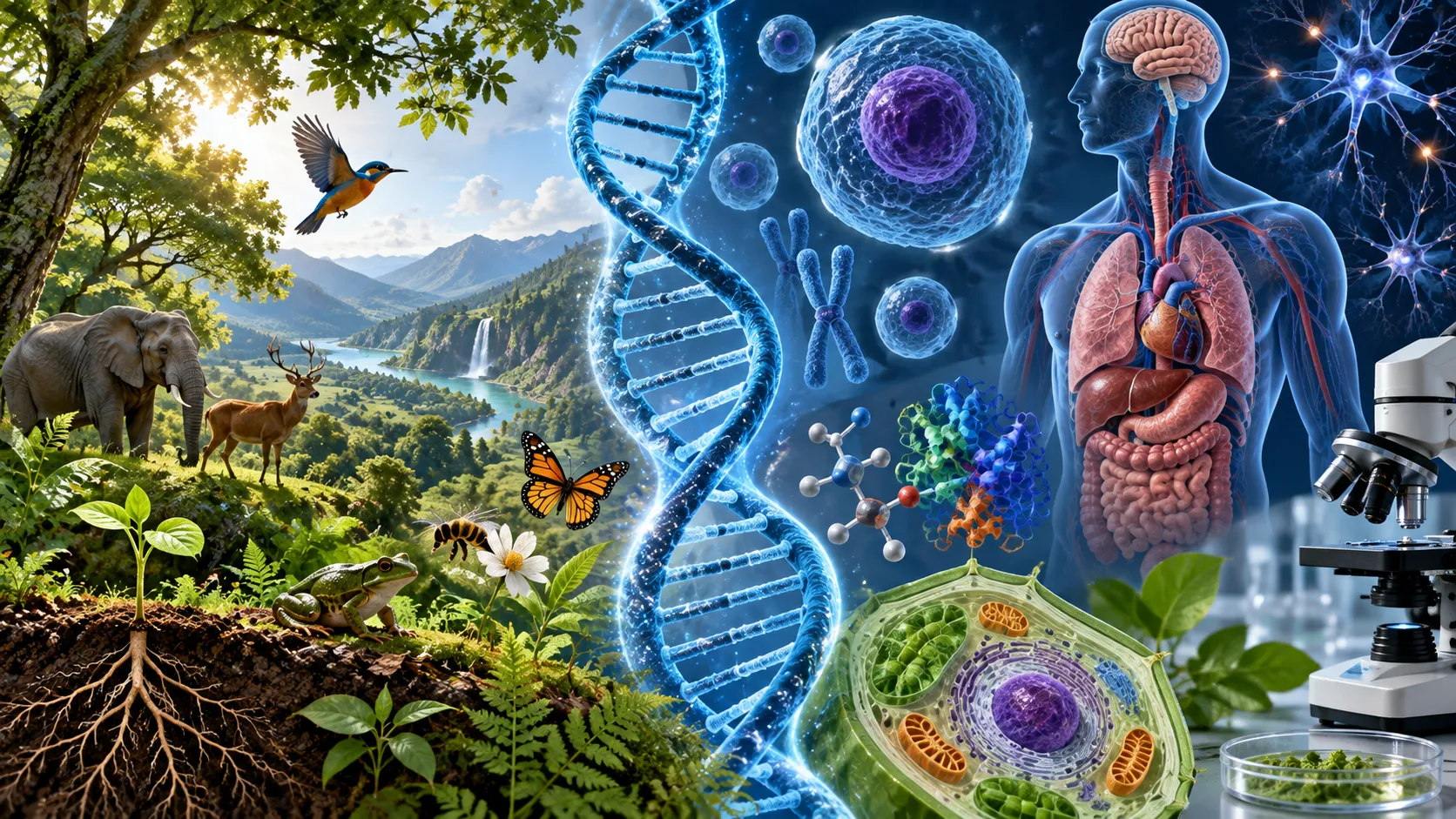
Biology is the scientific study of life. It examines organisms from microscopic bacteria and individual cells to plants, animals, ecosystems, and the entire biosphere.
Life sciences is a broader term covering biology and related fields that study living organisms, their molecules, their environments, and the processes that allow life to function. Major branches include cell biology, genetics, microbiology, ecology, botany, zoology, anatomy, physiology, evolutionary biology, molecular biology, and biotechnology.
Biology connects many scientific ideas. DNA carries hereditary information, cells use energy and materials to remain alive, organisms reproduce, populations evolve, and species interact with one another and their environments. Understanding these connections provides a foundation for medicine, agriculture, conservation, biotechnology, and environmental science.
Learning Objectives
After studying this guide, you should be able to:
Identify the major characteristics and levels of organization of life.
Explain the structure and functions of cells and important organelles.
Describe DNA, genes, chromosomes, inheritance, and protein production.
Explain photosynthesis, cellular respiration, and metabolism.
Describe natural selection, evolution, and biological classification.
Explain basic ecological relationships, microorganisms, homeostasis, and major body systems.
What Makes Something Alive?
Biologists recognize several characteristics commonly shared by living organisms.
Living things generally:
Consist of one or more cells.
Use energy and materials.
Maintain internal conditions.
Grow and develop.
Respond to environmental changes.
Reproduce.
Contain hereditary information.
Belong to populations capable of evolutionary change.
No single characteristic by itself provides a perfect definition of life. Fire, for example, can grow and use energy but is not considered alive.
Levels of Biological Organization
Life can be studied at several levels.
Level | Meaning |
Molecule | Chemical structure such as DNA or glucose |
Organelle | Specialized structure inside a cell |
Cell | Basic structural and functional unit of life |
Tissue | Group of similar cells performing related functions |
Organ | Structure containing tissues working together |
Organ system | Multiple organs performing a major function |
Organism | Individual living thing |
Population | Members of one species in an area |
Community | Populations of different species interacting |
Ecosystem | Community plus its physical environment |
Biosphere | All regions of Earth where life exists |
Biology connects these levels. Changes occurring in DNA molecules, for example, can eventually affect populations and ecosystems.
Cells: The Basic Units of Life
The cell is the basic structural and functional unit of living organisms. Cell biology studies cellular structure, behavior, growth, reproduction, chemistry, and function.
Some organisms consist of only one cell. Others, including humans, consist of enormous numbers of specialized cells working together.
Prokaryotic and Eukaryotic Cells
Cells can be broadly divided into two major structural types.
Prokaryotic Cells
Prokaryotic cells do not have a membrane-enclosed nucleus.
Bacteria and archaea are prokaryotes.
Their DNA is located within the cell but is not enclosed inside a nuclear membrane.
Eukaryotic Cells
Eukaryotic cells contain a membrane-bound nucleus and other specialized internal structures called organelles.
Animals, plants, fungi, and protists are eukaryotes.
Important Cell Structures
Cell Membrane
The cell membrane surrounds the cell and regulates movement of substances into and out of it.
Cytoplasm
The cytoplasm includes the material inside the cell surrounding its internal structures.
Many chemical reactions occur there.
Nucleus
The nucleus contains most of the DNA in eukaryotic cells.
Mitochondria
Mitochondria perform important stages of cellular respiration, helping cells obtain usable energy from nutrients.
Ribosomes
Ribosomes assemble proteins according to genetic instructions.
Endoplasmic Reticulum
The endoplasmic reticulum, or ER, helps produce and process proteins and lipids.
Golgi Apparatus
The Golgi apparatus modifies, sorts, and packages molecules for transport.
Chloroplasts
Plant cells and many algae contain chloroplasts, where photosynthesis occurs.
Vacuoles
Vacuoles store water, dissolved substances, and other materials. Plant cells commonly contain a large central vacuole.
Plant Cells vs. Animal Cells
Plant and animal cells share structures such as membranes, nuclei, mitochondria, and ribosomes.
Plant cells additionally possess structures such as:
Cell walls
Chloroplasts
Large central vacuoles
Animal cells lack chloroplasts and rigid cell walls.
Biological Molecules
Living organisms depend on several major groups of carbon-based molecules.
Carbohydrates
Carbohydrates include sugars and starches.
They can provide energy and serve structural roles.
Glucose is an important carbohydrate used by cells.
Lipids
Lipids include fats, oils, and related compounds.
They can:
Store energy.
Form cell membranes.
Insulate organisms.
Participate in chemical signaling.
Proteins
Proteins consist of amino acids linked together.
Proteins perform many functions, including:
· Catalyzing reactions.
· Providing structural support.
· Transporting substances.
· Producing movement.
· Helping defend against disease.
· Sending and receiving signals.
Nucleic Acids
DNA and RNA are nucleic acids.
They play essential roles in storing, transmitting, and using biological information.
DNA, Genes, and Chromosomes
DNA, or deoxyribonucleic acid, contains biological instructions used in growth, function, and reproduction. DNA is passed between generations and consists of four nucleotide bases: adenine, thymine, cytosine, and guanine.
The bases are commonly represented as:
A, T, C, G
In double-stranded DNA:
A pairs with T
C pairs with G
What Is a Gene?
A gene is a region of DNA that contributes instructions for producing a functional biological product, often through the production of RNA and proteins.
Genes influence traits by helping direct cellular activities.
What Is a Chromosome?
A chromosome is a packaged structure containing DNA and associated proteins.
In humans, most cells contain 23 pairs of chromosomes, or 46 chromosomes in total. Reproductive cells normally contain one set of 23.
What Is a Genome?
A genome is an organism's complete set of genetic material.
Genetics focuses particularly on genes and inheritance, while genomics examines entire genomes and interactions among genes and environmental factors.
From DNA to Protein
Cells use genetic information to produce proteins.
A simplified sequence is:
DNA → RNA → Protein
Transcription
During transcription, information from DNA is copied into RNA.
Messenger RNA, or mRNA, can carry this information from the DNA-containing region of the cell.
Translation
During translation, ribosomes read information in mRNA and assemble amino acids into proteins.
Proteins then perform structural, chemical, signaling, and regulatory roles throughout the organism.
Cell Division
Cells arise from existing cells through division.
Mitosis
Mitosis produces new cells with essentially the same chromosome complement as the original cell.
It is important for:
· Growth
· Tissue repair
· Replacing old cells
· Some forms of asexual reproduction
Meiosis
Meiosis produces reproductive cells such as eggs and sperm in sexually reproducing animals.
It reduces chromosome number so that fertilization can restore the normal number.
Meiosis also contributes to genetic variation.
Metabolism and Enzymes
Metabolism refers to the complete set of chemical reactions occurring within an organism.
Some reactions break molecules apart and release energy, while others use energy to build more complex molecules.
Enzymes
An enzyme is usually a protein that speeds up a chemical reaction without being permanently consumed by that reaction.
Enzymes are essential because many biological reactions would otherwise occur too slowly to sustain life.
Temperature, pH, and the concentrations of reacting substances can affect enzyme activity.
Photosynthesis
Photosynthesis allows plants, algae, and some microorganisms to capture light energy and store it in chemical form.
A simplified equation is:
Carbon dioxide + Water + Light energy → Glucose + Oxygen
Photosynthesis primarily occurs in chloroplasts in plants.
It is extremely important to ecosystems because it introduces energy into many food webs and produces much of the oxygen available to aerobic organisms.
Cellular Respiration
Cellular respiration allows cells to release usable energy from organic molecules such as glucose.
A simplified aerobic relationship is:
Glucose + Oxygen → Carbon dioxide + Water + Usable energy
Much of aerobic cellular respiration in eukaryotic cells occurs within mitochondria.
Photosynthesis and respiration are related but are not simply identical processes running backward. Each involves multiple controlled biochemical reactions.
Genetics and Inheritance
Heredity is the transmission of biological information from parents to offspring.
Organisms inherit different versions of genes called alleles.
Genotype and Phenotype
Genotype refers to an organism's genetic composition at particular locations.
Phenotype refers to observable characteristics.
Phenotype may be influenced by:
Genes + Environment + Their interactions
Therefore, not every trait is determined by one gene alone.
Dominant and Recessive Alleles
In simple Mendelian inheritance, a dominant allele can affect phenotype when one copy is present, while a recessive allele may require two copies to produce the associated phenotype.
Many real traits are more complicated than this simple pattern. They may involve multiple genes, environmental influences, incomplete dominance, codominance, or other mechanisms.
Mutations
A mutation is a change in genetic material.
Mutations can result from:
· DNA-copying errors.
· Radiation.
· Certain chemicals.
· Other biological processes.
Mutations may be harmful, beneficial, or have little noticeable effect.
They are also an important source of genetic variation used by evolutionary processes.
Evolution
Biological evolution is change in inherited characteristics within populations across generations.
Evolution occurs in populations, not because individual organisms deliberately change themselves to meet environmental needs.
The Smithsonian describes evolution as genetic change in populations over generations that can lead to adaptation, diversification, and extinction.
Natural Selection
Natural selection occurs when inherited differences influence survival or reproductive success under particular environmental conditions.
A simplified sequence is:
1. Individuals within populations vary.
2. Some variation is heritable.
3. Organisms differ in reproductive success.
4. Certain inherited traits become more common across generations.
Natural selection does not work toward a predetermined goal.
A trait useful in one environment may become disadvantageous if conditions change.
Adaptation
An adaptation is an inherited feature that increases reproductive success in a particular environment.
Adaptations can be:
· Structural
· Physiological
· Behavioral
Common Ancestry
Evolutionary biology shows that species are related through common ancestry.
Humans, for example, did not evolve from the monkeys living today. Humans and other modern primates share older common ancestors.
Classification of Life
Taxonomy is the science of identifying, naming, and classifying organisms.
A commonly taught hierarchy is:
Domain → Kingdom → Phylum → Class → Order → Family → Genus → Species
A useful mnemonic is:
Dear King Philip Came Over For Good Soup.
Scientific Names
Scientists use binomial nomenclature, a two-part naming system.
Modern humans are:
Homo sapiens
Homo is the genus.
sapiens identifies the species within that genus.
Scientific naming helps researchers communicate across different languages.
Microorganisms
A microorganism is an organism or biological entity small enough to require microscopic examination.
Important groups include bacteria, archaea, microscopic fungi, protists, and microscopic algae.
Viruses are also studied extensively by microbiologists, although their classification as "living" is debated because they cannot reproduce independently of host cells.
Bacteria
Bacteria are single-celled prokaryotic organisms.
Some cause disease, but enormous numbers are harmless or beneficial.
Bacteria contribute to:
· Nutrient cycling.
· Digestion.
· Decomposition.
· Food production.
· Biotechnology.
Viruses
Viruses consist of genetic material enclosed within a protective structure and sometimes an additional membrane.
They must use host cells to reproduce.
This dependence is one reason their status as living organisms remains conceptually unusual.
The Microbiome
The microbiome includes communities of microorganisms and their genetic material living in environments such as the human body.
Human-associated microbes can help digest food, influence immune development, and protect against certain pathogens.
Ecology
Ecology studies relationships among organisms and between organisms and their environments.
Producers
Producers, or autotrophs, make organic material from inorganic sources, commonly using sunlight.
Plants are major terrestrial producers.
Consumers
Consumers obtain energy by eating other organisms.
Examples include:
· Herbivores
· Carnivores
· Omnivores
Decomposers
Decomposers break down dead material and wastes, returning nutrients to ecosystems.
Fungi and bacteria are major decomposers.
Food Chains and Food Webs
A food chain shows one simplified pathway through which energy passes between organisms.
Example:
Grass → Grasshopper → Frog → Snake
A food web represents many connected feeding relationships.
Real ecosystems are better represented by food webs because most species interact with several food sources and predators.
Ecosystem Relationships
Species can interact in several ways.
Competition
Organisms compete when they depend on the same limited resource.
Predation
A predator captures and consumes prey.
Mutualism
Both interacting species benefit.
Parasitism
One organism benefits while the host is harmed.
Commensalism
One organism benefits while the other is neither significantly helped nor harmed.
Homeostasis
Homeostasis is the maintenance of relatively stable internal conditions despite external changes.
Examples include regulation of:
· Body temperature.
· Blood glucose.
· Water balance.
· pH.
Homeostasis does not mean conditions never change. Instead, biological control systems keep important variables within workable ranges.
Major Human Organ Systems
Human survival depends on interacting organ systems.
System | Major Function |
Nervous | Communication and rapid control |
Endocrine | Hormonal regulation |
Circulatory | Transports blood, gases, nutrients, and wastes |
Respiratory | Exchanges oxygen and carbon dioxide |
Digestive | Breaks down food and absorbs nutrients |
Urinary | Removes wastes and regulates water and ions |
Muscular | Movement |
Skeletal | Support, protection, movement |
Immune | Defense against pathogens |
Reproductive | Produces reproductive cells and enables reproduction |
No system operates completely independently. The respiratory and circulatory systems, for example, work together to supply tissues with oxygen.
Biology as an Experimental Science
Biology relies on evidence rather than assumption.
A scientific investigation may involve:
1. Making observations.
2. Asking a question.
3. Forming a hypothesis.
4. Designing an experiment.
5. Collecting data.
6. Analyzing results.
7. Drawing conclusions.
8. Replicating and reviewing findings.
Hypothesis vs. Theory
A hypothesis is a testable proposed explanation.
A scientific theory is much broader. It is a well-supported explanatory framework built from extensive evidence.
In science, calling evolution a "theory" does not mean it is merely a guess. Scientific theories are supported by evidence and generate predictions that can be tested.
Common Mistakes
Mistake 1: All Cells Are the Same
False. Cells vary enormously in structure and function.
Mistake 2: Plants Do Not Perform Cellular Respiration
False. Plants photosynthesize, but their cells also perform cellular respiration.
Mistake 3: Genes Determine Everything About an Organism
False. Many characteristics result from interactions among multiple genes and environmental factors.
Mistake 4: Individuals Evolve During Their Lifetimes
False. Biological evolution concerns inherited changes in populations over generations.
Mistake 5: All Bacteria Cause Disease
False. Many bacteria are harmless, beneficial, or essential to ecosystems and animal health.
Mistake 6: Viruses and Bacteria Are the Same
False. Bacteria are cellular organisms. Viruses have a fundamentally different structure and depend on host cells for replication.
Mistake 7: A Scientific Theory Is Just a Guess
False. A scientific theory is a broad explanation supported by substantial evidence.
Memory Tips
Remember the levels of organization:
Cell → Tissue → Organ → Organ System → Organism
For genetic information:
DNA → RNA → Protein
For cells:
Nucleus = genetic control
Mitochondria = cellular respiration
Ribosomes = proteins
Chloroplasts = photosynthesis
For ecology:
Producer → Consumer → Decomposer
For evolution:
Variation + Heredity + Differential reproduction = Natural selection
Summary
Biology is the science of life and covers everything from molecules and cells to organisms, ecosystems, and evolution.
Cells are the fundamental structural and functional units of living organisms. Prokaryotic cells lack membrane-bound nuclei, while eukaryotic cells contain nuclei and specialized organelles.
DNA stores hereditary information. Genes are regions of DNA, chromosomes package DNA, and cells use genetic instructions through RNA to produce proteins. Cell division allows organisms to grow, repair tissues, and reproduce.
Living organisms obtain and transform energy through metabolic reactions. Photosynthesis captures light energy, while cellular respiration releases usable energy from organic molecules.
Evolution explains inherited changes in populations over generations. Natural selection can make advantageous inherited traits more common under particular environmental conditions.
Ecology examines interactions among organisms and environments, while anatomy and physiology explain how organismal structures and body systems function.
Together, these ideas provide the foundation for understanding life from the molecular level to the global biosphere.
FAQ
1. What is biology?
Biology is the scientific study of living organisms and life processes.
2. What is the basic unit of life?
The cell is the basic structural and functional unit of life.
3. What is the difference between prokaryotic and eukaryotic cells?
Prokaryotic cells lack a membrane-bound nucleus, while eukaryotic cells possess one.
4. What does DNA do?
DNA stores biological information used in development, cellular function, and reproduction.
5. What is a gene?
A gene is a region of DNA that contributes information used to produce a functional biological product.
6. What is photosynthesis?
Photosynthesis is a process by which organisms such as plants use light energy to produce energy-rich organic molecules from carbon dioxide and water.
7. What is cellular respiration?
Cellular respiration is a set of reactions that releases usable energy from organic molecules.
8. What is natural selection?
Natural selection occurs when inherited differences affect reproductive success, causing some traits to become more common across generations.
9. Are all microorganisms harmful?
No. Many microorganisms perform beneficial or essential functions in organisms and ecosystems.
10. What is homeostasis?
Homeostasis is the regulation of internal conditions within ranges that allow an organism to function properly.
Key Takeaways
· Cells are the fundamental units of living organisms.
· DNA contains hereditary information, while genes and chromosomes organize and transmit that information.
· Photosynthesis captures energy, while cellular respiration helps cells obtain usable energy.
· Evolution occurs through inherited changes in populations over generations, with natural selection as one major mechanism.
· Biology connects molecular processes, organisms, ecosystems, genetics, evolution, and environmental interactions.
References
1. National Library of Medicine. Cell Biology — Collection Development Guidelines. National Library of Medicine — Cell Biology
2. National Center for Biotechnology Information. An Overview of Cells and Cell Research. NCBI Bookshelf — The Cell
3. National Human Genome Research Institute. Deoxyribonucleic Acid (DNA) Fact Sheet. NHGRI — DNA Fact Sheet
4. National Human Genome Research Institute. Chromosomes Fact Sheet. NHGRI — Chromosomes Fact Sheet
5. National Human Genome Research Institute. Genetics vs. Genomics Fact Sheet. NHGRI — Genetics vs. Genomics
6. National Human Genome Research Institute. A Brief Guide to Genomics. NHGRI — Guide to Genomics
7. Smithsonian Institution, Human Origins Program. Introduction to Human Evolution. Smithsonian — Introduction to Human Evolution
8. Smithsonian Institution, Human Origins Program. Frequently Asked Questions. Smithsonian — Evolution FAQs
9. National Institute of Environmental Health Sciences. Microbiome. NIEHS — The Human Microbiome
10. National Library of Medicine, NCBI Bookshelf. Genetics 101. NCBI Bookshelf — Genetics 101