


Introduction
Science is the systematic study of the natural world through observation, measurement, experimentation, evidence, and logical reasoning. It helps us explain how matter behaves, how organisms live, how Earth changes, and how stars, planets, and galaxies develop.
Science is not simply a collection of facts. It is also a method for asking questions and testing possible explanations. Scientific knowledge can change when new evidence becomes available, which is one reason science becomes more accurate over time.
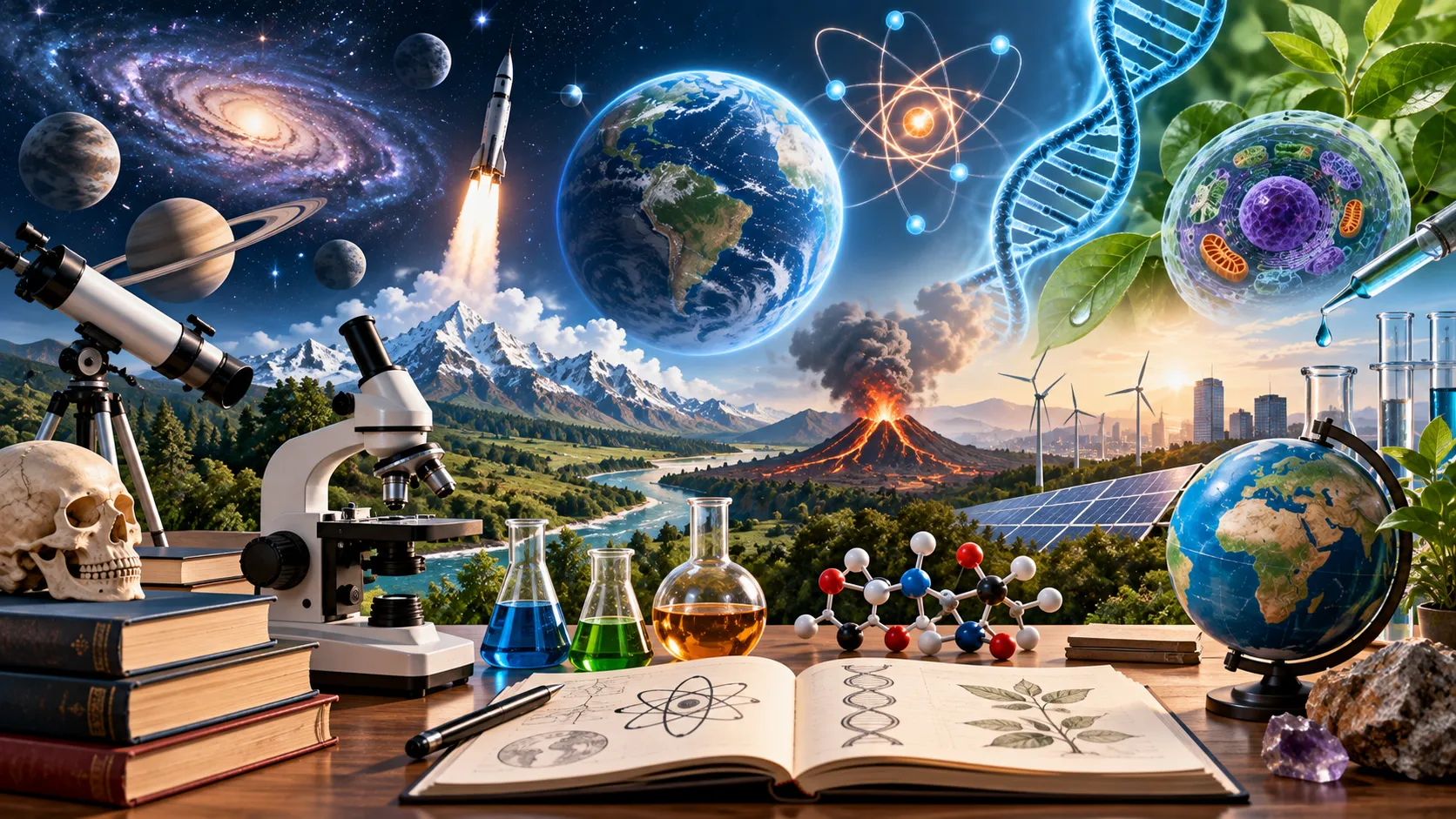
The major natural sciences include physics, chemistry, biology, Earth science, and astronomy. These fields overlap constantly. Chemistry helps explain biology, physics helps explain astronomy, and Earth science combines physics, chemistry, and biology to study our planet.
Learning Objectives
After studying this guide, you should be able to:
· Explain how scientific investigations use evidence and testing.
· Distinguish hypotheses, theories, laws, and models.
· Describe the basic structure of matter.
· Explain forces, motion, energy, heat, and electricity.
· Identify important biological concepts involving cells and ecosystems.
· Describe major Earth systems and basic astronomical structures.
What Is Science?
Science seeks explanations about the natural universe that can be examined using evidence.
Scientists may use:
· Observations
· Experiments
· Measurements
· Mathematical models
· Computer simulations
· Field studies
· Comparisons of existing data
Different scientific fields use different methods. An astronomer cannot place a star in a laboratory, for example, but can test ideas using observations, physical laws, telescopes, and models.
A strong scientific explanation must be consistent with available evidence and open to further testing.
The Scientific Method
There is no single rigid sequence followed in every investigation, but scientific work often involves several common steps.
1. Observation
A scientist notices a pattern or phenomenon.
Example:
Plants near a window appear to grow toward the light.
2. Question
The scientist asks a focused question.
Example:
Does light direction affect plant growth?
3. Hypothesis
A hypothesis is a testable proposed explanation.
Example:
If light comes mainly from one direction, plant shoots will grow toward that light.
4. Experiment or Investigation
The scientist designs a fair test.
One variable may be changed while others are kept as similar as possible.
5. Data Collection
Measurements and observations are recorded.
6. Analysis
The scientist examines patterns in the data.
7. Conclusion
The results are compared with the hypothesis.
A hypothesis may be supported, rejected, or modified.
8. Replication and Review
Other researchers may repeat the work or evaluate the methods and evidence.
Replication is important because a result observed once may be caused by error, chance, or unusual circumstances.
Variables in Experiments
An experiment commonly includes several kinds of variables.
Independent Variable
The independent variable is the factor deliberately changed.
Dependent Variable
The dependent variable is what is measured in response.
Controlled Variables
Controlled variables are factors kept as constant as reasonably possible.
Suppose a student tests how fertilizer affects plant height.
· Fertilizer amount = independent variable
· Plant height = dependent variable
· Light, water, plant species, and temperature = controlled variables
Hypothesis, Theory, and Law
These terms are often misunderstood.
Hypothesis
A hypothesis is a testable proposed explanation.
Scientific Theory
A scientific theory is a broad explanation supported by substantial evidence from many observations and investigations.
Examples include:
· Cell theory
· Germ theory
· Theory of evolution
· Plate tectonic theory
A scientific theory is not simply a guess.
Scientific Law
A scientific law describes a consistent relationship or pattern in nature, often mathematically.
A law usually describes what happens, while theories seek to explain why or how processes occur.
A theory does not "graduate" into a law. They serve different scientific purposes.
Measurement and SI Units
Science depends on reliable measurement.
The International System of Units, or SI, provides standardized units used internationally.
Important examples include:
Quantity | SI Unit |
Length | meter (m) |
Mass | kilogram (kg) |
Time | second (s) |
Temperature | kelvin (K) |
Electric current | ampere (A) |
Amount of substance | mole (mol) |
Standard units allow scientists in different countries to compare results accurately.
Matter
Matter is anything that has mass and occupies space.
Matter is composed of atoms.
Common states of matter include:
· Solid
· Liquid
· Gas
· Plasma
Solids
Solids have a relatively fixed shape and volume.
Liquids
Liquids have a fixed volume but take the shape of their container.
Gases
Gases expand to fill available space.
Plasma
Plasma consists of electrically charged particles and occurs naturally in stars and lightning.
Atoms
An atom is the basic unit of a chemical element.
Atoms contain smaller particles.
Protons
Protons have a positive electric charge and are found in the nucleus.
Neutrons
Neutrons have no net electric charge and are also found in the nucleus.
Electrons
Electrons have negative charge and occupy regions around the nucleus.
The number of protons determines which chemical element an atom represents.
Elements and the Periodic Table
An element is a pure substance made of atoms containing the same number of protons.
Examples include:
· Hydrogen
· Carbon
· Oxygen
· Iron
· Gold
The periodic table organizes elements according to atomic number and recurring chemical properties.
Elements in the same group often share important chemical characteristics.
Molecules and Compounds
A molecule consists of atoms chemically bonded together.
For example:
O₂ contains two oxygen atoms.
A compound contains atoms of more than one element chemically combined.
Water is:
H₂O
It contains hydrogen and oxygen.
Physical and Chemical Changes
A physical change alters form without creating a new substance.
Examples:
· Melting ice
· Cutting paper
· Boiling water
A chemical change produces one or more new substances.
Examples:
· Rusting iron
· Burning wood
· Digesting food
Signs of a chemical reaction may include temperature change, gas production, color change, or formation of a new solid.
Force and Motion
A force is a push or pull that can change an object's motion.
Examples include:
· Gravity
· Friction
· Magnetic force
· Tension
· Normal force
Speed
Speed describes how quickly an object moves.
A basic relationship is:
Speed = Distance ÷ Time
Velocity
Velocity includes both speed and direction.
Acceleration
Acceleration is the rate at which velocity changes.
An object accelerates if it speeds up, slows down, or changes direction.
Newton's Laws of Motion
Isaac Newton described several fundamental relationships between force and motion.
First Law
An object remains at rest or continues moving at constant velocity unless acted upon by a net external force.
This tendency is called inertia.
Second Law
Force, mass, and acceleration are related by:
F = ma
Greater force produces greater acceleration when mass remains the same.
Third Law
For every interaction, forces occur in equal and opposite pairs.
When a person pushes backward on the ground while walking, the ground pushes the person forward.
Gravity
Gravity is the attraction between masses.
On Earth, gravity causes objects to fall toward the planet and gives them weight.
Gravity also:
· Keeps the Moon in orbit around Earth.
· Keeps planets orbiting the Sun.
· Helps form stars and galaxies.
Mass and weight are not identical.
Mass measures the amount of matter in an object.
Weight depends on gravitational force.
Energy
Energy is the capacity to cause change or perform work.
Major forms include:
· Kinetic energy
· Potential energy
· Thermal energy
· Chemical energy
· Electrical energy
· Nuclear energy
· Radiant energy
Kinetic Energy
Kinetic energy is energy of motion.
Potential Energy
Potential energy is stored energy related to position or configuration.
A raised object has gravitational potential energy.
Conservation of Energy
Energy can change form, but in an isolated system the total amount of energy is conserved.
For example, electrical energy in a lamp may become light and thermal energy.
Heat and Temperature
Temperature measures the average kinetic behavior of particles in a substance.
Heat is energy transferred because of a temperature difference.
Heat can move through:
Conduction
Energy transfer through direct particle interactions.
Convection
Energy transfer through moving fluids such as liquids or gases.
Radiation
Energy transferred through electromagnetic waves.
Sunlight reaches Earth mainly through radiation.
Electricity
Electricity involves electric charge and its movement.
An electric current is the flow of electric charge.
A simple electrical circuit may include:
· Energy source
· Conducting wires
· Load such as a bulb
· Switch
Materials that allow charge to move easily are conductors.
Materials that resist charge movement are insulators.
Biology and Cells
Biology is the study of living organisms.
The cell is the fundamental structural and functional unit of life.
Living organisms may be:
· Unicellular
· Multicellular
Important cell structures include:
· Cell membrane
· Cytoplasm
· Genetic material
· Ribosomes
Eukaryotic cells also contain a membrane-bound nucleus and other organelles.
Genetics
DNA contains hereditary information.
A gene is a region of DNA that contributes instructions used by cells.
Genes are transmitted from parents to offspring and help influence traits.
Genetic variation is important because populations need variation for evolutionary processes such as natural selection.
Evolution
Evolution describes inherited changes in populations across generations.
Natural selection occurs when heritable differences affect survival or reproductive success.
Over many generations, traits that improve reproductive success in particular environments may become more common.
Evolution does not mean individual organisms intentionally change themselves because they "need" to adapt.
Ecology
Ecology examines relationships among organisms and their environment.
Important ecological levels include:
· Organism
· Population
· Community
· Ecosystem
· Biosphere
Producers
Producers, such as plants, capture energy and make organic matter.
Consumers
Consumers obtain energy by eating other organisms.
Decomposers
Decomposers break down dead material and recycle nutrients.
A simple food chain might be:
Grass → Rabbit → Fox
Real ecosystems contain interconnected food webs rather than isolated food chains.
Earth Science
Earth science examines Earth's structure, surface, atmosphere, oceans, and history.
Major branches include:
· Geology
· Meteorology
· Oceanography
· Climatology
Earth's Layers
Earth can be described using several major internal layers.
Crust
The thin outer solid layer.
Mantle
A thick layer of hot rock beneath the crust.
Core
Earth's central region, consisting mainly of iron and nickel.
The core has a liquid outer portion and solid inner portion.
Plate Tectonics
Earth's outer rigid shell is divided into tectonic plates.
These plates move slowly.
Plate interactions can produce:
· Earthquakes
· Volcanoes
· Mountain ranges
· Ocean trenches
· Rift valleys
Plate tectonics explains many large-scale features of Earth's surface.
The Water Cycle
Water continuously circulates among Earth's surface, atmosphere, and underground systems.
Important processes include:
· Evaporation
· Condensation
· Precipitation
· Runoff
· Infiltration
· Groundwater flow
The Sun provides much of the energy driving this cycle.
Weather and Climate
Weather describes short-term atmospheric conditions.
Examples include today's:
· Temperature
· Wind
· Rainfall
· Cloud cover
Climate describes long-term patterns of weather in a region.
A rainy afternoon is weather.
A region's typical rainfall pattern over decades is climate.
Astronomy
Astronomy studies objects and processes beyond Earth.
The universe contains:
· Planets
· Moons
· Stars
· Asteroids
· Comets
· Nebulae
· Galaxies
The Solar System
Our solar system consists of the Sun and objects gravitationally bound to it.
The eight planets, in order from the Sun, are:
1. Mercury
2. Venus
3. Earth
4. Mars
5. Jupiter
6. Saturn
7. Uranus
8. Neptune
Stars
A star is a massive sphere of hot plasma powered largely by nuclear fusion.
The Sun is Earth's nearest star.
Galaxies
A galaxy is a vast system containing stars, gas, dust, dark matter, and other material held together by gravity.
Our solar system lies within the Milky Way Galaxy.
Common Mistakes
Mistake 1: A Scientific Theory Is Just a Guess
False. A scientific theory is supported by extensive evidence and testing.
Mistake 2: Mass and Weight Are the Same
False. Mass is the amount of matter; weight depends on gravity.
Mistake 3: Heat and Temperature Mean the Same Thing
False. Temperature describes thermal state, while heat is energy transferred because of temperature differences.
Mistake 4: Atoms and Molecules Are the Same
False. Molecules consist of bonded atoms.
Mistake 5: Seasons Are Caused Mainly by Earth's Distance From the Sun
False. Earth's axial tilt is the main cause of seasonal changes.
Mistake 6: Evolution Means Organisms Change Because They Want To
False. Evolution occurs through inherited changes in populations across generations.
Memory Tips
Remember the scientific process:
Question → Hypothesis → Test → Data → Conclusion
For atoms:
Proton = positive
Neutron = neutral
Electron = negative
For motion:
Speed = Distance ÷ Time
For heat:
Conduction = contact
Convection = circulation
Radiation = rays
For Earth:
Crust → Mantle → Core
For planets:
Mercury, Venus, Earth, Mars, Jupiter, Saturn, Uranus, Neptune
Summary
Science uses evidence, measurement, experimentation, observation, and logical reasoning to understand the natural world.
Physics studies matter, energy, forces, motion, heat, electricity, and other physical processes. Chemistry examines atoms, elements, molecules, compounds, and chemical reactions. Biology studies cells, genetics, evolution, organisms, and ecosystems.
Earth science examines rocks, tectonic plates, water, atmosphere, weather, climate, and Earth's history. Astronomy extends scientific study beyond Earth to planets, stars, galaxies, and the universe.
Although these sciences are often taught separately, they are deeply connected. Understanding general science means recognizing how matter, energy, life, Earth, and space operate as interacting parts of the natural universe.
FAQ
1. What is science?
Science is the systematic study of the natural world using evidence, observation, measurement, and testing.
2. What is a hypothesis?
A hypothesis is a testable proposed explanation for an observation or question.
3. What is the difference between a theory and a law?
A scientific theory provides a broad evidence-based explanation, while a law describes a consistent pattern or relationship.
4. What is matter?
Matter is anything that has mass and occupies space.
5. What is an atom?
An atom is the fundamental unit of a chemical element.
6. What is energy?
Energy is the capacity to cause change or perform work.
7. What is the basic unit of life?
The cell is the basic structural and functional unit of life.
8. What causes earthquakes?
Most earthquakes result from sudden movement along faults associated with stresses in Earth's crust, often linked to tectonic plate movement.
9. What is the difference between weather and climate?
Weather refers to short-term atmospheric conditions, while climate describes long-term patterns.
10. What galaxy contains our solar system?
The solar system lies in the Milky Way Galaxy.
Key Takeaways
· Science relies on evidence, testing, measurement, and repeatable investigation.
· Matter consists of atoms, while energy appears in forms such as kinetic, chemical, thermal, and electrical energy.
· Physics explains forces and motion, chemistry explains substances and reactions, and biology explains living systems.
· Plate tectonics, the water cycle, weather, and climate are central Earth-science concepts.
· Astronomy studies the solar system, stars, galaxies, and the wider universe.
References
1. National Institute of Standards and Technology. SI Units. NIST — International System of Units
2. National Institute of Standards and Technology. Periodic Table of the Elements. NIST — Periodic Table
3. National Aeronautics and Space Administration. Solar System Exploration. NASA — Solar System
4. National Aeronautics and Space Administration. The Sun. NASA — Sun
5. National Aeronautics and Space Administration. Galaxies. NASA — Galaxies
6. U.S. Geological Survey. This Dynamic Earth: The Story of Plate Tectonics. USGS — Plate Tectonics
7. U.S. Geological Survey. The Water Cycle. USGS — Water Cycle
8. National Oceanic and Atmospheric Administration. Weather and Climate. NOAA — Climate.gov Science Resources
9. National Human Genome Research Institute. Deoxyribonucleic Acid (DNA) Fact Sheet. NHGRI — DNA Fact Sheet
10. Smithsonian National Museum of Natural History. Introduction to Human Evolution. Smithsonian — Evolution