


Introduction
Television is a system for transmitting moving images and sound to viewers. Broadcasting is the distribution of audio or audiovisual programmes from one source to many receivers, traditionally through radio-frequency signals but now also through cable, satellite, internet networks, and streaming platforms.
Television combines technologies from photography, radio, electronics, computing, sound recording, telecommunications, and digital compression. It is also a major cultural medium used for news, entertainment, education, advertising, sports, and public information.
Television has changed from early experimental systems to electronic broadcasting, color television, satellite distribution, digital television, high-definition formats, and internet-delivered video. The Library of Congress maintains extensive collections documenting television and broadcasting history, including programme logs, scripts, news copy, and commercial materials.
Learning Objectives
After studying this guide, you should be able to:
· Explain how television broadcasting sends pictures and sound to audiences.
· Distinguish terrestrial, cable, satellite, IPTV, and streaming television.
· Compare analog and digital broadcasting.
· Understand channels, networks, stations, transmitters, and receivers.
· Identify major television production roles and control-room terminology.
· Explain common programme formats, ratings, advertising, and broadcasting terms.
What Is Broadcasting?
Broadcasting traditionally means transmitting programmes from a station so that many people can receive them.
Broadcast media include:
· Radio
· Television
· Some satellite services
· Digital terrestrial television
Traditional broadcasting differs from one-to-one communication because the same programme is distributed to a large audience.
The Library of Congress treats broadcasting as a distinct media field and preserves extensive radio and television collections.
How Television Works
At the simplest level, a television system must:
1. Capture images and sound.
2. Convert them into electronic or digital information.
3. Transmit or distribute that information.
4. Receive and decode it.
5. Reproduce pictures and sound for viewers.
Modern television usually represents video and audio digitally.
The signal may then reach audiences through:
· Terrestrial transmitters
· Cable systems
· Satellites
· Internet connections
Television Camera
A television camera converts light from a scene into electronic image information.
Modern cameras use digital image sensors.
The recorded image can then be:
· Stored
· Edited
· Transmitted live
· Combined with graphics
· Compressed for distribution
Television Receiver
A television receiver processes incoming video and audio signals and presents them through:
· Display
· Speakers
Modern televisions may also contain:
· Internet connectivity
· Streaming applications
· Digital tuners
· Media processors
A television capable of running applications and connecting directly to internet services is commonly called a smart TV.
Broadcast Station and Network
These terms are related but different.
Television Station
A station is an individual broadcasting operation serving a particular area or audience.
A station may produce:
· Local news
· Weather reports
· Community programmes
· Advertising
It may also carry programming supplied by a larger network.
Television Network
A network distributes programming to multiple affiliated stations or outlets.
Networks can provide:
· News
· Drama
· Sports
· Entertainment
· National advertising
Memory Tip
Station → local outlet
Network → programme distribution across multiple outlets
Terrestrial Television
Terrestrial television uses transmitters on Earth to send radio-frequency television signals through the air.
Viewers may receive the signals through antennas.
Traditional over-the-air broadcasting involves:
Studio → transmitter → radio waves → receiving antenna → television
Digital terrestrial systems can carry multiple programme services and additional data within allocated broadcast spectrum.
Cable Television
Cable television distributes programmes through physical cable networks.
Historically, cable systems often used coaxial cable, although modern systems may combine:
· Coaxial cable
· Fiber optics
· Internet technologies
Cable can carry many channels without requiring each household to receive every television service directly from a terrestrial broadcast tower.
Satellite Television
Satellite television sends programming through communications satellites.
A simplified path is:
Broadcaster → uplink station → satellite → receiving dish
Satellite systems are useful for covering very large geographic regions.
Weather, terrain, antenna alignment, and signal frequencies can affect reception.
IPTV
Internet Protocol Television (IPTV) distributes television using internet-protocol networking.
It is often provided through a managed network operated by a telecommunications or television provider.
IPTV differs from traditional terrestrial broadcasting because programmes travel as network data rather than solely as conventional broadcast radio signals.
Streaming Television
Streaming delivers video over internet networks as viewers watch it.
Streaming services may provide:
· Live television
· Movies
· Series
· Sports
· On-demand programmes
Unlike traditional scheduled television, streaming often allows viewers to select content and viewing time individually.
Broadcast vs Streaming
Broadcast → one transmission distributed to many receivers
Streaming → internet-delivered video, often requested individually
Linear Television
Linear television follows a predetermined schedule.
For example:
· 6:00 PM news
· 7:00 PM game show
· 8:00 PM drama
Viewers watch whichever programme is being transmitted at that time.
Video on Demand
Video on Demand (VOD) allows viewers to choose a programme when they want to watch it.
VOD changed television consumption by reducing dependence on fixed schedules.
Streaming platforms commonly rely heavily on on-demand viewing.
Analog Television
Analog television represents changing picture and sound information using continuously varying signals.
Older broadcasting systems commonly used analog standards.
Analog signals can gradually become noisier as reception worsens, producing effects such as:
· Static
· Ghosting
· Distorted pictures
Digital Television
Digital television (DTV) represents audio and video numerically.
Advantages can include:
· More efficient use of spectrum
· Higher image quality
· Multichannel broadcasting
· Additional programme information
· Improved audio capabilities
ATSC's first-generation digital television system helped enable high-definition terrestrial television and multichannel digital broadcasting, while newer ATSC 3.0 standards use IP-based technologies and support additional capabilities.
Memory Tip
Analog → continuously varying signal
Digital → numerical data
Resolution
Resolution describes the number of picture elements, or pixels, used to form an image.
Common television terms include:
· Standard Definition (SD)
· High Definition (HD)
· Full HD
· Ultra High Definition (UHD)
Higher resolution can provide greater image detail when the display, programme, and transmission system support it.
Common Quiz Fact
4K television generally refers to an Ultra High Definition format with approximately 4,000 horizontal pixels.
Pixels
A pixel is a small individual picture element in a digital image.
Millions of pixels can combine to create one television frame.
A higher pixel count does not automatically guarantee better picture quality because quality also depends on factors such as:
· Compression
· Color
· Contrast
· Frame rate
· Source quality
Aspect Ratio
Aspect ratio describes the relationship between an image's width and height.
Two historically important television ratios are:
4:3 — common in older television
16:9 — standard widescreen television format
Old programmes displayed on modern screens may therefore appear with black bars at the sides unless the image is cropped or stretched.
Frame Rate
Video creates the impression of motion by displaying a sequence of images called frames.
The frame rate tells us how many frames are displayed per second.
It may be written as:
fps → frames per second
Different television and film systems use different frame rates.
Interlaced and Progressive Video
Two methods have historically been used to display video.
Interlaced Scan
An interlaced system divides each image into alternating sets of lines called fields.
Notation may include:
1080i
where the i means interlaced.
Progressive Scan
Progressive systems draw each complete frame in sequence.
Notation may include:
720p
or:
1080p
where p means progressive.
Compression
Raw digital video requires enormous amounts of data.
Video compression reduces the amount of information needed to store or transmit it.
Compression makes practical:
· Streaming
· Digital broadcasting
· Video calls
· Online video
· Digital storage
Modern broadcast standards specify technologies for compressing and transporting video and audio.
Live Television
Live television is transmitted as an event occurs, usually with only a short technical delay.
Common live programming includes:
· News
· Sports
· Award ceremonies
· Political events
· Special broadcasts
Live television creates production challenges because mistakes cannot simply be removed before the initial transmission.
Recorded Television
Recorded programmes are produced before broadcast.
This allows editors to:
· Select takes
· Rearrange sequences
· Add music
· Insert graphics
· Correct some errors
Most drama and comedy series are primarily recorded rather than created as continuous live broadcasts.
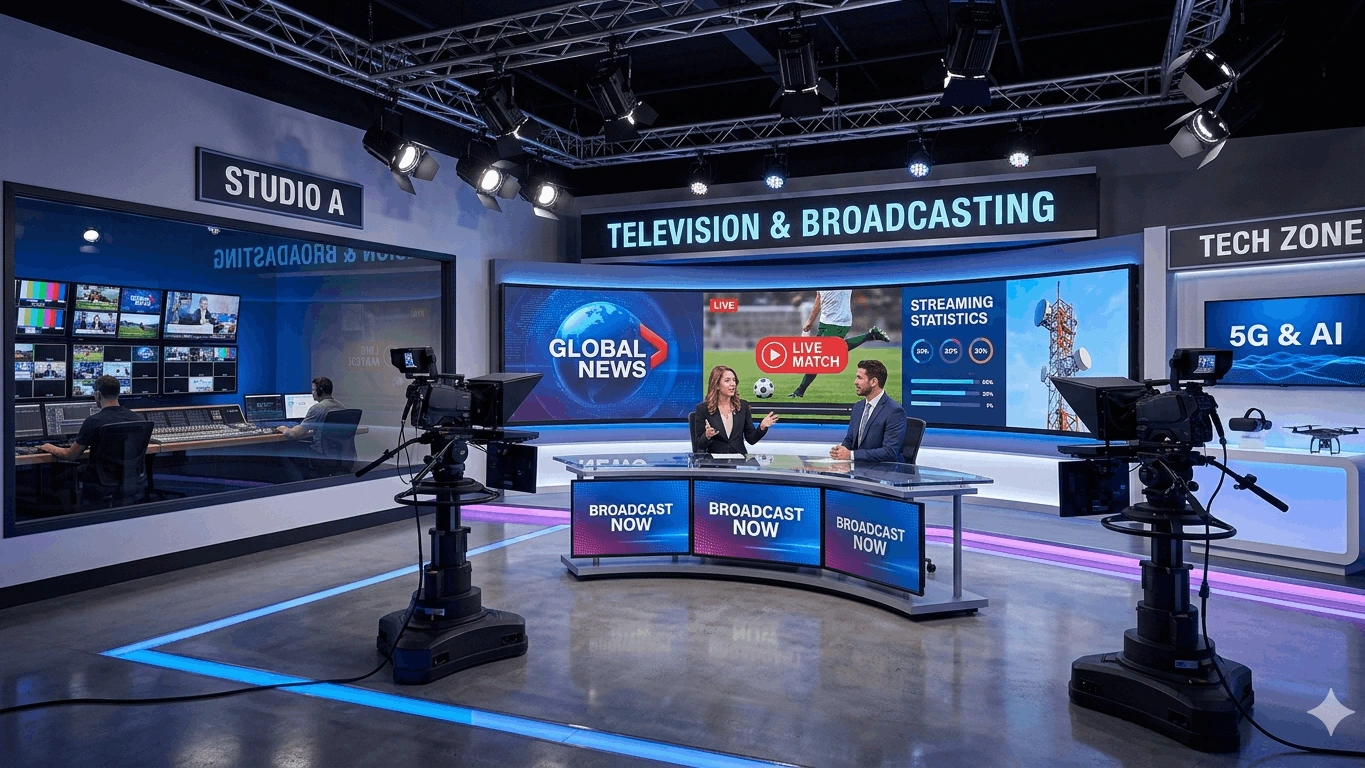
Television Studio
A television studio is a controlled environment where programmes can be produced.
Typical studio equipment includes:
· Cameras
· Microphones
· Lighting
· Sets
· Monitors
· Teleprompters
Studios may produce:
· News
· Talk shows
· Game shows
· Interviews
· Entertainment programmes
Control Room
A television control room coordinates the programme being produced or transmitted.
Personnel may control:
· Camera selection
· Graphics
· Audio
· Recorded clips
· Timing
In live production, the director may rapidly switch between multiple cameras.
Vision Mixer / Video Switcher
A vision mixer, or video switcher, selects which video source appears in the programme output.
Sources may include:
· Camera 1
· Camera 2
· Recorded package
· Graphic
· Remote feed
The operator works closely with the director.
Teleprompter
A teleprompter displays text near the camera lens so a presenter can read while appearing to look toward the audience.
Teleprompters are commonly used for:
· News
· Speeches
· Studio presentation
Television Producer
A television producer helps organize and manage a programme.
Responsibilities may involve:
· Programme development
· Budgets
· Scheduling
· Content decisions
· Staff coordination
Exact producer roles vary between productions.
Television Director
The director controls how the programme is presented visually and dramatically.
In a live studio, the director may instruct:
· Cameras
· Floor staff
· Video switching
· Timing
In drama production, the role resembles film directing more closely.
News Anchor and Reporter
A news anchor presents and connects news stories from the studio.
A reporter gathers and presents information, often from locations outside the studio.
A correspondent may specialize in a particular location or subject such as:
· Politics
· International affairs
· Business
· Science
Programme Genres
Television contains many programme types.
Common genres include:
· News
· Drama
· Comedy
· Documentary
· Reality television
· Game shows
· Talk shows
· Sports
· Children's programmes
· Educational television
A programme may combine several genres.
Series, Season, and Episode
A series is a programme consisting of multiple installments.
An episode is one individual installment.
A season is a group of episodes released or broadcast during a particular production or scheduling cycle.
Memory Tip
Series → whole programme
Season → group
Episode → individual installment
Pilot Episode
A pilot is an initial programme produced to demonstrate the concept of a proposed television series.
A successful pilot may lead to a full series order.
Not every pilot becomes a continuing series.
Sitcom
Sitcom is short for:
situation comedy
A sitcom normally follows recurring characters in comedic situations.
Classic sitcom structures often use recurring locations and self-contained episode plots, although modern sitcom formats vary widely.
Soap Opera
A soap opera is a serialized drama featuring continuing characters and storylines.
The term developed historically from daytime radio and television dramas whose commercial sponsors often included soap manufacturers.
Documentary
A documentary presents nonfiction subjects using techniques such as:
· Interviews
· Archival footage
· Narration
· Location filming
Documentaries can cover science, history, nature, politics, culture, and other subjects.
Television News
Television news combines:
· Reporting
· Video
· Interviews
· Graphics
· Live coverage
· Studio presentation
A short prerecorded news report is sometimes called a package.
A reporter speaking directly from a remote location may appear through a live shot.
Public Broadcasting
Public broadcasting is organized primarily around public-service purposes rather than depending entirely on commercial advertising.
Funding systems vary by country and may involve:
· Public funds
· Licence fees
· Donations
· Sponsorship
· Other revenue
The structure and independence of public broadcasters differ considerably among political and media systems.
Commercial Broadcasting
Commercial broadcasting earns revenue largely through commercial activities such as:
· Advertising
· Sponsorship
· Programme sales
· Distribution fees
An advertisement, or commercial, is paid promotional content inserted into or around programmes.
Audience Ratings
Television ratings estimate the size or characteristics of an audience.
Ratings information may be used by:
· Broadcasters
· Advertisers
· Producers
· Networks
Audience measurement usually relies on samples and data systems rather than literally recording every viewer.
Ratings vs Content Rating
Two meanings are easily confused:
Audience rating → how many people watched
Content rating → suitability classification
Syndication
Syndication is the licensing or distribution of television programmes to multiple stations or outlets outside one original network run.
Syndication has historically allowed successful programmes to continue appearing long after their first broadcasts.
Rerun
A rerun is a repeat broadcast of a programme that aired previously.
Reruns became important to television economics because programmes could continue attracting audiences after their original transmission.
Television Archive and Preservation
Television broadcasts are important historical records.
Archiving can preserve:
· News
· Entertainment
· Advertisements
· Interviews
· Sports
· Public events
The Library of Congress has collected television material since 1949 and preserves extensive broadcast collections, including NBC programme records dating back to the early era of television.
Brief History of Television
Television developed gradually rather than through one single invention.
Early Experiments
Researchers experimented with transmitting images electrically during the late 19th and early 20th centuries.
Mechanical television systems appeared before fully electronic systems became practical.
Electronic Television
During the 1920s and 1930s, researchers developed electronic camera and display technologies that became foundations for modern television.
Important historical figures included innovators working in several countries and organizations, so the invention of television should not be credited to one person alone.
Expansion of Broadcasting
Television services expanded significantly during the mid-20th century.
The Library of Congress's NBC records document broadcasting activity beginning in the 1930s and continuing through later decades.
Color Television
Color systems gradually replaced black-and-white broadcasting in many countries during the mid- to late-20th century.
Satellite and Cable Growth
Satellite communication expanded the ability to transmit television over long distances.
Cable systems greatly increased the number of channels available to many households.
Digital Television
Digital broadcasting introduced more efficient signal processing, higher-resolution television, and new ways to distribute multiple services.
Internet and Streaming Era
Broadband internet changed television again by allowing viewers to watch programmes through:
· Computers
· Smartphones
· Tablets
· Smart televisions
This weakened the old distinction between television broadcasting and internet video.
Common Mistakes
Television and Broadcasting Are Not Identical
Television is a medium.
Broadcasting is one method of distributing content.
The Internet Is Not the Same as Streaming
The internet is the network infrastructure.
Streaming is one way of delivering media across it.
Cable Is Not Over-the-Air Broadcasting
Cable uses a wired distribution network.
Digital Does Not Automatically Mean HD
A digital signal can carry different resolutions.
4K Refers Mainly to Resolution
It does not by itself describe frame rate, sound quality, or overall image quality.
A Network and Station Are Different
A network distributes programming among outlets.
A station serves as an individual broadcasting operation.
Ratings Have More Than One Meaning
Audience ratings measure viewership.
Content ratings classify programme suitability.
Television Was Not Invented by One Person
It developed from the work of multiple researchers, engineers, companies, and institutions.
Memory Tips
For distribution:
Terrestrial → transmitter
Cable → wire
Satellite → space
Streaming → internet
For television technology:
Analog → continuous
Digital → numerical
Pixel → image element
Resolution → image detail
For production:
Camera → captures
Director → coordinates
Switcher → selects
Teleprompter → displays script
For programming:
Series → whole show
Season → group of episodes
Episode → one installment
Summary
Television combines image, sound, electronics, telecommunications, and digital technology to distribute programmes to audiences.
Traditional television broadcasting sends programmes from stations and networks through terrestrial transmitters, cable systems, or satellites. Modern television also includes IPTV and internet streaming, which allow both live and on-demand viewing.
Analog television represents information through continuously varying signals, while digital television encodes information numerically. Digital systems enable efficient compression, high-definition pictures, multichannel broadcasting, and additional services.
Television production involves cameras, sound, lighting, control rooms, directors, producers, presenters, editors, graphics, and technical staff. Programmes range from news and documentaries to drama, comedy, reality television, game shows, sports, and educational content.
For quizzes, remember the differences between station and network, broadcast and streaming, analog and digital, HD and resolution, live and recorded television, and audience ratings and content ratings.
FAQ
What is television broadcasting?
Television broadcasting is the distribution of audiovisual programmes to large audiences using systems such as terrestrial radio transmission, cable, or satellite.
What is the difference between a station and a network?
A station is an individual broadcasting outlet, while a network distributes programming across multiple stations or services.
What is digital television?
Digital television encodes picture and sound as digital data rather than continuously varying analog signals.
What does HD mean?
HD means High Definition, referring to television formats with greater image resolution than older standard-definition systems.
What does 4K mean?
4K generally describes an Ultra High Definition image format containing approximately 4,000 horizontal pixels.
What is streaming?
Streaming delivers video or audio over a network as it is being consumed rather than requiring the entire file to be obtained beforehand.
What is a television pilot?
A pilot is an initial episode or presentation produced to demonstrate the concept of a possible television series.
What is a sitcom?
A sitcom is a situation comedy, usually centered on recurring characters and comedic situations.
What is television syndication?
Syndication is the licensing and distribution of programmes to stations or outlets outside their original broadcast arrangement.
What is the difference between audience ratings and content ratings?
Audience ratings estimate viewership, while content ratings classify programmes according to suitability or content.
Key Takeaways
· Television distributes moving images and sound through terrestrial broadcasting, cable, satellite, IPTV, and internet streaming.
· Digital television represents programmes as numerical data and allows efficient compression, high-definition video, and additional services.
· Stations, networks, producers, directors, studios, control rooms, and transmitters perform different roles within broadcasting.
· Television programmes include news, drama, comedy, documentaries, reality programmes, sports, talk shows, and many other formats.
· Television developed gradually through multiple inventors and technologies, progressing from mechanical experiments to electronic, color, satellite, digital, and streaming systems.
References
· Library of Congress — Television Research Guides
Research resources covering television history, programming, broadcasting archives, commercials, news, music, and other television subjects.
Library of Congress — Television
· Library of Congress — Broadcasting Research Guides
Research collection covering radio and television broadcasting and related archival resources.
Library of Congress — Broadcasting
· Library of Congress — Television Collections Overview
Overview of the Library's television holdings and preservation of broadcast material as a distinct historical medium.
Library of Congress — Television Collections
· Library of Congress — NBC Television Master Books
Archival collection containing programme logs, scripts, advertising copy, news material, and other broadcasting records dating from the early television era.
Library of Congress — NBC Television Master Books
· Library of Congress — The Story of Television
Historical audiovisual resource covering television cameras, transmitters, receivers, black-and-white television, and color broadcasting.
Library of Congress — The Story of Television
· ATSC — Digital Television Standards
Technical standards covering digital terrestrial television systems, video, audio, transport, and broadcast transmission.
ATSC — Technical Documents
· ATSC — ATSC 1.0 Standards
Technical documentation for the first-generation digital television system associated with high-definition terrestrial broadcasting and digital surround sound.
ATSC — ATSC 1.0
· ATSC — ATSC 3.0 Standards
Current technical standards for an IP-based next-generation terrestrial broadcasting system supporting advanced video, audio, emergency information, and interactive services.
ATSC — ATSC 3.0