


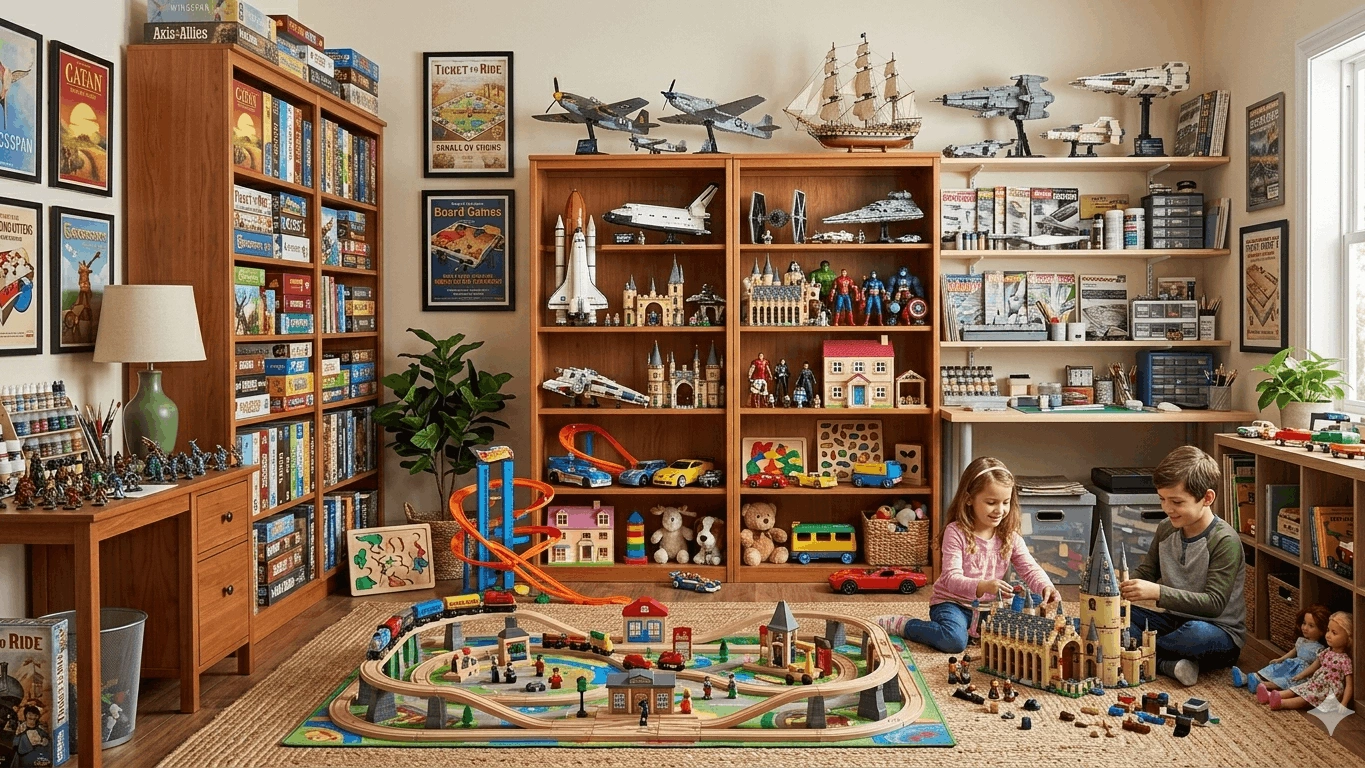
Introduction
Toys, board games, and hobbies are forms of play and leisure that develop imagination, skill, creativity, strategy, social interaction, and personal interests. They range from simple objects such as balls, dolls, blocks, and puzzles to complex strategy games, model-building kits, collectible items, and tabletop role-playing games.
Toys are often associated with childhood, but play continues throughout life. Museums preserve toys and games because they reveal how people lived, learned, socialized, and entertained themselves in different periods. The Smithsonian's collections, for example, include everything from teddy bears and toy vehicles to puzzles and electronic games.
A hobby is a regular leisure activity pursued mainly for enjoyment rather than as a primary occupation. Hobbies may involve collecting, making, solving, competing, learning, or creating.
Learning Objectives
After studying this guide, you should be able to:
· Distinguish toys, games, puzzles, and hobbies.
· Identify common board-game mechanics and terminology.
· Explain the differences between strategy, chance, cooperative, and competitive games.
· Recognize famous games such as chess, Monopoly, Scrabble, and role-playing games.
· Describe hobbies such as collecting, model building, crafts, puzzles, and miniature gaming.
· Understand how play can involve creativity, learning, social interaction, and skill development.
What is a Toy?
A toy is an object primarily designed or used for play.
Common toy categories include:
· Dolls and figures
· Building sets
· Toy vehicles
· Balls
· Puzzles
· Construction toys
· Pretend-play objects
· Electronic toys
Some objects become toys even if they were not originally manufactured as such. A cardboard box, stick, blanket, or ordinary household object can become part of imaginative play.
The Strong National Museum of Play recognizes both manufactured products and simple objects among historically important toys, reflecting how play depends as much on imagination as on technology.
Educational and Construction Toys
Some toys encourage building, experimentation, or problem-solving.
Examples include:
· Building blocks
· Construction sets
· Model kits
· Science kits
· Puzzles
Construction toys allow players to combine components into new structures.
They can encourage:
· Spatial reasoning
· Planning
· Creativity
· Fine motor coordination
The important feature is not necessarily that a toy teaches a formal school subject. Open-ended toys can support learning by allowing experimentation.
Dolls, Figures, and Pretend Play
Dolls and action figures allow players to create characters and stories.
Pretend play may involve:
· Families
· Superheroes
· Historical characters
· Fantasy worlds
· Everyday occupations
Dollhouses, miniature furniture, toy kitchens, toy vehicles, and costumes expand this form of imaginative play.
Toys can also reflect the cultures and social expectations of the periods in which they were made. Historical toy collections therefore provide useful evidence about changing ideas of childhood and society.
What Is a Board Game?
A board game is a structured game played on or around a marked surface, often using pieces, cards, dice, counters, or tiles.
Typical components include:
· Board
· Playing pieces
· Cards
· Dice
· Tokens
· Score markers
Not every tabletop game requires a literal board. Card games, tile games, miniature games, and tabletop role-playing games belong to the wider tabletop-game family.
Basic Board-Game Terms
Turn
A turn is one player's opportunity to act.
A turn may involve:
· Moving a piece
· Playing a card
· Rolling dice
· Buying resources
· Making a strategic choice
Round
A round usually contains one turn or phase for several or all players.
The exact meaning differs between games.
Player Piece
A piece, pawn, token, or counter represents a player, unit, resource, or object within a game.
Game Board
The board provides the playing area.
Boards may use:
· Squares
· Hexagons
· Paths
· Regions
· Grids
Objective
The objective is the condition players try to achieve.
Examples include:
· Checkmating a king
· Scoring the most points
· Reaching a destination
· Collecting resources
· Solving a mystery
Strategy and Chance
Many games combine two important elements:
Strategy and chance
Strategy
A strategy game rewards decisions, planning, and anticipation.
Examples include:
· Chess
· Go
· Checkers
Players can analyze possibilities and choose among different actions.
Chance
Chance introduces unpredictable results.
Common chance mechanisms include:
· Dice
· Shuffled cards
· Random tiles
· Spinners
A game can involve both strategy and luck.
Memory Tip
Strategy → decisions
Chance → randomness
Competitive and Cooperative Games
Competitive Games
Players compete against one another.
Examples may reward:
· Highest score
· Last surviving player
· Fastest completion
· Achievement of a specific objective
Cooperative Games
Players work together toward a shared goal.
They may win or lose as a group.
Team Games
Some games divide players into opposing teams.
Communication and coordination then become part of the strategy.
Abstract Strategy Games
An abstract strategy game emphasizes rules and spatial decisions rather than detailed storytelling.
Examples include:
· Chess
· Go
· Checkers
These games usually contain little or no hidden information and may use limited or no randomness.
Chess
Chess is played by two players on an 8 × 8 board containing 64 squares.
Each side begins with 16 pieces:
· 1 king
· 1 queen
· 2 rooks
· 2 bishops
· 2 knights
· 8 pawns
The objective is to checkmate the opponent's king.
Check means the king is under attack.
Checkmate means the king is under attack and has no legal way to escape.
The official over-the-board rules are maintained by FIDE, the International Chess Federation.
Quiz Tip
Check → king threatened
Checkmate → game-ending unavoidable threat
Checkers
Checkers, also called draughts in many regions, is played on a checkered board.
Players move pieces diagonally and capture opposing pieces.
Pieces that reach the far side of the board can usually be promoted to more powerful kings, although exact rules vary among regional versions.
Checkers is a classic example of an abstract strategy game.
Go
Go is an ancient strategy game originating in East Asia.
Players place black and white stones on intersections of a grid.
Its central ideas include:
· Surrounding territory
· Capturing stones
· Maintaining connected groups
Go has simple basic placement rules but extremely deep strategy.
Monopoly
Monopoly is a property-trading board game involving movement, money, rent, houses, hotels, and property ownership.
Its history can be traced to The Landlord's Game, patented by Elizabeth Magie in the early 20th century. The game was designed partly to demonstrate ideas about land ownership and economic inequality. Later versions evolved into the commercial Monopoly game popularized in the 1930s.
Monopoly combines:
· Dice-based movement
· Chance
· Negotiation
· Resource management
Common Mistake
Monopoly did not appear suddenly as a completely new invention in the 1930s. Its development involved earlier designs and players who modified the game over time.
Scrabble
Scrabble is a word game in which players place letter tiles on a board to form connected words.
Letters have different point values.
Special squares can multiply:
· Letter scores
· Word scores
Architect Alfred Mosher Butts developed the game that eventually became Scrabble during the 1930s. It was later refined and renamed before becoming widely successful.
Scrabble combines:
· Vocabulary
· Letter probability
· Board positioning
· Score management
Word Games and Trivia Games
Word games test language skills.
Examples may involve:
· Spelling
· Anagrams
· Crosswords
· Word creation
Trivia games test knowledge in subjects such as:
· History
· Science
· Entertainment
· Geography
· Sports
Knowledge alone may not determine victory if the game also uses chance or board movement.
Dice Games
Dice introduce random numerical outcomes.
The most familiar die is a cube with:
6 sides
However, tabletop games may use dice with:
· 4 sides
· 8 sides
· 10 sides
· 12 sides
· 20 sides
Dice can determine:
· Movement
· Damage
· Success or failure
· Random events
Card Games
Cards are among the most flexible game tools.
Traditional playing-card decks can support hundreds of games.
Card games may involve:
· Matching
· Trick-taking
· Collecting
· Bluffing
· Hand management
Some modern tabletop games are built entirely around specialized decks.
Collectible Card Games
A collectible card game allows players to build personal decks from a larger collection of cards.
Different cards may have:
· Different abilities
· Different rarity
· Different strategic uses
Deck construction itself becomes part of the game.
This differs from a conventional boxed card game in which every player normally uses the same fixed set.
Tabletop Role-Playing Games
A tabletop role-playing game (TTRPG) combines rules, imagination, storytelling, and character decisions.
Players usually control fictional characters.
Another participant often serves as a:
· Game Master
· Dungeon Master
· Referee
· Narrator
depending on the game.
The game master describes situations and interprets rules, while players decide what their characters attempt to do.
Dungeons & Dragons
Dungeons & Dragons (D&D) became one of the most influential tabletop role-playing games.
Gary Gygax and Dave Arneson developed D&D from traditions including miniature war games and fantasy storytelling. It was first published in the 1970s and helped establish role-playing games as a distinct form of tabletop play.
D&D uses features such as:
· Character roles
· Statistics
· Dice
· Collaborative storytelling
· Imaginary worlds
Its influence later extended into computer role-playing games and other digital-game genres.
Puzzles
A puzzle presents a problem to be solved.
Common forms include:
· Jigsaw puzzles
· Crosswords
· Sudoku
· Logic puzzles
· Mechanical puzzles
· Word searches
Puzzles differ from many games because they may not require an opponent.
The challenge itself provides the objective.
Jigsaw Puzzles
A jigsaw puzzle consists of pieces that must be assembled into a complete picture or design.
Solving jigsaw puzzles can involve:
· Shape recognition
· Color matching
· Pattern recognition
· Spatial reasoning
Common solving methods include finding:
1. Corner pieces
2. Edge pieces
3. Distinctive colors or patterns
before completing more difficult areas.
Mechanical Puzzles
Mechanical puzzles require physical manipulation.
Famous examples include twisty puzzles such as the Rubik's Cube.
These puzzles challenge:
· Memory
· Spatial reasoning
· Pattern recognition
· Algorithmic thinking
Unlike a typical board game, a mechanical puzzle is usually solved rather than won against another player.
What Is a Hobby?
A hobby is an activity regularly pursued during leisure time for enjoyment, interest, or personal development.
Hobbies can be:
· Creative
· Technical
· Physical
· Collecting-based
· Intellectual
Examples include:
· Painting
· Photography
· Gardening
· Model building
· Knitting
· Coin collecting
· Stamp collecting
· Birdwatching
· Puzzle solving
Collecting
Collecting involves finding, organizing, preserving, and studying objects within a chosen category.
Popular collections include:
· Coins
· Stamps
· Trading cards
· Toys
· Books
· Miniatures
· Rocks and minerals
Collectors may value items because of:
· History
· Rarity
· Design
· Personal meaning
Important Distinction
Rare does not automatically mean valuable.
Value also depends on condition, authenticity, demand, and other factors.
Philately
Philately is the study and collection of postage stamps and related postal materials.
A stamp collector may study:
· Country of origin
· Printing
· Date
· Design
· Postal history
Numismatics
Numismatics is the study or collection of:
· Coins
· Tokens
· Medals
· Related currency objects
A numismatist studies or collects such items.
Memory Tip
Philately → stamps
Numismatics → coins and medals
Model Building
Model-building hobbies create smaller representations of real or imagined objects.
Examples include:
· Aircraft
· Ships
· Cars
· Trains
· Buildings
· Science-fiction vehicles
Models can be:
· Preassembled
· Snap-fit
· Glued
· Painted
Scale is important.
A 1:100 scale model means one unit on the model represents 100 equivalent units on the original object.
Miniature Gaming
Miniature games use physical models to represent:
· Soldiers
· Vehicles
· Creatures
· Characters
Players may move them across measured playing areas or terrain.
Miniature gaming often combines:
· Modeling
· Painting
· Strategy
· Dice
· Rules
Historical war gaming helped influence the later development of tabletop role-playing games.
Arts and Crafts as Hobbies
Creative hobbies include:
· Drawing
· Painting
· Sewing
· Knitting
· Crochet
· Woodworking
· Origami
These hobbies produce physical objects while developing practical skills.
Craft hobbies often involve repeated practice and increasing levels of technique.
Hobby Terminology
Beginner
Someone learning the basic skills.
Enthusiast
Someone with a strong interest in the hobby.
Collector
A person who gathers related objects systematically.
Collection
The group of objects gathered.
Kit
A package containing materials or parts needed for a project.
Miniature
A small-scale model or representation.
Play and Learning
Games can develop different forms of thinking.
Examples include:
Chess → planning and anticipation
Scrabble → vocabulary and probability
Puzzles → spatial and logical reasoning
Role-playing → imagination and collaborative problem-solving
However, not every toy or game must have an educational purpose. Recreation and enjoyment are themselves major reasons people play.
Toy Safety
Toy design must consider the age and abilities of the intended users.
For young children, particular hazards can include:
· Small parts
· Small balls
· Balloons
· Sharp components
· Unsafe riding equipment
The U.S. Consumer Product Safety Commission advises following age guidance and keeping small parts away from children under three because of choking risks.
Age recommendations can reflect both safety and the level of skill required to use a toy.
Brief History of Toys and Games
Toys and games are far older than modern manufacturing.
People have played with objects such as:
· Balls
· Dolls
· Dice
· Boards
· Miniatures
for thousands of years.
Industrial manufacturing later made toys and games easier to mass-produce.
In the 19th and 20th centuries, commercial toys and games expanded significantly. For example, Milton Bradley produced The Checkered Game of Life in 1860, an early milestone in the American board-game industry.
The 20th century produced many internationally recognized toys and games, including Monopoly, Scrabble, construction sets, plastic figures, mechanical puzzles, and tabletop role-playing games.
Common Mistakes
Not Every Game Is a Board Game
Card games, role-playing games, dice games, and miniature games may be tabletop games without using a traditional board.
Strategy and Luck Are Not Opposites
A game can contain both.
A player may make strong strategic decisions while still facing random dice or card results.
A Puzzle Does Not Need an Opponent
Many puzzles are solved individually.
Check Is Not Checkmate
Check means the king is threatened.
Checkmate means there is no legal escape.
A Hobby Is Not Necessarily a Collection
Collecting is only one type of hobby.
Toys Are Not Only for Children
Adults also collect, build, display, design, and play with toys and games.
Expensive Does Not Mean Rare
Market price depends on more than scarcity.
Role-Playing Games Are Not Simply Board Games
They emphasize characters, rules, storytelling, and player choices, often without requiring a conventional board.
Memory Tips
For game types:
Strategy → planning
Chance → randomness
Cooperative → work together
Competitive → oppose others
For hobbies:
Philately → stamps
Numismatics → coins
Modeling → scaled objects
Collecting → organized objects
For chess:
Check → danger
Checkmate → no escape
For tabletop games:
Board game → board
Card game → cards
TTRPG → characters + storytelling
Puzzle → solve a problem
Summary
Toys, board games, and hobbies are major forms of recreation and creative activity. Toys can support imaginative, physical, social, or construction play, while games introduce structured rules and objectives.
Board games may depend on strategy, chance, negotiation, word knowledge, resource management, or combinations of these elements. Chess emphasizes strategy, Monopoly combines economic decisions with chance, and Scrabble combines vocabulary with board positioning and scoring.
Tabletop gaming also includes card games, miniature games, and role-playing games. Dungeons & Dragons helped establish the modern tabletop role-playing tradition by combining character development, rules, dice, and collaborative storytelling.
Puzzles challenge players to find solutions rather than necessarily defeat an opponent. Hobbies expand leisure activity beyond games into areas such as collecting, model building, crafts, photography, and gardening.
For quizzes, remember the major distinctions: strategy vs chance, competitive vs cooperative, toy vs game, puzzle vs game, philately vs numismatics, and check vs checkmate.
FAQ
What is a board game?
A board game is a structured game played using a board or marked playing surface, usually with pieces, cards, dice, or other components.
What is the difference between strategy and chance?
Strategy depends on player decisions and planning, while chance depends on unpredictable elements such as dice or shuffled cards.
What is checkmate in chess?
Checkmate occurs when the king is under attack and no legal move can remove the threat.
Who developed the game that became Monopoly?
Elizabeth Magie's earlier Landlord's Game provided the foundation from which Monopoly developed.
Who created Scrabble?
Architect Alfred Mosher Butts developed the word game that eventually became Scrabble.
What is a tabletop role-playing game?
It is a game in which players control fictional characters and participate in a story governed by rules, often with a game master.
What is philately?
Philately is the study and collection of postage stamps and related postal materials.
What is numismatics?
Numismatics is the study or collection of coins, tokens, medals, and related objects.
What is a cooperative game?
It is a game in which players work together toward a shared objective.
What is the difference between a toy and a hobby?
A toy is an object used for play, while a hobby is an activity pursued regularly for enjoyment or interest.
Key Takeaways
· Toys support many kinds of play, including imagination, construction, physical activity, and problem-solving.
· Board games use structured rules and may depend on strategy, chance, cooperation, competition, or combinations of these elements.
· Chess, Monopoly, and Scrabble illustrate very different game systems: abstract strategy, property management, and word building.
· Hobbies include collecting, model building, crafts, puzzles, photography, gardening, and many other leisure activities.
· Tabletop role-playing games combine characters, rules, dice, imagination, and collaborative storytelling.
References
· Smithsonian Institution — Playtime: Toys, Games, and Puzzles
Museum collection featuring toys, puzzles, vehicles, electronic games, and other play objects from different periods.
Smithsonian — Toys, Games and Puzzles
· Smithsonian National Museum of American History — Sports and Leisure
Historical collections containing classic toys and games, including information on early commercial board games and play culture.
Smithsonian — Sports and Leisure
· The Strong National Museum of Play — National Toy Hall of Fame
Museum resource documenting historically important toys, games, puzzles, and forms of creative play.
The Strong — National Toy Hall of Fame
· The Strong National Museum of Play — Monopoly
Historical account of Monopoly's development from Elizabeth Magie's Landlord's Game through later commercial versions.
The Strong — Monopoly
· The Strong National Museum of Play — Scrabble
History of Alfred Mosher Butts's word game and its development into Scrabble.
The Strong — Scrabble
· The Strong National Museum of Play — Dungeons & Dragons
History of the influential tabletop role-playing game developed by Gary Gygax and Dave Arneson.
The Strong — Dungeons & Dragons
· FIDE — Laws of Chess
Official international rules governing over-the-board chess, including piece movement, check, checkmate, and competition rules.
FIDE — Laws of Chess
· U.S. Consumer Product Safety Commission — Toy Safety
Government safety guidance covering age recommendations, small parts, choking hazards, and other toy-safety considerations.
CPSC — Toys
· U.S. Consumer Product Safety Commission — Small Parts and Choking Hazards
Official guidance explaining safety requirements for small parts in children's toys and other products.
CPSC — Small Parts Guidance